
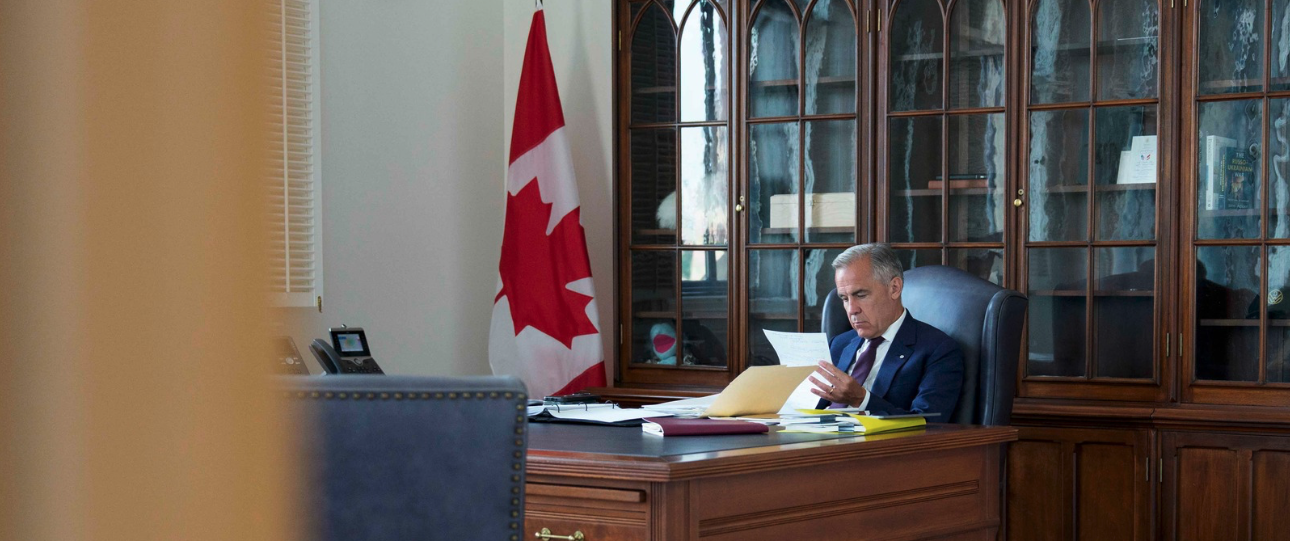
 Photo Credit: Lars Hagberg, Prime Minister's Office
A Triple Helix publication

by Dr. Olena Kryzhanivska
January 2026
Table of Contents
- Introduction
- Canada's Defence Investment Agency
- The United Kingdom
- Australia
- France
- Conclusion and Recommendations
- About the Author
- Canadian Global Affairs Institute
Introduction
Over the decades following the Cold War, Canada has moved toward reduced defence spending, decentralization of its defence procurement system, and increasing alignment with the military goals of its only land neighbour, the United States. Canada's historical approach to defence has created severe vulnerabilities in its military capabilities and capacity, which can be exploited by state or non-state actors when the opportunity arises.
Since 2014, NATO members have pledged to spend at least 2 per cent of their GDP on national defence. Canada was slow to meet this target, but in 2025, the Carney government announced a $9.3-billion increase in defence spending, bringing the total to $62.7 billion. Under NATO’s definition of defence expenditure, this would allow Canada to reach the 2 per cent threshold in the 2025/26 fiscal year.
In the security and defence sector, one of the most significant recent government announcements was the establishment of the Defence Investment Agency (DIA) in October 2025, aimed at “overhauling and streamlining Canada’s defence procurement.”
Three Canada’s partners, the United Kingdom, Australia, and France, were mentioned in the press release and described as countries that “already have dedicated procurement bodies, making joint defence purchases and partnerships easier and more efficient.” While Canada shares historical, cultural, and industrial ties with these nations, its approach to defence procurement remains quite different: all three maintain centralized procurement systems.
Previous research shows that neither centralized nor decentralized procurement systems are able to address challenges common to Western states, such as cost overruns, delayed deliveries, and the inability to meet operational requirements. At the same time, a single agency has the potential to provide a clear point of accountability.
This research paper examines the defence procurement systems of the U.K., Australia, and France, focusing on the lessons Canada can draw in establishing its new Defence Investment Agency. The report combines findings from secondary sources, including official government documents, academic studies, and media reports, with interviews conducted with experts in the three countries.
Canada's Defence Investment Agency
The Defence Investment Agency is a newly established Special Operating Agency within Public Services and Procurement Canada. It is led by the Secretary of State (Defence Procurement), while a Chief Executive Officer manages its day-to-day operations.
The agency will focus on building domestic manufacturing capacity and strengthening supply chains to ensure that the Canadian Armed Forces have the necessary equipment.
Among the publicly announced characteristics of this new body are:
- consolidation of procurement processes, removing duplicative approvals and red tape — essentially a shift toward centralization;
- a focus on developing domestic capabilities;
- a closer link between the military and the defence industry;
- a mandate extending to contracts worth $100 million or more;
- the involvement of specialized staff from different departments trained in defence acquisitions;
- and a stronger alignment with partners such as the United Kingdom, Australia, and France — a step that signals diversification of defence partnerships and a gradual move away from the traditional reliance on cooperation with the United States.
Although the detailed framework of the new institution remains under development, the Canadian public, experts, and industry representatives have expressed cautious optimism about this initiative. The general perception is that the newly formed DIA signals that Canada is serious about rearming its forces, modernizing its industry, and stepping more confidently into its role as a trusted partner in global security. On the other hand, some observers worry that the agency might add another layer to an already complex bureaucratic process and emphasize the need to see not only words but tangible action.
Currently, Canada’s defence procurement system spans multiple federal bodies, including the Department of National Defence, Public Services and Procurement Canada, Innovation, Science and Economic Development, and the Treasury Board Secretariat, rather than being housed within a single department. This multi-agency structure, in place since 1969, is unusual compared with other countries. For more than two decades, there has been ongoing discussion about whether Canada should consolidate defence procurement under a single federal organization.
In Canadian society, there are proponents and sceptics of defence procurement centralization. Proponents include former Assistant Deputy Minister of Materiel Alan Williams and Senior Conference of Defence Association Fellow Charles Davies; while former National Security Advisor to the Prime Minister Richard Fadden cautioned against viewing a single, centralized entity as a “perfect model.”
With the government’s clear move towards centralization of defence procurement processes, at least for the large contracts of over $100 million, the questions remain about the status of the newly appointed Chief Executive Officer of the Defence Investment Agency in the hierarchy of the defence procurement bodies, and his accountability for the possible force-majors happening with the defence procurement process. It is essential to ensure that the new entity is structured to mitigate potential challenges, such as a lack of ministerial accountability.
Ultimately, the role of the Prime Minister in this process is key, as his engagement in the defence and national security file will shape how the reforms are implemented. The Prime Minister’s direct involvement in selecting the new Chief Executive Officer of the DIA can be viewed as a positive sign.
In this context, it is helpful to examine the defence procurement systems of the three countries mentioned in the announcement: the United Kingdom, Australia, and France.
The reference to these countries in the DIA announcement suggests that some of their experiences may serve as a model for shaping this new agency.
The United Kingdom
“We’re pulling it further together rather than pushing it apart,” commented Prof. Trevor Taylor from RUSI during an interview, stressing the continued process of centralization of defence procurement in the U.K.
The separate defence procurement body, the Defence Equipment and Support, was established in April 2007 through the merger of the Defence Procurement Agency and the Defence Logistics Organization.
According to the 2023 House of Commons Committee report, the U.K. defence procurement process was characterized as “highly bureaucratic, overly stratified, far too ponderous, with an inconsistent approach to safety, very poor accountability and a culture which appears institutionally averse to individual responsibility.”
The issue of accountability was also highlighted in the report, which emphasized the need for the Chief Executive Officer of the Defence Equipment and Support to serve as the accounting officer to Parliament for the entire equipment and support budget, and to hold a seat on the Defence Board alongside the Defence Secretary. As of 2025, the Chief Executive Officer of the Defence Equipment and Support is indeed a member of the Defence Board, the highest decision-making committee within the Ministry of Defence.
In April 2025, the defence procurement system got even further centralized with the creation of the National Armaments Director position, leading the National Armaments Director Group. According to the 2025 Strategic Defence Review, “Under the [National Armaments Director]’s leadership… Defence must overhaul its acquisition processes to improve productivity and create a new partnership with industry—moving away from the customer-vendor relationship and creating the conditions under which high-IP companies can scale and grow.”
The Group is tasked to bring the industry in early to discuss goals and help solve problems, reward companies when they improve productivity or take on more investment risk, and remove obstacles to collaboration, especially for small firms. The entity, which also absorbed the Defence Equipment and Support among other related bodies, will apply a segmented approach to procurement – using different processes and timelines depending on the type of project, the supplier involved, and the level of risk.
Despite centralisation, the U.K.’s defence procurement system has also faced significant challenges. The U.K. has had notable difficulties with several major programmes, including the Ajax armoured vehicle and the Type 45 destroyer, both of which have suffered from significant cost overruns and delays. Ajax, originally expected to enter service in 2017, achieved Initial Operating Capability only in November 2025—meaning it can now be deployed as a squadron on operations.
The Type 45 class of guided-missile destroyers has also faced major setbacks, with some ships stuck in port undergoing extensive refits for more than 3,000 days—longer than it took to build them.
The issue of accountability became a major focus of the 2025 Defence Industrial Strategy announced in September 2025, which features an Accountability Table outlining the senior officials responsible for implementing its policies. Notably, the vast majority of policy measures are assigned to the National Armaments Director, particularly those related to creating a fit-for-purpose acquisition system, ensuring effective implementation of the Procurement Act, and providing industry with a clear, long-term demand signal.
Australia
In Australia, the Capability Acquisition and Sustainment Group, a division within the Department of Defence, oversees the acquisition, lifecycle management, and disposal of the Australian Defence Force’s weapon systems and military equipment. The entity was established in 2015 following a series of defence sector reforms. The senior leader of the entity is the Deputy Secretary, Capability Acquisition and Sustainment, who reports to the Secretary of Defence. The head of the Capability Acquisition and Sustainment Group is appointed by the Minister of Defence, but the selection is shaped by recommendations coming from the Secretary of Defence.
The Capability Acquisition and Sustainment Group was created with an aim to professionalize and centralize defence procurement, reduce duplication, and align capability delivery with long-term strategic goals. The entity has been considered successful in managing the whole-of-capability lifecycle.
According to Dr. John Coyne from the Australian Strategic Policy Institute, the centralization of defence procurement under a single division is advantageous in peacetime, as it ensures consistent spending and allows countries to scale production.
However, like in Canada and the U.K., Australia’s system is often slow to adapt and overly process-driven, he noted. Multi-layered approval frameworks, ministerial sensitivities, and risk aversion frequently extend project timelines far beyond operational needs. While industry engagement is improving, it still tends to be too transactional and compliance-focused rather than partnership-based.
In the Defence Strategic Review 2023, Australia’s approach to capability acquisition was deemed not fit for purpose: “The system needs to abandon its pursuit of the perfect solution or process and focus on delivering timely and relevant capability. Defence must move away from processes based around project management risk rather than strategic risk management.” Experts also recommend that the Australian government reassess how industry, Parliament, and the media are informed about capability needs and associated risks.
“The Cost of Defence: ASPI Defence Budget Brief 2025-2026” report stated that the Defence Department continues to face major structural and personnel challenges: it remains overly complex and bureaucratic, with a growing senior leadership cadre that slows decision-making and weakens accountability.
Accordingly, Australia’s Defence has reduced transparency in its Portfolio Budget Statements. Many key metrics previously used to assess performance, such as assurances that “80% of approved IIP projects are on track in scope, cost, and schedule”, are no longer published. Instead of clear summaries of individual project status, the Portfolio Budget Statements rely on generic language that offers no meaningful insight into success or failure. Important information on capital and estate projects has also been removed. As the Australian National Audit Office noted in its 2023-2024 Major Projects Report, there has been “a continued reduction in transparency and accountability to Parliament and other stakeholders.”
“Also, there is a parliamentary committee that reviews Defence’s annual report and activities, but when they ask questions about specific projects, the answers they receive are extremely vague,” said Marc Ablong, a Senior Fellow with the Australian Strategic Policy Institute and an author of the above-mentioned analysis.
Further reports indicate that Australia’s defence sector has faced serious cost overruns and schedule delays across several major projects in recent years. Significant issues have emerged in the country’s $4-billion Offshore Patrol Vessel (OPV) program, with new government analysis revealing multiple additional project delays that are putting growing pressure on the Defence budget. The OPV program is now listed among at least 28 major defence projects collectively running 97 years behind schedule.
“Nobody has been held fundamentally accountable for this. That’s a failure of our Westminster systems. These structures are so large and complex that accountability becomes almost impossible,” said Marc Ablong during an interview.
He also mentioned that when it comes to AUKUS, Australia would probably need a special entity outside the Ministry of Defence to run these issues. “You need a narrowly defined body with clear responsibilities and real accountability — something easier to focus. Think of it like the Manhattan Project: a dedicated body with a specific mission, tight scope, and unambiguous lines of accountability,” Mr. Ablong added.
In December 2025, the Albanese government announced the creation of a new dedicated agency to bring greater coherence to defence acquisition and sustainment. The Defence Delivery Agency will consolidate three existing capability-delivery structures — the Capability Acquisition and Sustainment Group, the Guided Weapons and Explosive Ordnance Group, and the Naval Shipbuilding and Sustainment Group.
The new agency will report directly to ministers and control its own budget. A National Armaments Director will be appointed to lead the agency.
At the same time, as Mr. Ablong has noted, this is not Australia’s first attempt at organisational reform. There is a degree of scepticism about whether structural changes alone will deliver meaningful results. As he put it, structure matters less than culture — and changing the culture of CASG has proven far more difficult than reshuffling organisational charts.
France
France has a highly centralized defence procurement system. Its central institution, Direction générale de l’armement (the Directorate General of Armament), is led by the Délégué général de l’armement (the General Delegate of Armament), who holds a highly influential position within the French system. It is responsible for the entire acquisition process from conception to delivery of all weapon systems and military equipment used by France’s armed forces. It also plays a key role in promoting export sales for the French defence industry.
Established in 1961 under President Charles de Gaulle, it is considered “one of the key decisions made to guarantee French independence.” The Délégué général de l’armement occupies a central position not only within the Ministry of the Armed Forces but also in the broader organization of the French state. Its head holds the same hierarchical rank as the Chief of Defence.
Jean-Marie Kowalski, Associate Professor at Sorbonne University, commented on the nature of the institution in the following way: “The Directorate General of Armament is more than a procurement agency — it is a strategic actor that combines technical expertise, research funding, and oversight of France’s defence industrial base. This integrated approach enables a systemic understanding of military capabilities, though it also reflects the constraints of a highly controlled industry.”
In January 2024, former Délégué général de l’armement Emmanuel Chiva announced reforms aimed at making the French procurement agency “simpler and more efficient,” including the creation of a rapid acquisition force for urgent needs. The agency was reorganised, notably with the establishment of a defence industry directorate, to shift the agency from a peacetime model to one capable of operating under the pressures of modern conflict.
The Directorate General of Armament now controls all procurement and equipment-related spending of the Ministry of Defence, says Prof. Kowalski. When it was created, only 40% of each fiscal year's defence equipment funds were dedicated to its projects (nuclear, rockets, electronics). Now, the budget’s Programme 146 – Équipement des forces (Equipment for the Armed Forces) credits of the MoD are 100% dedicated to the Délégué général de l’armement’s projects.
Dr. Renaud Bellais, an Associate Researcher, CESICE, Grenoble Alps University, said that in France, the Chief of Joint Staff and the Head of the Directorate General of Armament are jointly responsible for equipment credits (Programme 146), while the management of programmes, operational responsibility rests with the latter. “The Minister can face political responsibility, but it is unlikely that he/she would be sanctioned for drifting costs or delays of capability programmes,” Dr. Bellais mentioned.
Prof. Kowalski explained that there are penalty mechanisms in place—for example, for delivery delays. In such cases, Délégué général de l’armement oversees the enforcement of contracts with defence suppliers, meaning it is the industrial contractors who must pay penalties when deadlines are missed. The Délégué général de l’armement itself is generally not held responsible, although disputes can arise in cases of force majeure when a contractor argues that the delay was beyond its control.
Cost overruns are a more complex issue. Historically, they were common, driven by factors such as underestimating program complexity, intentionally low initial cost projections to secure approval, or reductions in planned order volumes. These risks still exist, but oversight mechanisms have tightened significantly. One of the most important ways to prevent cost overruns is to ensure programmes are properly defined before they begin.
In the National Strategic Review 2025, the government emphasized the need for more efficient and modernized procurement structures. “Procurement procedures must continue to evolve to meet the requirements of agility, rapid acquisition, and ‘urgent innovation’ for the armed forces,” the review states.
In relation to EU defence procurement, France adopts a two-track approach. First, it prioritises the concept of strategic autonomy and does not consider it desirable for the European Commission to take the lead in developing a European defence industrial policy that would partially or fully replace national-level policies. Second, France is actively engaged in shaping a more unified European foreign and security policy, with the objective of fostering a stronger and more influential Europe.
With the strategic shift in European defence towards greater strategic independence in 2025, and the announcement of the White Paper on European Defence - Readiness 2030, France has declared its determination to play a full role in the creation of new capability coalitions, which aims to synchronise the rearmament of European countries. France will support the principle of European preference (design European, produce European, buy European) both in EU-level negotiations and through the conclusion of bilateral agreements.
In parallel, according to the Review, under the proposed European Defence Industry Programme and the Security Action for Europe regulation, France will continue to promote European-preference criteria and subsidy mechanisms for industrial production capacities.
Conclusion and Recommendations
While analyzing three of Canada’s allies — the United Kingdom, Australia, and France — through secondary research and expert interviews, it became evident that there is no “silver bullet” or ideal model for defence procurement systems in today’s evolving security landscape.
Although there is growing discussion about the need to learn from Ukraine’s experience, where wartime conditions forced a decentralized procurement model, this approach is generally not considered viable for large, industrialized states in peacetime. At the same time, a stronger focus on end users, namely the armed forces, is something that all four countries should consider integrating into their procurement systems.
The challenges Canada faces with its decentralized procurement system, including a culture of risk aversion, institutional inertia, and bureaucratization leading to excessively long and complex acquisition cycles, are not unique. Its three allies experience similar difficulties, and centralization does not necessarily resolve them.
At the same time, political will is essential for making the defence procurement system more efficient. The appointmentof Defence Investment Agency’s CEO Guzman directly by Prime Minister Carney is widely viewed as a positive signal of readiness to confront long-standing challenges.
However, a clearer explanation is needed regarding how the DIA will cooperate with other bodies involved in the defence procurement process.
While the creation of the Defence Investment Agency may not significantly address the shortcomings common to both centralized and decentralized procurement systems, such as delays and cost overruns, it is expected to improve accountability in the defence procurement process.
To achieve this, the following measures are recommended:
- implement a detailed, metrics-based reporting framework on all ongoing procurement programmes;
- establish a formal reporting line to Parliament or a Defence Board–type body;
- clearly map which authorities, powers, and processes will transfer to the DIA;
- establish clear lines of responsibility to reduce the diffusion of accountability across multiple actors;
- maintain consistent communication with industry representatives and the broader public regarding the Defence Investment Agency’s mandate, authorities, and accountability mechanisms, ensuring confidence in how the new agency is structured and governed;
- draw on structures from the U.K., France, and Australia as templates and not rigid blueprints.
About the Author
Dr. Olena Kryzhanivska is CGAI’s COVE Fellow and an Editor for the NATO Association of Canada. Originally from Ukraine, she relocated to Turkey for her studies and earned a PhD in Political and Social Sciences in 2024. Olena has previously provided expert analysis for the Norwegian Embassy in Turkey and the United Nations Office for Disarmament Affairs. She is currently an Emerging Expert in the 2024-2025 cohort of the Forum on the Arms Trade, where she contributes to regular monitoring of arms transfers to Ukraine. Olena’s research interests include international migration, diaspora engagement, and arms control policies. She publishes her weekly newsletter, Ukraine’s Arms Monitor, on LinkedIn, providing the latest updates on the Russian-Ukrainian war.
Canadian Global Affairs Institute
The Canadian Global Affairs Institute focuses on the entire range of Canada’s international relations in all its forms including trade investment and international capacity building. Successor to the Canadian Defence and Foreign Affairs Institute (CDFAI, which was established in 2001), the Institute works to inform Canadians about the importance of having a respected and influential voice in those parts of the globe where Canada has significant interests due to trade and investment, origins of Canada’s population, geographic security (and especially security of North America in conjunction with the United States), social development, or the peace and freedom of allied nations. The Institute aims to demonstrate to Canadians the importance of comprehensive foreign, defence and trade policies which both express our values and represent our interests.
The Institute was created to bridge the gap between what Canadians need to know about Canadian international activities and what they do know. Historically Canadians have tended to look abroad out of a search for markets because Canada depends heavily on foreign trade. In the modern post-Cold War world, however, global security and stability have become the bedrocks of global commerce and the free movement of people, goods and ideas across international boundaries. Canada has striven to open the world since the 1930s and was a driving factor behind the adoption of the main structures which underpin globalization such as the International Monetary Fund, the World Bank, the World Trade Organization and emerging free trade networks connecting dozens of international economies. The Canadian Global Affairs Institute recognizes Canada’s contribution to a globalized world and aims to inform Canadians about Canada’s role in that process and the connection between globalization and security.
In all its activities the Institute is a charitable, non-partisan, non-advocacy organization that provides a platform for a variety of viewpoints. It is supported financially by the contributions of individuals, foundations, and corporations. Conclusions or opinions expressed in Institute publications and programs are those of the author(s) and do not necessarily reflect the views of Institute staff, fellows, directors, advisors or any individuals or organizations that provide financial support to, or collaborate with, the Institute.
Showing 1 reaction