

Source: Canadian Forces Combat Camera, Corporal Brendan Gamache
by Dr. Andrea Charron
October 2025
Table of Contents
- Introduction
- U.S. Geographic Commands & The Trump Administration
- Kalaallit Nunaat
- Implications for Canada
- The North American Aerospace Defence Command (NORAD)
- So what?
- About the Author
- Canadian Global Affairs Institute
Introduction
The U.S. Unified Command Plan (UCP) is an Executive Branch document prepared by the Chairman of the Joint Chiefs of Staff (CJCS) informed by the U.S. National Security Strategy, Defense Strategy, and Military Strategy. It is reviewed every two years and it assigns missions; planning, training, and operational responsibilities, and geographic areas of responsibility (AOR) to Combatant Commands and their commanders and specifies functional responsibilities for functional combatant commanders. Presidents often take the considered advice of their military experts and bless the classified plan rather than directing it. President Trump, however, has been particularly hands on when it comes to a recent change to the UCP and the defence of the United States writ large. He “ordered” a change to the UCP.[1][2]
There is often little discussion among allies about the UCP, despite the UCP influencing their force structures and how they integrate with U.S. forces. Given that the UCP also dictates the mission commanders for allied organizations like NORAD and NATO, the lack of attention is curious. While Canadians are paying more attention to defence spending, very few registered a recent change to the UCP even though it has myriad implications. But Canadians should care and pay attention. The UCP is the manifestation of U.S. defence priorities. Where you reside within an area of responsibility can matter – are you on the edges of command boundaries or close to the U.S, headquarters? Does your state fall within a well-resourced combatant command, or a backwater? And which combatant command controls the resources for your area of responsibility? In the case of Canada, the combatant command under which it falls geographically has changed boundaries; USNORTHCOM now includes Greenland (Kalaallit Nunaat), and that has implications for all states involved as well as NORAD and NATO.
[1]The author is grateful to comments by Sara Olsvig, Lance Blyth, Chris Morrison, James Fergusson and others. All omissions and errors are those of the author.
[2] See https://www.defense.gov/News/Releases/Release/article/4218736/statement-by-chief-pentagon-spokesman-sean-parnell-on-the-unified-command-plan/
U.S. Geographic Commands & The Trump Administration
The UCP is a map and framework for the U.S. military’s missions in the world. The U.S. military divides the world into eleven geographic and functional commands, all commanded by a four-star U.S. general/admiral.[1] Each geographic combatant command has an area of responsibility (AOR) and is assigned personnel, resources and capabilities with distinct regional priorities. Functional commands operate around the world and provide niche capabilities to the geographic commands and the forces.
Canada falls within USNORTHCOM’s AOR which encompasses the continental United States, Alaska, Canada, Mexico, and the surrounding waters out to approximately 500 nautical miles. It also includes the Gulf of Mexico, the Straits of Florida, and parts of the Caribbean. And it now includes Greenland.
Gen Gregory Guillot, USAF, is USNORTHCOM’s commander and his top mission priority is homeland defence which includes particular attention to border security (especially with Mexico) and federal protection (such as sending the National Guard and Marines to Los Angeles during protests this summer and more recently to Chicago). Next is defense support of civil authorities (DSCA) which includes disaster relief assistance, military support to state funerals and other assistance (e.g. COVID 19 assistance). Finally, USNORTHCOM is responsible for theatre security and cooperation in the Bahamas and Mexico. USNORTHCOM is also the U.S. military’s Arctic advocate but many of the command’s resources and capabilities are held by neighbouring USINDOPACOM. USNORTHCOM has many sub commands including the U.S. 2nd Fleet, which is the U.S. Navy's component command to USNORTHCOM, but it is also twinned to NATO’s Joint Forces Command (JFC) Norfolk. Both the 2nd Fleet and JFC Norfolk are responsible for maritime operations in the Atlantic and Arctic. The USNORTHCOM boundary shift may help elevate the “bridging” function of JFC Norfolk between North America and Europe; time will tell.
On 17 June 2025, the UCP changed but barely anyone in Canada noticed. Changes do happen frequently, and indeed new commands have been added in the past including Africa Command (2008) and USNORTHCOM (2002), and boundaries do shift. For example, Israel shifted from EUCOM to CENTCOM (2021).
By Executive Order, President Trump required a change to USNORTHCOM’s eastern boundary to include Greenland (Kalaallit Nunaat) which had been part of EUCOM’s AOR. In a sense, Greenland is now in USNORTHCOM’s front yard whereas it was in EUCOM’s backyard.
Under 10 U.S.C. §161, Congress has delegated to the U.S. Department of Defense “the authority to alter, adjust, create, or disestablish combatant command structures, missions, and geographic AORs”.[2] As the UCP encapsulates key strategic missions and responsibilities, there is normally a lengthy process of review that includes senior service leaders, the National Security Council, and the Secretary of Defense. Changes require sober analysis and consultation with many actors (including other government departments and agencies). The plan needs to be assessed, adjudicated and reviewed taking a year plus before final sign off by the Commander in Chief -the President.
This is not the first time President Trump has made this change and precipitously. For a brief time during his first Presidency, he ordered the Pentagon to draft a change to the combatant command plan that saw the USNORTHCOM boundary enclose Greenland on 13 January 2021. However, this was done with little consultation and was viewed as a hasty, ill-advised change at the time. The order was rescinded by the President on 4 June 2021.[3]
On the one hand, how the U.S. military organizes itself is entirely for the United States to decide. The U.S. military has global forward reach and power projection. Dividing the world into commands is a way to manage the complexity of its global span of control.
On the other hand, commands are often twinned with other allied organizations, and therefore, changes to the combatant command plans can have knock on effects.
In the case of EUCOM, its U.S. Commander is also the Commander of NATO (the Supreme Allied Commander of NATO). And in the case of USNORTHCOM, its U.S. Commander is also the Commander of the North American Aerospace Defense Command or NORAD – a binational Canada-U.S. military alliance. The problematic Greenland-Iceland-U.K. (GIUK) gap - long a concern for NATO - still falls to EUCOM but now the territory of Greenland is in USNORTHCOM’s AOR.
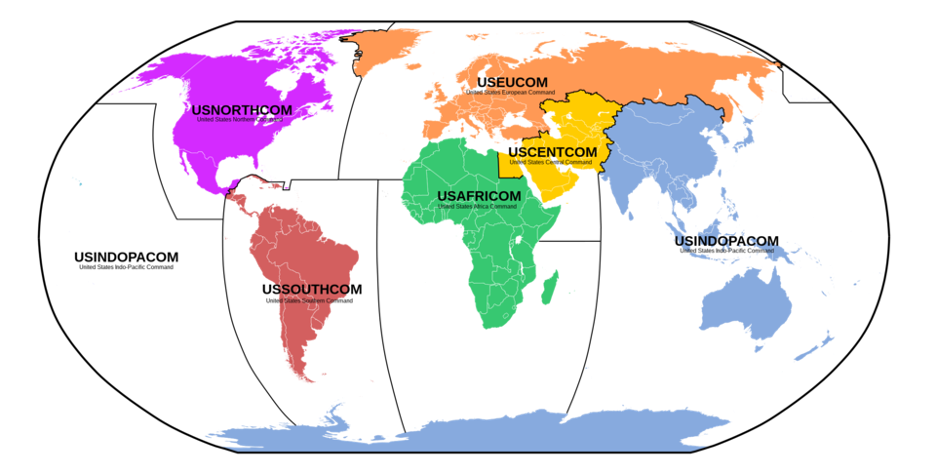
Figure 1: The Old Combatant Command Plan Map prior to 17 June 2025
Source: U.S. Military
Greenland will now be shaded purple and the USNORTHCOM boundary will flip to trace the eastern edge of Greenland (figure 1).
[1] Geographic commands: AFRICOM, CENTCOM, EUCOOM, INDOPACOM, NORTHCOM, SOUTHCOM, SPACECOM Functional commands: CYBERCOM, SOCOM, STRACOM, TRANSPORTCOM,
[2] Robert Switzer and Claire Seelke, “Defense Primer: U.S. Northern Command (USNORTHCOM0” Congressional, Research Services. 25 June 2025. https://www.congress.gov/crs_external_products/IF/PDF/IF13044/IF13044.1.pdf
[3] See https://www.federalregister.gov/documents/2021/06/09/2021-12221/2020-unified-command-plan
Kalaallit Nunaat
As Iris Ferguson, former U.S. Deputy Assistant Secretary of Defense for Arctic and Global Resilience, noted on LinkedIn, one of NORTHCOM's key roles is developing requirements and advocacy for continental United States and the North American Arctic. Kalaallit Nunaat has hosted U.S. and later NORAD radars which protect North American since 1954. Pituffik Space Base is an important staging base for Canada to resupply Alert and for U.S. space assets. Nuuk is the only deep-water Arctic port used by the Canadian and U.S. militaries and Coast Guards to refuel.
Kalaallit Nunaat is the largest island in the world. Nearly 90% of the 56,000 inhabitants are Inuit. Kalaallit Inuit have close connections to Canadian Inuit and Alaskan and Chukotkan (Russia) Inuit. In 1979, Kalaallit Nunaat introduced Home Rule after negotiations with Denmark, establishing its own parliament (Inatsisartut) and government (Naalakkersuisut), and in 2008, Kalaallit voted for self-government expanding on the legislative areas held by Naalakkersuisut and Inatsisartut. Danish interpretation of the constitutional arrangement delimits powers to Kalaallit Nunaat to exclude foreign policy, security, defence matters, and territorial sovereignty.
Danish forces have been responsible for air control of Greenland with the assistance of the United States via the 27 April 1951 Defense Agreement which was amended in 2004. This status quo is set to remain. From the perspective of Denmark, Kalaallit Nunaat is the responsibility of Denmark to protect militarily regardless of the combatant command plan boundaries. While Greenland was once included in what was called the U.S. Northeast Command(1946-1977) that included U.S. forces assigned to Newfoundland, Labrador (not yet part of Canada until 1951), and Greenland (a territory of the Kingdom of Denmark), it has been part of a European Command until now. Denmark still falls within EUCOM’s AOR and EUCOM and NATO are very preoccupied with Russia and Ukraine. EUCOM/NATO are focused increasingly on the eastern flank and the Baltic Sea and away from the Atlantic. USNORTHCOM has its hands full with President Trump’s preoccupation with borders, protests, and climate disasters even if the President is a devout climate change denier and skeptic of scientific facts.[1]
The seam created between combatant commands is particularly prone to probing by adversaries if only to test the coordination between commands. NATO and NORAD are only just realizing they need to work in concert rather than in parallel and the fight for resources and capabilities rarely encourages unity of effort between commands in a budgetary bun fight.
Details of the implications of this new boundary shift are few. USNORTHCOM has a one paragraph note about the change in its AOR noting “U.S. Northern Command is prepared to take on this enhanced relationship and will work with U.S. European Command, Greenland, and the Kingdom of Denmark during the transition.” More concerning is that this change was made with little consultation of partners and/or considering the future, wider ramifications of such an adjustment.
[1] Ralph Keeling, “Donald Trump’s war on climate science has staggering implications’, The Economist (30 July 2025).
Implications for Canada
The Canadian Joint Operations Command (CJOC) is responsible for all missions in Canada and abroad except those conducted by special forces or NORAD. CJOC and its liaison officers are the military connectors with the U.S. combatant commands and organizations like NATO and the UN. While this change to the UCP is unlikely to change CJOC’s six regional joint task forces, CJOC will need to forge new relationships with personnel within USNORTHCOM as tasks are reassigned. While this is routine for the CAF (there is always constant movement of personnel and knowledge centres), there are bound to be coordination challenges. Most importantly, Canada can assist by ensuring CAF personnel know and have strong relationships with their Greenlandic and Danish counterparts – they are the first point of contact with any missions or exercises involving Kalaallit Nunaat. Canada is likely to have more amicable relationships than the United States will – not only do Canada and Greenland share the insult of having received threats of U.S. annexation, but Canada and Greenland share many cultural connections, especially through the Inuit. A consulate in Nuuk and newly named Canadian Arctic Ambassador (Virginia Mearns) could not have come at a more propitious time. A largely forgotten tricommand Arctic Framework (involving NORAD, CJOC, and USNORTHCOM) should be dusted off, and Kalaalit Nunaat and Denmark should be added.
The North American Aerospace Defence Command (NORAD)
NORAD is a binational command that includes Canada and the United States. NORAD has an aerospace and maritime warning mission and aerospace control mission. NORAD has a global area of operations for warning purposes which means it is not bound geographically. For aerospace control, however, NORAD does tend to be guided by USNORTHCOM’s AOR.
NORAD has 3 regions. The Regions are based on sovereign airspace but are agnostic to the national origin of the forces operating in them: i) Continental NORAD Region (CONR, responsible for the continental U.S.; ii) Canadian NORAD region (CANR, responsible for all of Canada); and iii) Alaskan NORAD region (ANAR, responsible for Alaska, and the Aleutian Islands).
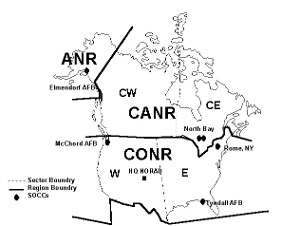
Figure 2. NORAD’s 3 regions; Source: US Military
Will the eastward change in USNORTHCOM’s boundary impact NORAD? The answer is no; USNORTHCOM’s missions are very different from NORAD’s and even the areas in which they operate are different; NORAD operates within the continental United States, Alaska and Canada, although there has always been an important connection to Greenland.
The United States and NORAD operate from Pituffik Space Base in Greenland and will continue to operate from there, flying into CANR-controlled airspace in the Arctic. NORAD will continue to coordinate with USNORTHCOM, Denmark/Kalaallit Nunaat for all operations and exercises.
But NORAD, as the aerospace control solution for North America, could be responsible for aerospace warning and control and maritime warning for Kalaallit Nunaat in a future when Greenland is fully sovereign and if it decides to join what could be a trinational command. Considerable consultations and discussions would be required.
The 1958 binational NORAD agreement, last amended in 2006, is unlikely to be renegotiated in the near future; there is no appetite given the current political climate for Canada to propose a change. But given U.S. Golden Dome plans and the current change in USNORTHCOM’s AOR and were Kalaallit Nunaat no longer tied to the Kingdom of Denmark, Kalaallit Nunaat might choose to join NORAD.
Were such a change to be made and based on geography (and no changes to the current NORAD regions), it would appear on the surface to make the most sense for Kalaallit Nunaat to fall within the CANR AOR. However, the CAF hasn’t the resources to extend routine air operations to include Kalaallit Nunaat in the near future.
Continental NORAD Region (CONR and specifically its Eastern Air Defense Sector, headquartered at the Griffiss Business and Technology Park in Rome, New York, subordinate to CONR in Tyndall, Florida) might be the NORAD region of choice for such missions or simply a new and separate USNORTHCOM mission. But, of course, this would require the approval of Kalaallit Nunaat and is simply speculation of a potential future scenario. Other changes may necessitate new command and control organizations and arrangements including the ultimate architecture and command and control processes for Golden Dome and any Canadian variants. And all of this presupposes the UCP will continue to have geographical combatant commands.
So what?
For now, the status quo reigns. Denmark will remain responsible for the air defence of Kalaallit Nunaat with assistance from the United States, as has long been the case and NORAD, Canada, and the United States will continue to operate from Pituffik Space Base with the permission of Denmark and Kalaallit Nunaat to resupply Alert, for example.
In the works for the past two years, the Danish military liaison officer assigned to STRATCOM should move to USNORTHCOM reflective of the importance of Greenland, geographically and strategically to North America.[1] But the change has been slow in coming.
Lots of combatant command plan issues remain, however. These include: i) the US strategic coordination of the still bifurcated Arctic Ocean which falls mainly to USNORTHCOM and EUCOM’s AORs; ii) the fact that the bulk of USNORTHCOM’s assets are held by INDOPACOM (despite being the U.S. military’s Arctic advocate); iii) coordination with the Nordic Joint Air Operations Centre (in Bodo Norway)[2] and Denmark’s F35 fleet; iv) the coordination between the 2nd Fleet and JFC Norfolk and NATO more generally; and iv) the maritime, land, and cyber protection implications of this seemingly innocuous change of an invisible boundary line on a map. So far, adversaries have been quiet on this change, but new boundaries create exploitation opportunities. The United States often reminds allies of their responsibilities to the United States, but Canada, the Kingdom of Denmark, and Kalaallit Nunaat have contributed immensely to the defence of the United States for decades now. Normally, changes to combatant command plans and trade issues are separate and apart. But at a time when the U.S. threatens to impose tariffs on allies like Canada and Denmark (via the EU), let us hope the professionalism of the militaries involved continue to rise above the political fray and concentrate on the defence roles at hand.
[1] Mikkel Perlt, “The Kingdom of Denmark and the Defense of Greenland,” The Watch, Version 4: 44 – 47. https://thewatch-journal.com/TheWatch_V4071223.pdf
[2] https://www.forsvaret.no/en/news/articles/nordic-division
About the Author
Dr. Andrea Charron holds a PhD from the Royal Military College of Canada (Department of War Studies). She obtained a Master in International Relations from Webster University, Leiden, The Netherlands, a Master of Public Administration from Dalhousie University and a Bachelor of Science (Honours) from Queen’s University. Her research and teaching areas include NORAD, the Arctic, foreign and defence policy and sanctions. She served on the DND’s Defence Advisory Board and has published in numerous peer-reviewed journals.
Dr. Charron worked for various federal departments including the Privy Council Office in the Security and Intelligence Secretariat and Canada’s Revenue Agency. She is now Director of the University of Manitoba’s Centre for Defence and Security Studies and Professor in International Relations.
Canadian Global Affairs Institute
The Canadian Global Affairs Institute focuses on the entire range of Canada’s international relations in all its forms including trade investment and international capacity building. Successor to the Canadian Defence and Foreign Affairs Institute (CDFAI, which was established in 2001), the Institute works to inform Canadians about the importance of having a respected and influential voice in those parts of the globe where Canada has significant interests due to trade and investment, origins of Canada’s population, geographic security (and especially security of North America in conjunction with the United States), social development, or the peace and freedom of allied nations. The Institute aims to demonstrate to Canadians the importance of comprehensive foreign, defence and trade policies which both express our values and represent our interests.
The Institute was created to bridge the gap between what Canadians need to know about Canadian international activities and what they do know. Historically Canadians have tended to look abroad out of a search for markets because Canada depends heavily on foreign trade. In the modern post-Cold War world, however, global security and stability have become the bedrocks of global commerce and the free movement of people, goods and ideas across international boundaries. Canada has striven to open the world since the 1930s and was a driving factor behind the adoption of the main structures which underpin globalization such as the International Monetary Fund, the World Bank, the World Trade Organization and emerging free trade networks connecting dozens of international economies. The Canadian Global Affairs Institute recognizes Canada’s contribution to a globalized world and aims to inform Canadians about Canada’s role in that process and the connection between globalization and security.
In all its activities the Institute is a charitable, non-partisan, non-advocacy organization that provides a platform for a variety of viewpoints. It is supported financially by the contributions of individuals, foundations, and corporations. Conclusions or opinions expressed in Institute publications and programs are those of the author(s) and do not necessarily reflect the views of Institute staff, fellows, directors, advisors or any individuals or organizations that provide financial support to, or collaborate with, the Institute.
Showing 1 reaction