
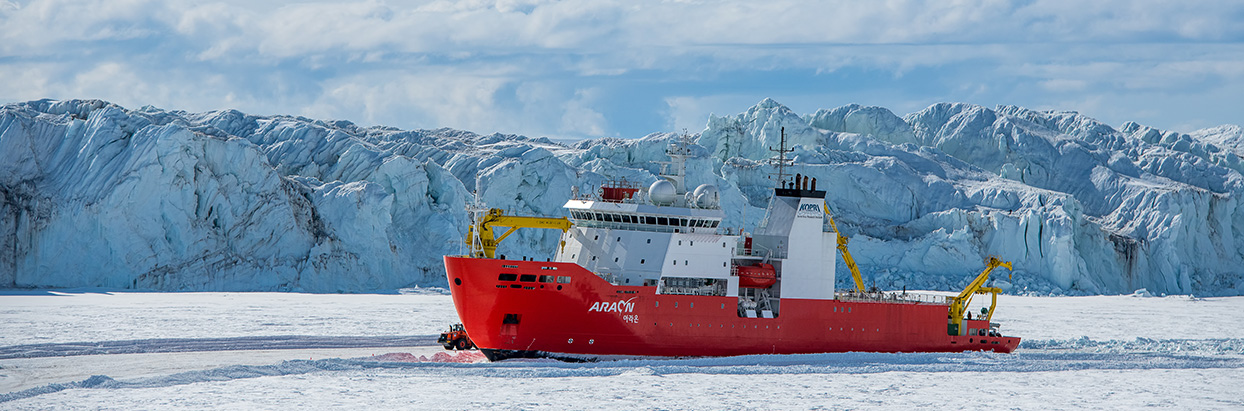
 Image Credit: KOPRI
by Dr. Julie Kim
March 2026
This publication is part of a project on Canada-Republic of Korea defence cooperation funded by the Korea Foundation.
Table of Contents
- Introduction
- The ROK in the Arctic
- Seoul's Interests in the Arctic Shipping Route
- Emerging Security Challenges in the Arctic
- Opportunities for Canada-Korea Arctic Security Cooperation
- Conclusion
- Policy Recommendations
- About the Author
- Canadian Global Affairs Institute
Introduction
Canada’s 2024 defence policy, Our North, Strong and Free (ONSAF), identifies three key issues that will shape the country’s future security and prosperity: “a more open and accessible Arctic and northern region driven by climate change, increasing global instability, and rapid advances in technology.” In response to this evolving security environment, ONSAF places renewed emphasis on protecting Canada’s Arctic and northern regions.
Canada has the longest coastline in the world, bordered by the Atlantic, Arctic, and Pacific oceans. This extensive coastline faces security challenges due to the accelerating pace of climate change. The Arctic is warming at four times the global average, making it more accessible to external actors with regional military ambitions, including Russia and China. Historically, the United States (U.S.) has been Canada’s closest and most reliable partner in defending its northern regions. However, recent unpredictability in U.S. policy — including the imposition of tariffs and President Donald Trump’s remarks about annexing Canada as the “51st state,” as well as his pursuit of Greenland — has significantly undermined Canada-U.S. relations and introduced uncertainty into bilateral cooperation.
In light of these developments, it is increasingly important for Canada to diversify its defence and security partnerships. While Ottawa has traditionally approached Arctic security primarily through a Euro-Atlantic lens, the North Pacific dimension remains underexplored. This imbalance limits Canada’s ability to address emerging cross-regional security challenges that increasingly link the Arctic and the North Pacific. Therefore, Canada should look more closely toward the Indo-Pacific and deepen cooperation with its key North Pacific allies, such as the Republic of Korea (ROK, South Korea).
This article examines South Korea’s Arctic policy and its growing interests in the region. It then analyzes emerging security challenges in the Arctic, including China’s expanding presence and growing China-Russia military cooperation. Finally, it explores opportunities for Canada-ROK Arctic security cooperation. Amid intensifying geopolitical tensions, climate change, and the search for new trade routes, the Arctic is becoming a key part of the ROK’s maritime strategy. Although Russia has long been South Korea’s primary Arctic partner, deteriorating relations and Seoul’s need to diversify its energy sources and supply chains create opportunities for Canada to emerge as a reliable partner. In this context, strengthening Canada-ROK cooperation in the Arctic would allow both countries to leverage their complementary strengths while contributing to a more stable and rules-based Arctic region.
The ROK in the Arctic
South Korea began conducting independent Arctic research in 2001 with the establishment of the Korean Arctic Science Council. The country joined the International Arctic Science Committee in 2002 and, in the same year, established its first permanent Arctic research outpost, the Dasan Station, in Svalbard, Norway. In 2009, South Korea launched its first icebreaker, Araon, which conducts annual research activities in Antarctica from October to April and in the Arctic from July to August.
After becoming an Arctic Council observer in 2013, South Korea released its first Arctic policy, Arctic Policy Master Plan. This is notable for being the first Arctic policy issued by a non-Arctic state. It has three main goals: 1) strengthening international cooperation, 2) enhancing scientific research activities, and 3) exploring economic opportunities through participation in the Arctic Council and its Working Groups.
South Korea’s Arctic approach has gradually evolved from science-led engagement to more economically and strategically oriented participation. As part of this shift, South Korea established the Trilateral High-Level Dialogue on the Arctic with China and Japan in 2016. The updated 2018 policy further emphasized economic cooperation in the Arctic, particularly in shipping and logistics, fisheries, and energy and resource development, with Russia identified as a key partner.
More recently, the Arctic has gained greater prominence in the country’s national strategy. In 2025, newly inaugurated President Lee Jae Myung and the ruling party designated Arctic shipping routes as a pillar of South Korea’s long-term economic agenda. As part of this initiative, the government relocated the Ministry of Oceans and Fisheries to Busan, a major port city in southern Korea, reinforcing the city’s role as the country’s maritime and logistics hub.
Seoul’s Interests in the Arctic Shipping Route
The Arctic shipping route is emerging as an increasingly important component of the ROK’s maritime strategy, as it offers alternative trade routes and new economic opportunities. Among several Arctic Ocean passages, South Korea has shown particular interest in the Northern Sea Route. The Northern Sea Route, which is about 5,600 kilometres long, runs along the Russian coastline from the Bering Strait in the North Pacific to the Barents Sea north of the Scandinavian Peninsula.
The Northern Sea Route offers several advantages for South Korea. First, it is the shortest shipping route between the Asia-Pacific and Western Europe, reducing the distance between Busan in South Korea and Rotterdam in the Netherlands by about 7,000 kilometres. The South Korean government is therefore planning a pilot voyage during the summer of 2026 using a 3,000-TEU-class container ship from Busan to Rotterdam. Second, this route bypasses major maritime chokepoints in Southeast Asia and the Suez Canal, thereby reducing exposure to geopolitical risks, piracy, and delays caused by maritime congestion.
In addition, the Northern Sea Route presents potential economic benefits to South Korea. It could lower shipping costs and increase demand for the country’s shipbuilding expertise. The Northern Sea Route also provides access to resource development projects in Russia’s Arctic region. Since South Korea relies heavily on energy imports — particularly from the Middle East, which accounts for nearly 70% of its oil supply — the government has a strong interest in diversifying supply sources, including liquefied natural gas (LNG) from the Arctic.
Historically, Russia has been South Korea’s principal Arctic partner due to its geographic proximity and its control over most of the coastline along the Northern Sea Route. In practice, this cooperation has manifested in several projects, including South Korea’s participation in the Northern Sea Route trial voyages and South Korean shipyards providing technical expertise and building icebreaking LNG carriers for Russia’s Yamal LNG project. Consequently, Seoul’s Arctic policy has largely centered on cooperation with Moscow. However, Russia’s invasion of Ukraine, South Korea’s participation in sanctions against Russia, and deepening Russia-North Korea military ties have significantly deteriorated bilateral relations, making the resumption of cooperation unlikely in the near future. This shift creates a strategic opening for South Korea to seek alternative partners in the Arctic region.
Emerging Security Challenges in the Arctic
Although climate change is a global problem, it is having particularly serious effects in the Arctic. As sea ice melts at an accelerating pace, the Arctic is becoming more accessible to foreign actors with military and economic ambitions. For the Arctic states and their NATO allies, this transformation introduces new security challenges.
China has been expanding its presence in the Arctic since becoming an Arctic Council observer in 2013. In 2018, Beijing announced its first official Arctic policy, the Polar Silk Road, which envisioned its deeper involvement in Arctic governance, along with scientific research and resource exploration. More recently, China has declared itself a “near-Arctic state,” despite not having any territory in the region.
For several years, China has emphasized the commercial value of Arctic shipping routes, especially the Northern Sea Route, because they bring significant logistical advantages for connecting East Asia with Europe. More recently, however, Beijing has adopted a more security-oriented approach. In particular, China and Russia have displayed growing military and security cooperation in the region. In 2022 and 2023, Chinese and Russian naval forces conducted joint operationsnear the Aleutian Islands in Alaska. In April 2023, the Chinese Coast Guard and the Russian Federal Security Service Border Service signed a memorandum of understanding (MOU) on strengthening maritime law enforcement cooperation. Although the MOU is not exclusive to the Arctic, it addresses activities in the region, including countering illegal migration, illegal fishing, smuggling as well as terrorism. In September 2024, the two countries conducted their first joint coast guard patrol in the Arctic Ocean, symbolizing a new phase in China’s Arctic presence.
These developments are increasingly relevant for both Canada and South Korea. ONSAF identifies the growing presence of non-Arctic states, particularly China, as a key factor shaping the future security environment in the North. Ottawa is therefore paying closer attention to Chinese activity in the Arctic and its expanding military ties with Russia. At the same time, China’s expanding Arctic engagement intersects with South Korea’s interests. As a maritime trading nation with a growing interest in Arctic shipping routes, Seoul is closely monitoring how China’s cooperation with Russia may shape access to Arctic shipping routes, energy resources, and regional security.
The expansion of Sino-Russian activity in the Arctic has sparked debate over its potential impact on regional and global security. On the one hand, their joint activity raises concern among NATO members. According to the top commander of the North American Aerospace Defence Command (NORAD), in 2025 Russian and Chinese air and sea incursions in the Arctic near North America had become more frequent and coordinated. A recent study also suggests the two countries are advancing ahead of NATO nations in drone capabilities in Arctic conditions. On the other hand, their partnership is often characterized as a “marriage of convenience”: China relies on Russia for energy supply, while Russia depends on China for markets and investment. Some experts even argue that China’s ambitions and activities in the Arctic have been “highly exaggerated” and are often mobilized to frame Chinese involvement in an adversarial way, describing them in “alarmist language in terms of scale, scope, and risk.”
Nevertheless, the growing involvement of non-Arctic actors and their military activities highlight that the Arctic is no longer safe from broader geopolitical competition. This changing security environment increases the importance of diversifying partnerships for Canada and creates new opportunities for cooperation with like-minded non-Arctic allies such as South Korea. Against this backdrop, cooperation between Canada and South Korea offers a practical way to address emerging cross-regional security challenges linking the Arctic and the North Pacific.
Opportunities for Canada-Korea Arctic Security Cooperation
Canada’s 2024 Arctic Foreign Policy places greater emphasis on emerging security challenges in the region and recognizes the need to cooperate with non-Arctic states that share Canadian values and interests. In particular, the policy highlights the strategic importance of the North Pacific, and identifies Japan and the ROK as key partners. It also complements Canada’s Indo-Pacific Strategy and ONSAF, both of which frame the Indo-Pacific as central to Canada’s future prosperity and stability.
South Korea is a natural partner in this context. It is one of Canada’s longest-standing allies in the Indo-Pacific, and the bilateral relationship was elevated to a Comprehensive Strategic Partnership in September 2022. More recently, the two countries strengthened defence cooperation with the signing of the Canada-Republic of Korea Security and Defence Cooperation Partnership in October 2025. Ottawa has traditionally relied on the U.S. and its Nordic allies to protect its northern regions. In March 2026, Prime Minister Carney visited Norway, where the two countries reaffirmed their shared commitment to Arctic security, including through exercises such as Exercise Cold Response and Operation NANOOK. However, expanding cooperation with a capable non-Arctic partner such as South Korea would help diversify Canada’s partnerships and strengthen resilience across both the Arctic and the North Pacific.
Canada and the ROK can collaborate in multiple areas, including maritime capability development, scientific research, and combating illegal fishing. Canada could benefit from South Korea’s shipbuilding expertise and advanced icebreaking technologies, which are essential for Arctic operations. In addition, the two countries should work together to address global concerns such as protecting the Arctic environment and Indigenous lands. They could institutionalize high-level Arctic security dialogues and expand them into Track 1.5 forums involving industry and academia, supporting joint initiatives in Arctic research and maritime security.
Energy security presents another strategic opportunity. South Korea has historically relied on Russian energy imports, but geopolitical tensions have made renewed Arctic energy cooperation with Moscow unlikely in the near term. Canada could therefore emerge as a stable and reliable energy partner. As Seoul seeks to diversify crude supply sources, Korean oil refiners have begun increasing imports from Canada: in 2025, HD Hyundai Oilbank imported 548,000 barrels of crude oil in April, and SK Energy imported 574,000 barrels in May.
Finally, Canada and South Korea could expand cooperation with Japan. The three countries possess complementary strengths: Canada in resources and geography, and South Korea and Japan in manufacturing, shipbuilding, technology, and robotics, which are essential for developing Arctic-capable systems and equipment. Given their heavy reliance on critical mineral imports from China, Canada could provide a stable and rules-based supply of critical minerals for defence applications. This could support joint research and development initiatives, equipment testing in Arctic conditions, and the development of Arctic-capable naval and autonomous systems. In addition, the three countries could hold trilateral naval exercises in the North Pacific or conduct training in Canada’s northern regions in cold weather environments to enhance interoperability. These initiatives would not only strengthen Canada-Korea-Japan trilateral ties, but also link the Arctic and the North Pacific into an increasingly integrated strategic space.
Conclusion
The Arctic is evolving from a remote peripheral region into an increasingly strategic space due to climate change, emerging sea routes, and growing geopolitical competition. Canada’s recent defence and Arctic policies recognize that protecting its North can no longer rely solely on traditional Euro-Atlantic partnerships but requires broader engagement with like-minded partners across the North Pacific. In this context, South Korea emerges as a natural and timely partner.
Although South Korea is a non-Arctic state, its long-standing scientific presence, advanced shipbuilding capabilities, and growing interest in Arctic shipping routes demonstrate that it is already an active stakeholder in the region’s future. At the same time, deteriorating ROK-Russia relations and Seoul’s need to diversify energy and supply chains create opportunities for deeper cooperation with reliable partners such as Canada.
Canada and South Korea can pursue Arctic cooperation in areas such as scientific research, maritime capability development, energy security, and protecting the environment and Indigenous lands. They could also expand cooperation with Japan and jointly develop Arctic-capable systems. By linking the Arctic and the North Pacific, Ottawa and Seoul would not only strengthen their bilateral partnership but also contribute to shaping a stable and rules-based regional order.
Policy Recommendations
- Canada and South Korea should expand joint scientific research and technology cooperation in the Arctic. The two countries should also explore opportunities for defence‑industrial partnerships. Canada’s strengths in artificial intelligence (AI) and robotics, and South Korea’s strengths in shipbuilding and advanced manufacturing, create significant opportunities for collaboration on Arctic‑capable vessels and autonomous systems.
- Canada and South Korea could expand information‑sharing and explore opportunities for joint exercises or training in Arctic conditions. For Canada, this would strengthen ties and enhance interoperability with a key North Pacific partner. For South Korea, it would provide operational experience in cold‑weather environments and strengthen maritime domain awareness.
- Canada and South Korea could institutionalize high‑level Arctic security dialogues and expand them into regular Track 5 forums involving government officials, industry representatives, and academics, in order to support joint initiatives in Arctic research and maritime security.
- Canada and South Korea could also promote trilateral cooperation with Japan. Canada could become a stable and reliable energy partner for both countries. In addition, the three countries could conduct joint research, test equipment in Arctic conditions, and hold naval exercises. These initiatives would strengthen cooperation among like‑minded partners across the Arctic and the North Pacific.
About the Author
Dr. Julie (Jung-eun) Kim is a Post-Doctoral Fellow leading the Korea Program at the Canadian Global Affairs Institute (CGAI) and a Country Expert on North Korea for the Bertelsmann Transformation Index (BTI). She received a PhD in Political Science from Heidelberg University as a German Academic Exchange Service (DAAD) scholar. Her dissertation explores the social control system and autocratic regime stability in North Korea. She has a Master of Arts in North Korean Studies and a Bachelor of Arts in German Language and Literature from Ewha Womans University.
Julie has previously worked as a Research Intern at the Stockholm International Peace Research Institute (SIPRI) and a Global Asia Fellow at the East Asia Foundation. She has published various articles and a book chapter, including in the Journal of East Asian Studies, BTI Country Report – North Korea, and Global Asia. Her research interests include authoritarian regimes, geopolitics with a regional focus on the Korean Peninsula, and Canada-Korea defence cooperation.
You can connect with Dr. Kim at [email protected]
Canadian Global Affairs Institute
The Canadian Global Affairs Institute focuses on the entire range of Canada’s international relations in all its forms including (in partnership with the University of Calgary’s School of Public Policy), trade investment and international capacity building. Successor to the Canadian Defence and Foreign Affairs Institute (CDFAI, which was established in 2001), the Institute works to inform Canadians about the importance of having a respected and influential voice in those parts of the globe where Canada has significant interests due to trade and investment, origins of Canada’s population, geographic security (and especially security of North America in conjunction with the United States), social development, or the peace and freedom of allied nations. The Institute aims to demonstrate to Canadians the importance of comprehensive foreign, defence and trade policies which both express our values and represent our interests.
The Institute was created to bridge the gap between what Canadians need to know about Canadian international activities and what they do know. Historically Canadians have tended to look abroad out of a search for markets because Canada depends heavily on foreign trade. In the modern post Cold War world, however, global security and stability have become the bedrocks of global commerce and the free movement of people, goods and ideas across international boundaries. Canada has striven to open the world since the 1930s and was a driving factor behind the adoption of the main structures which underpin globalization such as the International Monetary Fund, the World Bank, the World Trade Organization and emerging free trade networks connecting dozens of international economies. The Canadian Global Affairs Institute recognizes Canada’s contribution to a globalized world and aims to inform Canadians about Canada’s role in that process and the connection between globalization and security.
In all its activities the Institute is a charitable, non-partisan, non-advocacy organization that provides a platform for a variety of viewpoints. It is supported financially by the contributions of individuals, foundations, and corporations. Conclusions or opinions expressed in Institute publications and programs are those of the author(s) and do not necessarily reflect the views of Institute staff, fellows, directors, advisors or any individuals or organizations that provide financial support to, or collaborate with, the Institute.


Showing 1 reaction