
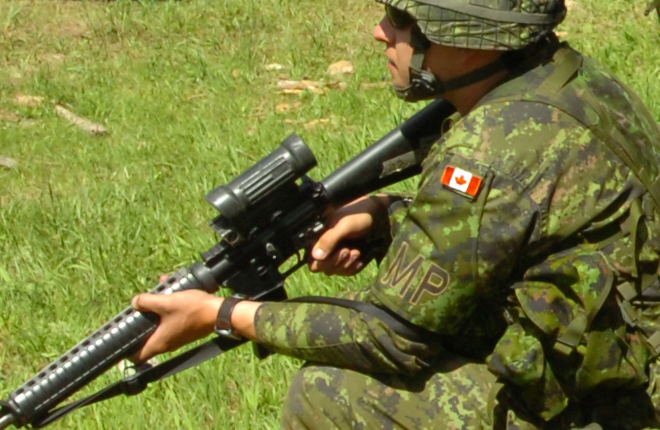
 Photo by Sgt. Greg Rudl
by Olena Kryzhanivska
May 2026
Table of Contents
- Summary
- Context
- Key Points: Sovereign Capabilities and Defence Innovation
- Further Considerations
- About the Author
- Canadian Global Affairs Institute
Summary
- The key element of the Defence Industrial Strategy, the Build–Partner–Buy framework, focuses on strengthening Canada’s domestic industrial base across a range of key sovereign capabilities and aims to enhance the role of Small Medium Enterprises (SMEs) in driving defence innovation. While these changes are timely, questions remain about how effective SMEs will be in delivering on the strategy’s ambitious goals in place of major prime contractors.
- It remains unclear how the government plans to balance the emphasis on domestic production of sovereign capabilities with the technical, operational, and industrial interoperability and integration with the United States that has developed over decades.
Context
- On 17 February 2026, Canada’s first Defence Industrial Strategy was launched by Prime Minister Mark Carney. This document sets the priorities for Canada’s national defence, research, innovation, and industrial development, and aims to provide a clear explanation of how Canada approaches current security threats and plans to rebuild its military capabilities.
- The key focus of the strategy is the Build-Partner-Buy framework, according to which: “The Government of Canada will focus first on building equipment and technology in Canada, particularly in areas of key sovereign capability or where Canada already has deep strengths. However, when Canada partners with allies to build together, or buy off-the-shelf, it will do so under conditions that flow back into domestic industry and ensure Canadian sovereign control.”
- Some of the goals of the strategy include growing defence revenues for SMEs by more than $5.1 billion annually; increasing Canada’s defence exports by 50 per cent; and creating 125,000 quality new jobs across the Canadian economy within the next 10 years.
Key Points: Sovereign Capabilities and Defence Innovation
- After decades of overreliance on acquiring American military equipment, the Strategy emphasizes the need to build sovereign capabilities and engage with domestic industry, prioritizing Canadian manufacturers. One of its goals is to “increase the share of defence acquisitions awarded to Canadian firms to 70 per cent.”
- Following the launch of the Strategy, perhaps the most widely discussed issue among commentators was how to define a “Canadian firm.” Different government programs apply different definitions, and there is no clarity about what exactly is meant by this term in the Strategy — a key issue, given that one of its priorities is “Buy Canadian.” Similar terms are used, such as “Canadian Champions” or “trusted allies,” which also lack clarity. More precise definitions would reduce guesswork and bring clarity to all actors involved.
- The Strategy outlines ten key sovereign capabilities that Canada intends to develop domestically: Aerospace; Ammunition; Digital Systems; In-Service Support; Personnel Protection; Sensors; Space; Specialized Manufacturing; Training and Simulation; and Uncrewed and Autonomous Systems. In fact, the categories are quite broad and encompass multiple subcategories that differ significantly in nature (for example, land vehicles and icebreakers under Specialized Manufacturing, or space launch and ISR under Space).
- This list provides greater clarity for industry stakeholders and the public regarding which areas are likely to receive increased funding and preferential support. It also highlights areas of long-term demand, enhancing opportunities for private investment. It has been commended by several industry associations, such as the Canadian Chamber of Commerce, which previously recommended inclusion of AI, cybersecurity, critical minerals, and life sciences.
- However, the list may be overly expansive, and that certain areas, such as “Personnel Protection – Medical Countermeasures,” should be considered core capabilities.
- The concept of “sovereignty” in this context also requires a clearer definition, as achieving full sovereignty across all ten capability areas within the next decade would be challenging for Canada. As such, a high level of cooperation with partners will remain essential.
- While the United States is only briefly mentioned in the document, the emphasis on sovereign defence capabilities reflects a broader shift toward strengthening Canada’s domestic industrial base in response to potential security and trade challenges in Canada–U.S. relations.
- However, questions remain as to how Canadian companies and Canada’s diversified partnerships could effectively substitute for equipment currently produced and supplied by U.S. firms.
- Moreover, given the long-standing continental integration between Canada and the United States in defence and security, interoperability will remain essential for any joint response to future threats. In this context, the concept extends beyond technical compatibility between the two countries to also include industrial integration and operational coordination.
- The discrepancy between the document's stated focus on sovereignty and the renewed defence commitments with the United States highlights a potential lack of a clear vision for balancing these directions.
- The war in Ukraine demonstrates that several key capabilities, such as anti-ballistic air defence systems and interceptors, artillery ammunition, fighter aircraft, and satellite intelligence, remain closely tied to the United States.
- European partners can only partially meet these needs, as their current technologies and production capacity are insufficient to meet multiple demands.
- One of the pillars of the Strategy is purposeful investment in strengthening an innovative Canadian defence sector. This deserves particular attention, as Canada’s defence procurement system, traditionally known for its risk-averse nature, has historically prioritized established defence firms over smaller innovators.
- The war in Ukraine, however, has demonstrated the critical role SMEs, particularly their ability to innovate and iterate rapidly, in strengthening a country’s industrial base, especially in conditions where traditional suppliers are constrained by lengthy internal bureaucratic processes.
- Under this pillar, the strategy proposes investing across the full innovation cycle—from fundamental and investigator-driven research, through applied R&D and field testing, to the scaling and commercialization of Canadian enterprises.
- To deliver on these goals, several new bodies have been proposed, including a Science and Research Defence Advisory Council and a Drone Innovation Hub, along with the lead organization—BOREALIS (the Bureau of Research, Engineering and Advanced Leadership in Innovation and Science), established in July 2025.
- The intention to strengthen defence research and innovation is an important feature of the Strategy and reflects a growing recognition of the realities of modern warfare. However, the Strategy provides limited detail on how coordination will be organized among existing, emerging, and newly created bodies.
- Additionally, given Canada’s continued reliance on multinational defence primes, it remains unclear how effectively SMEs can contribute to strengthening the domestic defence industrial base over the next ten years.
Further Considerations
- To strengthen the industry–government relationship in delivering the goals of the Defence Industrial Strategy, greater clarity is needed on key definitions in the document, particularly regarding what constitutes a “Canadian” company.
- A more detailed coordination framework is needed between newly created and existing institutions, especially those involved in defence innovation. At present, it is not always clear what different bodies, such as innovation hubs and advisory groups, are responsible for or how they will work together, which creates uncertainty for the industry.
- Given the broad range of sovereign capability areas identified, there is a need for a clearer explanation of how Canada intends to build its defence capabilities while maintaining industrial, technical, and operational interoperability with the United States. This is particularly important given the deeply integrated nature of the North American defence system.
About the Author
Olena Kryzhanivska is a COVE Post-Doctoral Fellow at the Canadian Global Affairs Institute, where she focuses on defence innovations in Canada. She holds a PhD in Political Science from Gazi University (Türkiye). Olena has provided expert analysis to the Norwegian Embassy in Türkiye, the United Nations Office for Disarmament Affairs, and the NATO Association of Canada. As an independent researcher for more than two years, she authors the weekly newsletter Ukraine’s Arms Monitor, which covers weapons transfers, defence production, and drone warfare in the context of the Russia–Ukraine war.
Canadian Global Affairs Institute
The Canadian Global Affairs Institute focuses on the entire range of Canada’s international relations in all its forms including (in partnership with the University of Calgary’s School of Public Policy), trade investment and international capacity building. Successor to the Canadian Defence and Foreign Affairs Institute (CDFAI, which was established in 2001), the Institute works to inform Canadians about the importance of having a respected and influential voice in those parts of the globe where Canada has significant interests due to trade and investment, origins of Canada’s population, geographic security (and especially security of North America in conjunction with the United States), social development, or the peace and freedom of allied nations. The Institute aims to demonstrate to Canadians the importance of comprehensive foreign, defence and trade policies which both express our values and represent our interests.
The Institute was created to bridge the gap between what Canadians need to know about Canadian international activities and what they do know. Historically Canadians have tended to look abroad out of a search for markets because Canada depends heavily on foreign trade. In the modern postCold War world, however, global security and stability have become the bedrocks of global commerce and the free movement of people, goods and ideas across international boundaries. Canada has striven to open the world since the 1930s and was a driving factor behind the adoption of the main structures which underpin globalization such as the International Monetary Fund, the World Bank, the World Trade Organization and emerging free trade networks connecting dozens of international economies. The Canadian Global Affairs Institute recognizes Canada’s contribution to a globalized world and aims to inform Canadians about Canada’s role in that process and the connection between globalization and security.
In all its activities the Institute is a charitable, non-partisan, non-advocacy organization that provides a platform for a variety of viewpoints. It is supported financially by the contributions of individuals, foundations, and corporations. Conclusions or opinions expressed in Institute publications and programs are those of the author(s) and do not necessarily reflect the views of Institute staff, fellows, directors, advisors or any individuals or organizations that provide financial support to, or collaborate with, the Institute.
Showing 1 reaction