
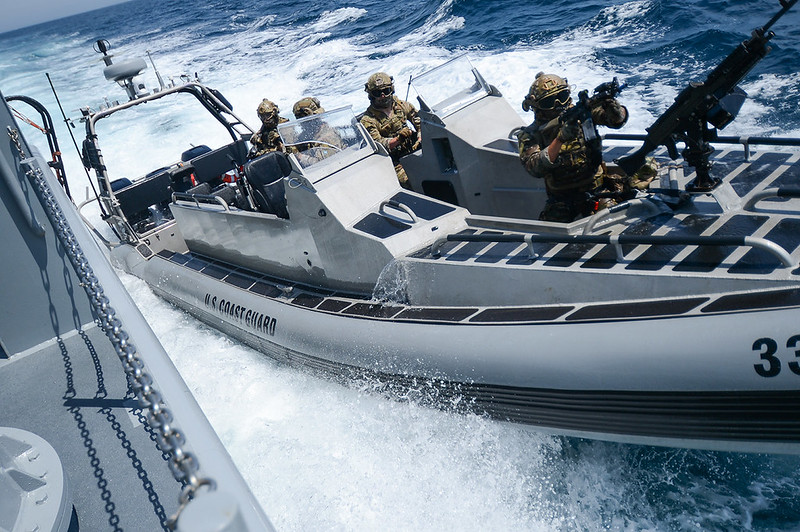
 Photo by Lt. Matthew A. Stroup
by Dr. Julie Kim
March 2026
This publication is part of a project on Canada-Republic of Korea defence cooperation funded by the Korea Foundation.
Table of Contents
- Introduction
- Context
- Key Findings from the Project
- Conclusion
- About the Author
- Canadian Global Affairs Institute
Introduction
This briefing note summarizes the key findings from the research project “Expanding Korea-Canada Defence Cooperation in the Indo-Pacific,” funded by the Korea Foundation. The project examined emerging opportunities for deeper collaboration in four areas: cyber security, defence industrial partnerships, Arctic security, and maritime security.
Context
● The security environment in the Indo-Pacific has changed rapidly over the past several years. Intensifying security threats—including North Korea’s missile provocations and its deepening military ties with Russia, the expansion of Chinese military capabilities, global supply chain disruptions, and economic uncertainty brought by U.S. tariffs—are reshaping the geopolitical landscape. In this context, cooperation among like-minded middle powers has become increasingly important.
● Canada and the Republic of Korea (ROK) are well positioned to strengthen this type of cooperation. The two countries share democratic values and a strong interest in promoting peace and stability in the Indo-Pacific, while building more resilient economic and defence partnerships.
● Since the two countries elevated their relations to a Comprehensive Strategic Partnership in 2022, defence cooperation has emerged as one of the main pillars of the bilateral relationship. Key developments include the inaugural Canada-ROK Foreign and Defence (2+2) Ministerial Meeting in November 2024 and the second meeting in February 2026; the signing of the Canada-Republic of Korea Security and Defence Cooperation Partnership in October 2025; and an Agreement on the Protection of Military and Defence Classified Information in February 2026.
● Overall, Canada-ROK defence cooperation is no longer limited to political dialogue or a symbolic partnership but is gradually becoming increasingly practical and operational.
Key Findings from the Project
● One of the main findings of the project is that Canada-ROK defence cooperation is expanding into new areas.
○ North Korea’s evolving cyber operations demonstrate that security threats are no longer limited to traditional military activity. As a result, closer collaboration between Canada and the ROK in areas such as cyber security, information-sharing, and emerging technologies is becoming increasingly important.
○ Canada has identified cyber security cooperation as a key component of its Indo-Pacific Strategy. In fact, there has been a noticeable increase in practical cooperation. In 2025, Canada and the ROK advanced their cyber security cooperation by participating jointly as a team in several cyber defence exercises.
○ Deeper cooperation in emerging security domains such as cyber security would strengthen not only bilateral defence ties but also broader regional resilience against shared threats.
● A second major finding is that defence industrial partnerships represent an important but still underdeveloped opportunity.
○ The ROK has become one of the world’s fastest growing defence exporters, with advanced capabilities in shipbuilding, manufacturing, and defence technology. ROK defence products offer systems that are interoperable with the United States and are already in service with several of Canada’s close allies.
○ At the same time, Canada aims to strengthen its defence industrial base and diversify its defence partnerships. Diversification should involve not only reinforcing existing partnerships but also expanding engagement with non-traditional partners.
○ Canada-ROK defence partnership has the potential to expand into long-term industrial and technological collaboration. Many opportunities remain to be explored, including in shipbuilding, land systems, guided weapons, aerospace, and emerging technologies. The key will be identifying strengths in each country that can complement one other.
● The project also explored opportunities for cooperation beyond the Indo-Pacific, particularly by linking the Arctic and the North Pacific.
○ Canada’s recent defence and Arctic policies recognize that protecting its North can no longer rely solely on traditional Euro-Atlantic partnerships but requires broader engagement with like-minded partners across the North Pacific.
○ This creates new opportunities for cooperation between Canada and the ROK. Although the ROK is not an Arctic state, its long-standing scientific presence,
advanced shipbuilding capabilities, and growing interest in Arctic shipping routes demonstrate that it is already an active stakeholder in the region.
○ Canada and South Korea can pursue cooperation in areas such as scientific research, developing Arctic-capable vessels and autonomous systems, energy security, and protecting the environment and Indigenous lands. They can also explore opportunities for joint exercises and training in Arctic conditions.
● Finally, maritime security has emerged as one of the most practical areas for expanding cooperation.
○ Both countries share strong interests in protecting freedom of navigation, reinforcing the rules-based international order, and contributing to stability in the Indo-Pacific.
○ Canada’s participation in naval deployments and multinational operations and exercises, such as Operation HORIZON, NEON, and RIMPAC, provides a strong foundation for expanding cooperation with the ROK Navy.
○ Building on this foundation, the two countries can strengthen their partnership across operational, technological, and strategic domains. They can increase joint exercises and operations to enhance interoperability, deepen cooperation on maritime domain awareness and information-sharing, and pursue partnerships in developing naval vessels and systems.
Conclusion
● The research project shows that Canada-ROK defence cooperation is entering a new phase. The relationship is no longer defined only by historical ties or political dialogue, but increasingly by practical cooperation in areas such as cyber security, the defence industry, and maritime security.
● Further, the research demonstrates that the partnership still has significant room to grow. Strengthening defence cooperation with the ROK would not only support Canada’s Indo-Pacific Strategy but also help position Canada as a more reliable and strategic security partner in the region.
● Canada’s new Defence Industrial Strategy also underscores the importance of closer cooperation with trusted Indo-Pacific partners such as the ROK. Canada should prioritize defence industrial collaboration with the ROK as a key area of the bilateral relationship, particularly in areas such as shipbuilding, advanced manufacturing, and emerging technologies.
About the Author
Dr. Julie (Jung-eun) Kim is a Post-Doctoral Fellow leading the Korea Program at the Canadian Global Affairs Institute (CGAI) and a Country Expert on North Korea for the Bertelsmann Transformation Index (BTI). She received a PhD in Political Science from Heidelberg University as a German Academic Exchange Service (DAAD) scholar. Her dissertation explores the social control system and autocratic regime stability in North Korea. She has a Master of Arts in North Korean Studies and a Bachelor of Arts in German Language and Literature from Ewha Womans University.
Julie has previously worked as a Research Intern at the Stockholm International Peace Research Institute (SIPRI) and a Global Asia Fellow at the East Asia Foundation. She has published various articles and a book chapter, including in the Journal of East Asian Studies, BTI Country Report – North Korea, and Global Asia. Her research interests include authoritarian regimes, geopolitics with a regional focus on the Korean Peninsula, and Canada-Korea defence cooperation.
You can connect with Dr. Kim at [email protected]
Canadian Global Affairs Institute
The Canadian Global Affairs Institute focuses on the entire range of Canada’s international relations in all its forms including (in partnership with the University of Calgary’s School of Public Policy), trade investment and international capacity building. Successor to the Canadian Defence and Foreign Affairs Institute (CDFAI, which was established in 2001), the Institute works to inform Canadians about the importance of having a respected and influential voice in those parts of the globe where Canada has significant interests due to trade and investment, origins of Canada’s population, geographic security (and especially security of North America in conjunction with the United States), social development, or the peace and freedom of allied nations. The Institute aims to demonstrate to Canadians the importance of comprehensive foreign, defence and trade policies which both express our values and represent our interests.
The Institute was created to bridge the gap between what Canadians need to know about Canadian international activities and what they do know. Historically Canadians have tended to look abroad out of a search for markets because Canada depends heavily on foreign trade. In the modern post Cold War world, however, global security and stability have become the bedrocks of global commerce and the free movement of people, goods and ideas across international boundaries. Canada has striven to open the world since the 1930s and was a driving factor behind the adoption of the main structures which underpin globalization such as the International Monetary Fund, the World Bank, the World Trade Organization and emerging free trade networks connecting dozens of international economies. The Canadian Global Affairs Institute recognizes Canada’s contribution to a globalized world and aims to inform Canadians about Canada’s role in that process and the connection between globalization and security.
In all its activities the Institute is a charitable, non-partisan, non-advocacy organization that provides a platform for a variety of viewpoints. It is supported financially by the contributions of individuals, foundations, and corporations. Conclusions or opinions expressed in Institute publications and programs are those of the author(s) and do not necessarily reflect the views of Institute staff, fellows, directors, advisors or any individuals or organizations that provide financial support to, or collaborate with, the Institute.
Showing 1 reaction