
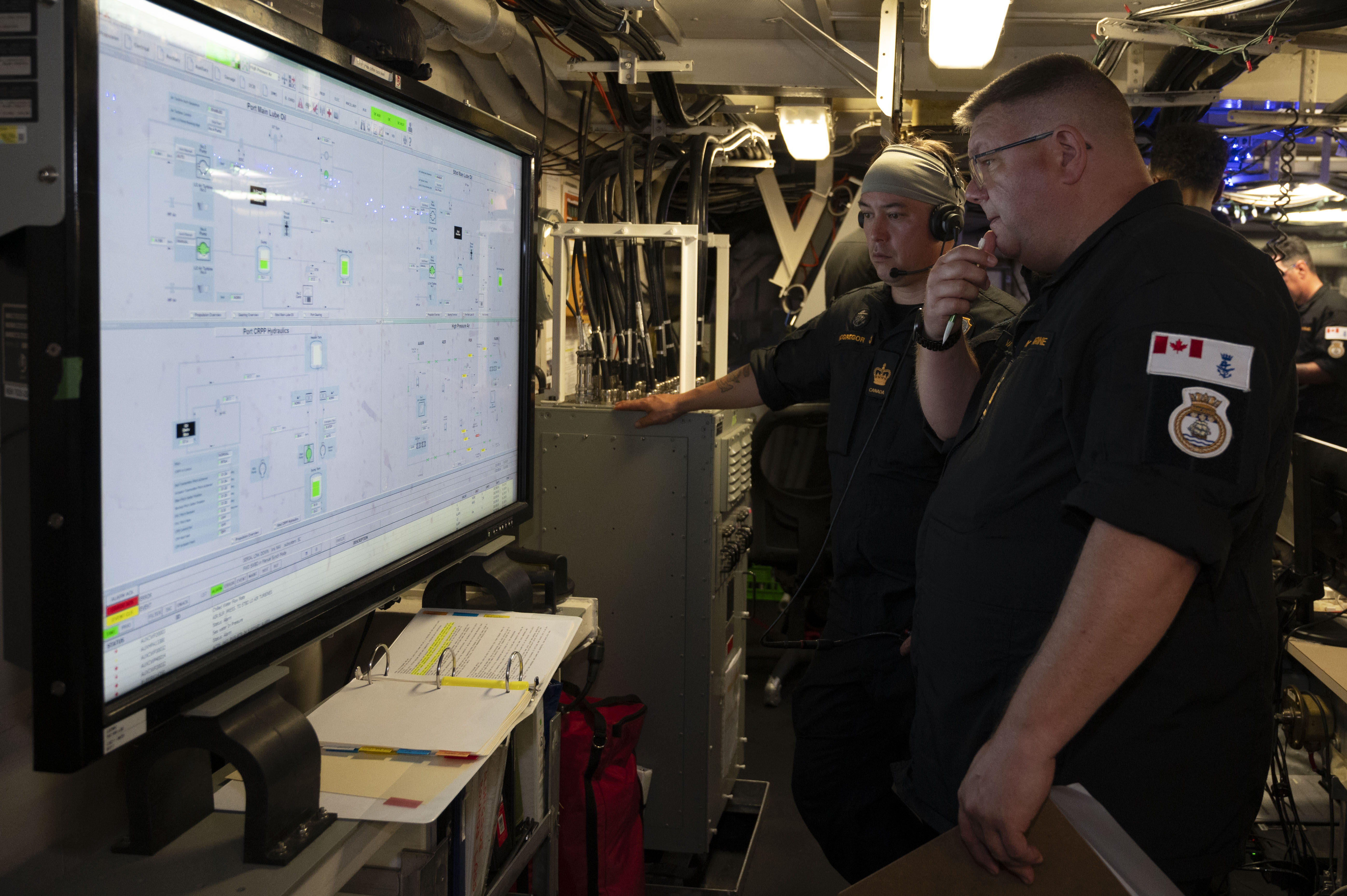
Royal Canadian Navy Marine Technicians review the ship's pressure and electrical systems during a simulated blackout exercise aboard His Majesty's Canadian Ship (HMCS) VANCOUVER
Corporal Alisa Strelley, Canadian Armed Forces Photo, Canadian Armed Forces
A Triple Helix publication

by Dr. Kevin Budning and Dr. Alex Wilner
November 2025
Table of Contents
- Introduction
- The Path Toward Change
- The Synthetic Environment and its Application Across the Five Eyes
- Canada and the SE
- The Push & Pull of a Canadian SE
- About the Author
- Canadian Global Affairs Institute
Introduction
In late 2024, Canada’s Chief of Defence Staff (CDS), Jennie Carignan, and the Canadian Armed Force’s (CAF) Chief Warrant Officer, Bob McCann, published their reflections on the past year and their outlook toward the future. Much of the letter emphasized Canada’s need to maintain operational readiness for a “rapidly changing world.” The likes of geopolitical tensions, climate-related disasters, conflicts, humanitarian challenges, and other emerging security threats will, they argued, require a “unified and focused defence team” that is harnessed through “modern equipment, advanced technologies, and cutting-edge training.”
At the time, these calls were far from novel. Canadian military officials and defence thought leaders have long cautioned that the CAF is ill-prepared to meet the demands of an increasingly unstable global environment. Perennial recruitment challenges, procurement delays, and piecemeal modernization efforts have left Canada, according to Professor Andrew Latham, “increasingly isolated…unable to secure its own interests or contribute meaningfully to allied defence efforts.” Without the capability to effectively deter foreign threats or adequately defend its sovereignty and national interests, Canadian political decision-makers quickly found themselves facing a lose-lose predicament: either commit to significant defence investments despite limited public support or continue to do the minimum required to maintain operational readiness.
Around the time Carignan and McCann released their report—and despite the warnings echoed by former CDS Wayne Eyre, it seemed Canada was headed for more of the same. The calls for action were loud, but both the political will and public appetite to address them were lacking. Then, in what can only be described as a series of unlikely events, Canada’s defence paradigm shifted dramatically within just eight months, driven by several converging factors: the re-election of U.S. President Donald Trump and his renewed antagonism toward Canadian sovereignty and prosperity, the unexpected political victory of Mark Carney as Canada’s Prime Minister, and the intensification of geopolitical conflict, cybersecurity threats, and armed aggression. Within his first 100 days in office, Prime Minister Carney broke from Canada’s long-standing defence apathy by announcing plans to invest 2% of GDP into national defence by the end of the fiscal year (i.e., March 2026), and committing to reaching 5% of GDP in core and support defence spending by 2030 at the 2025 NATO Summit in The Hague. These decisions finally aligned Canada with long-standing and newly emerging NATO defence-spending benchmarks. If realized, this will constitute the most significant investment in Canadian defence since the mid-Cold War.
While some aspects of the spending are known, many long-term questions remain unclear—particularly regarding where the money will come from and how it will ultimately be spent. In the coming months, officials at the Department of National Defence (DND) will be tasked, in part, with operationalizing this process and proposing options. The list of areas requiring investment—whether in hardware, software, critical infrastructure, training, or personnel—is too extensive to cover in this brief article.[1] Instead, we focus on one, still relatively niche and emerging capability that will enable CAF personnel to train faster, more efficiently, and with greater precision: the synthetic environment (SE). Unlike traditional, siloed training methods, the SE uses immersive, digitally enabled tools to simulate realistic operational conditions and scenarios for training, planning, and testing. When effectively implemented, synthetic environments can optimize how soldiers learn, reduce costs, enhance interoperability both within and across services, and improve the realism of exercises. These capabilities are important not only because they can significantly boost Canada’s force readiness but also because they help align Canada with its Five Eyes (FVEY) and NATO allies, who are increasingly adopting the SE as a central element of their wider defence modernization efforts.
The remainder of this paper is divided into four sections. The first briefly examines the events of the past year that catalyzed Canada’s shift from strategic passivity to a renewed focus on defence preparedness. The second provides an overview of the capabilities provided by the SE, highlighting the ways in which Canada’s closest allies are leveraging it. The third section builds on this foundation, zoning in on the ways Canada is using its SE abilities to meet the demands of modern warfare. Our article concludes with a straightforward argument: making the necessary investments in Canada’s modernization efforts today, including with SE, will yield long-term dividends. These investments will strengthen the country’s ability to deter and defeat adversaries, help solve the recruitment resource crisis, and signal to allies and strategic partners that Canada is contributing meaningfully to collective defence.
[1] For a few examples, see: Alexander Salt and Alex Wilner, “Emerging Technology and Canadian Defence: From Strong, Secure, Engaged to present,” May 2024, Canadian Global Affairs Institute; Paul Maddison, David Fraser, and John Scott Cowan, “What Spending Two Per Cent of GDP on National Defence Means for Canada,” April 2024, Canadian Global Affairs Institute.
The Path Toward Change
The road toward reshaping Canada’s defence posture began in 2019 at the NATO Summit in London. During a public exchange with Prime Minister Justin Trudeau, President Trump openly criticized Canada for failing to meet NATO’s 2% of GDP defence spending target, pointedly asking, “How much are you spending?” and describing the shortfall as “slightly delinquent.” Until then, Canada had largely avoided direct U.S. rebukes over its military contributions, benefiting from the long-standing assumption that the United States would always safeguard its northern border and otherwise provide Canada with military and strategic support.
The comfort of relying on America’s protective arm was a position most Canadians likely embraced, allowing taxpayer dollars to be directed toward what were seen as more pressing domestic priorities. Trump’s public branding of Canada as a free rider left an impression, but his failure to secure re-election in 2020 meant his calls for increased contributions never gained lasting momentum. It was only after Russia’s invasion of Ukraine in February 2022—and Trump’s return to the White House in 2024—that defence spending, and Canada’s shortfall in particular, moved to the forefront of the U.S. president’s agenda.
With visible contempt for Prime Minister Trudeau, President Trump repeatedly attacked Canada’s low defence spending both in the lead-up to his second presidential victory and in the early weeks of his new administration.[1] In early 2025, he unveiled a tariff agenda threatening to impose 25% duties on all goods entering the United States—an economic blow that risked crippling the Canadian economy. Trump’s disdain for and bullying of Trudeau, punctuated by his habit of calling him “Governor Trudeau,”and his provocative call to make Canada America’s 51st state, marked a stark shift in Canada–U.S. relations. For President Trump, questioning Canada’s sovereignty was inseparable from criticizing its weak defence posture. In a November 2024 press conference, for illustration, he remarked, “We give them [Canada] military protection. They’re about last in NATO. They say, ‘Why should we spend on the military? The U.S. protects us.’ That’s true. It’s not fair. They couldn’t exist if they had to pay their way.” Trump’s near-daily attacks on Canada’s sovereignty, economy, and reliance on the U.S. security (and intelligence) umbrella forced not only Canadian decision-makers but also the wider Canadian public to reassess their views on national defence spending and preparedness.
These questions became central to the 2025 Canadian federal election, when late-entering Liberal candidate Carney scored a major upset over Conservative frontrunner Pierre Poilievre. Both candidates focused on defence more than in any recent election, pledging to meet NATO’s 2% spending target. The Canadian public also became increasingly aware that national sovereignty could not be taken for granted and that the United States’ security guarantees might not be as iron-clad as once assumed. By July 2025, according to an Abacus Data poll, over 60% of Canadians supported Carney’s subsequent announcements to increase defence spending, a stark contrast to just three years earlier, when 66% of Canadians said the government was spending enough or should spend less on defence—a year in which the country allocated only 1.24% of its GDP to the military.
How and where this defence spending will be allocated remains unclear. Beyond providing a broad defence wish list—$2.1 billion to “strengthen Canada’s relationship with the defence industry,” $1 billion to “expand emerging military capabilities,” and $2 billion to “develop stronger defence partnerships”—details of the government’s specific plan are still be formulated. The only major concrete announcement came in early August 2025 when Carney dedicated $2 billion in pay increases for Canadian Armed Forces members, a welcome plan meant to shore up recruitment and retention efforts across the military.
What is clear is that the need for a modern military force has never been greater. The global landscape is increasingly complex, marked by Russia’s war of aggression on Ukraine, ongoing turmoil in the Middle East, and China’s credible threats against Taiwan. In Canada, looming conflict in the Arctic and increasingly aggressive Chinese and Russian actions—through cyber operations, foreign interference, aerial espionage, and other coercive grey zone activities—serve as a reminder that geographic distance from the frontline is not a marker or guarantee of security. Meanwhile, CAF members are already stretched thin, with significant deployments to Operation REASSURANCE (supporting NATO deterrence in Eastern Europe) and Operation UNIFIER (providing military training and capacity-building to Ukraine), with Prime Minister Carney recently announcing Canada’s intention to extend the former deployment to at least 2029. Meeting these commitments while remaining operationally ready at home creates a double-squeeze on an already strained military force.
The convergence of soaring international tensions and strained Canada–U.S. relations, combined with a severe recruitment and resource challenge as the CAF struggles to train applicants efficiently, has placed Canada’s defence policy squarely in the spotlight. While emerging technologies will be central to Canada’s evolving defence strategy, addressing one specific capability gap, the integration of a synthetic training environment, could play an outsized role in enabling the country to achieve and sustain its broader objectives.
[1] Canada committed in June 2025 to reach 2 per cent of GDP in defence spending by 31 March 2026, and 2025 Federal Budget reads that its defence spending will get to 3.5% of GDP by 2035.
The Synthetic Environment and its Application Across the Five Eyes
Military simulation has evolved dramatically over the past century—from the early Link Trainer of the 1930s, through Cold War–era wargaming, network computer-based systems of the late 20th century, and the digitized, immersive simulations of the 1990s and 2000s—each stage pushing realism, safety, and interoperability further. Today, this trajectory has culminated in the advent of the synthetic environment, which adds a new dimension to conventional simulation by integrating emerging technologies such as machine learning, extended and mixed reality, and advanced gaming engines to deliver unprecedented levels of realism. SEs replicate dynamic weather, terrain, and mission scenarios in real time, capture performance data for tailored training, and opens otherwise inaccessible, dangerous, or prohibitively expensive environments. By fusing live, virtual, and constructive elements into seamless, adaptive experiences, the SE transforms military training from static exercises into flexible, data-driven preparation for the complex challenges of modern warfare. Canada and its FVEY partners, particularly Australia, the U.K., and the U.S., have recognized the value of the SE for force development, simulation, and training, and have begun taking the necessary steps to integrate and leverage this capability in future defence planning. Each countries’ progress, however, varies considerably and the challenges (e.g., Canada’s recruitment resource delays) differ across the spectrum.
Australia
In 2020, the Australian government launched its Future Ready Training System, a defence roadmap designed to modernize the Australian Defence Force (ADF). A central tenet of this strategy is that training must be “engaging, repeatable, and measurable, utilizing technology, simulation, on-demand content, data analytics, and feedback to enhance learning and workforce performance.” Backed by a $650 million investment over the next decade, the Land Simulation Core 2.0 (LS Core 2.0) serves as the foundation of the simulation modernization efforts. The LS Core 2.0 provides a unified simulation platform across ADF services, enabling more effective preparation for modern warfare. Its key features include cloud-based access for global training, millions of square kilometers of mapped terrain, highly accurate 3D vehicle models, and advanced collaborative graphics. Together, these capabilities allow ADF personnel to rehearse complex, Joint All-domain Control and Command (JADC2) operations—including with, for example, future concept vehicles and systems not yet put into service—bringing an unprecedented level of readiness against potential adversaries.
The ADF’s emphasis on integrated live, virtual, and constructive (LVC) systems extends to leveraging data analytics during large-scale exercises to replicate both the physical environment and the electromagnetic spectrum, while also incorporating behavioral and psychological metrics to provide adaptive, feedback-driven, and personalized training. A key example is the Advanced Simulation Combat Trainer (ASCOT), developed by the U.S. firm Plexsys, which offers a dynamic, computer-based simulation environment. Its latest version, ASCOT 7, features a comprehensive database that can be updated in real time, enabling users to respond to evolving inputs, refine maneuvers with immediate feedback, adapt to weapon system changes, and rapidly construct or modify training modules.
The United Kingdom
In the U.K., the government recognized the importance of the SE in training and simulation as early as 2004, when it established the Synthetic Environment Tower of Excellence (SE Tower) Community of Practice (COP). This forum enabled the Ministry of Defence (MOD) to work alongside academia and industry to advance the British Armed Forces’ (BAF) capabilities in this area, while also strengthening ties with the COP supplier community. The initiative predates the BAF’s most recent modernization strategy, known as the Collective Training Transformation Programme (CTTP), which aims to “revolutionize” the BAF’s training practices via leveraging digital technologies and immersive systems. Valued at $1.14 billion over ten years, the CTTP proposes a framework that will help the BAF confront a variety of scenarios in a surrogate environment. This, for example, includes a synthetic environment where cross-functional, intra-government, inter-agency, or even multinational coordination and training can take place together in real time with live feedback and inputs leveraged by AI and other emerging technology.
The BAF is deploying a range of novel synthetic training technologies to support its modernization objectives. For example, Canadian-based CAE is providing the BAF with its Dynamic Synthetic Environment, a simulation platform capable of supporting up to 50,000 simultaneous participants. The system can simulate a range of scenarios, including army tasks such as infantry maneuvers, vehicle operations, piloting aircraft, and even observing missions from an unmanned aerial vehicle (UAV). To illustrate, one participant could operate a military vehicle while another, piloting an Apache helicopter on a high-fidelity simulator, participates from 50 miles away. In a different scenario, a pilot in Canada could control a UAV while another participant in London assumes the role of a commando.
Another system used by the British military is Elbit’s Interim Combined Arms Virtual Simulation – Deployed (ICAVS D), which allows soldiers to rehearse missions in a wide variety of environments. The Israel-based company’s approach relies on state-of-the-art gaming computers, and can train up to 55 participants simultaneously, even when located in different countries. It is particularly effective for mounted and dismounted operations and is currently being employed by British troops remotely in Estonia as part of Operation CABRIT.
Other systems, such as the Joint Fires Synthetic Trainer (JFST), enable the BAF to practice calling in fire support, coordinating airstrikes, artillery, and critical communications necessary for operational success. The range of SE capabilities implemented by the UK extends further; it includes Hadean’s Cloud-Distributed Simulation (which uses AI-augmented technologies to simulate civilians, adversaries, and social media reactions); BAE Systems’ Project OdySSEy (aimed at creating a unified synthetic environment across all military domains); and enhancements to the existing Gladiator System, (which facilitates LVC training by linking previously siloed simulators to achieve high fidelity and realism that duplicate live exercises). As the UK continues its modernization efforts, it has further committed an additional £600 million for CTTP activities, signaling its intention to expand synthetic environment capabilities well beyond the next decade.
The United States
For the United States Army, the Synthetic Training Environment (STE) is the cornerstone program for modernizing training, enhancing fidelity, realism, and repetition through virtual, constructive, and gaming environments. Unlike legacy systems, STE is more interactive, collects and analyzes significantly more data, enables multi-domain training (supporting interoperability), and can even simulate human interaction. Major STE initiatives include One World Terrain (OWT), which provides high-fidelity geospatial mapping of the globe for life-like simulation; Reconfigurable Virtual Collective Trainer (RVCT), a mobile, transportable system that allows pilots, ground vehicle crews, and dismounted infantry to train together; and the Training Management Tool (TMT), which helps commanders analyze training data to track performance and design, conduct, and monitor future exercises.
To illustrate one of the many STE contributions, in March 2024, soldiers from the U.S. 1st Cavalry Division began testing Abrams tanks and Bradley combat vehicles indoors. Using AR, VR, and gaming technologies with virtual reality goggles, operators gained a new perspective on situational awareness. Whereas previously tank crews could only train from inside the hatch, STE allowed them to see outside the vehicle, providing a much better understanding of their surroundings. After exercises are completed, trainers and trainees can then rehearse and review operations from a birds-eye view, allowing soldiers to study outcomes and improve performance in future missions.
While the STE is the most comprehensive training ecosystem in the U.S. Army, other military branches—including the Air Force, Navy, and Space Force—also employ LVC training environments in their training regimens. For example, under the U.S. Air Force’s Distributed Mission Operations Center (DMOC)—which oversees distributed simulator-based training—a program called Virtual Flag allows airmen to practice tactical warfighting and combat in a fully virtual battlespace. This exercise connects simulators across the country, enabling pilots and aircrew to train together in large-scale, realistic scenarios without physically being in the same location. Likewise, the Navy Continuous Training Environment (NCTE) is another example of LVC technology enabling live and synthetic training across the globe. NCTE allows sailors to practice a wide range of scenarios that would be difficult or impossible in full-scale exercises, from complex anti-ship missile threats to multi-fleet coordination across different time zones. It also provides scalable training, starting with simple challenges and progressing to more complex, realistic situations, enhancing operational readiness in a cost-effective and immersive environment.
Canada and the SE
Like its Five Eyes partners, the Department of National Defence has recognized the importance of synthetic environments for force modernization and readiness. As early as 2012, the Royal Canadian Navy (RCN) began its transformation with the establishment of the Distributed Mission Operations Centre (DMOC) at Navy School Atlantic. The goal of the DMOC was to consolidate separate resources into a comprehensive and unified synthetic training environment known as the Fleet Synthetic Training Environment (FSTE). This collective training environment integrated various branches of the military—including the Royal Canadian Air Force (RCAF)—as well as allied forces such as the United States Navy, the British Royal Navy, and the Royal Australian Navy. Moreover, the initiative extended beyond naval platforms to include other training systems, like the Cyclone and CF-18 trainers, enhancing interoperability and supporting joint training exercises.
The vision for the Fleet Synthetic Training Environment (FSTE) has evolved over the years through Canada’s various modernization strategies, including Strong, Secure, and Engaged (SSE) and Our North, Strong and Free (ONSAF). Both policies recognize the need for the CAF to leverage emerging technologies to remain prepared for any threat environment. SSE, for example, laid the foundation for the Future Integrated Training Environment (FITE), a working concept designed to integrate existing training and simulation technologies into a broader LVC ecosystem. As part of this multi-year initiative—targeted for full implementation by 2033—the Land Vehicle Crew Training System (LVCTS) was proposed. LVCTS is intended to replicate all crew stations across various armoured vehicles, including tanks, enabling individual and collective training for soldiers at all five primary Canadian Army garrisons.
Under the Canadian Army Doctrine and Training Centre—the lead developer of FITE—several other modernization initiatives related to the synthetic environment are also in development, though progress has been gradual. These include the Urban Operations Training System (UOTS), the Unit Weapons Training System (UWTS), and the Weapons Effects Simulation (WES) Modernization program. The UOTS consists of a cluster of buildings equipped with tracking systems, cameras, sensors, and simulated weapons, allowing for the monitoring of soldier movements and actions using 2D and 3D LVC technologies, with the ability to introduce simulated effects as needed. The UWTS is intended to replace the Small Arms Trainer (SAT) by providing a networked virtual environment for individual and unit-level weapons training. The WES Modernization program is a significant upgrade—valued between $250 million and $499 million—of the original WES system, aimed at enhancing both instructional delivery and simulation realism to ensure training remains as immersive and effective as possible.
While the CAF has rightly identified modernization as critical to future force development, significant ambiguity remains regarding specific programs, costs, timelines, and what these initiatives will look like once fully realized. Take, for example, the Army’s modernization strategy. Last released in 2020, the document calls for synthetic training environments to be “integrated where appropriate to maximize individual and collective training efforts,” yet offers few concrete details beyond that. Similarly, the Department of National Defence established the Canadian Synthetic Environment (CASE) in 2018 to develop network-based infrastructure and processes for Distributed Mission Training, Joint Mission Rehearsal, and air and ground crew training—a program intended to address historically fragmented infrastructure across the country. Although an estimated $50 to $99 million in funding is tied to CASE and it was expected to be fully operational by 2024/2025, little information has been made publicly available since its launch.
In a similar fashion, the RCAF has also recognized the significance of the SE, most notably through its RCAF Simulation Strategy, published in 2015. The strategy emphasized the importance of simulation and set an ambitious goal: that by 2025, the RCAF would have a “simulation-focused training system which skillfully leverages live, virtual, and constructive domains within a networked common synthetic environment.” However, this strategy—like the most recent RCAF Modernization Strategy released in April 2024—focuses mainly on explaining why the SE is critical but falls short in clearly explaining how this vision will be realized. The 2024 Modernization Strategy, for instance, proposes that the SE can be leveraged in three areas: Technology-Enabled Learning (TEL), Operational Training Infrastructure, and Capability Development and Sustainment, yet it offers no concrete examples. Instead, it broadly suggests that the SE will support networked training, enhance realism for trainees, and become a key consideration in balancing live and synthetic training during future procurement efforts.
The Push & Pull of a Canadian SE
Applying synthetic environments towards defence purposes is still a relatively novel idea. In a 2022 article we published with International Journal, Canada’s leading academic journal in international affairs, we found that almost no theoretical discussion and very little scholarly attention had been given to the topic of the SE despite significant investments in the technology. Moreover, when it came to practical implications, we further observed that among the Five Eyes, Canada’s implementation of SE was lagging significantly behind American, British, and Australian efforts. Nonetheless, our article highlighted the short and long-term opportunities (and challenges) that would arise from Canada’s integration of an SE in national defence. Most notably, we argued that for Canada to effectively leverage the technology, it would need both top-down and long-term commitment for a sustainable program, as well as investments in skillsets, and propriety engagement stemming from new government-industry-academic partnerships. In the years since we made those preliminary observations and arguments, geopolitical instability has grown, armed aggression and economic coercion have spilled beyond Europe, and defence budgets have ballooned globally. Here in Canada, national defence, national sovereignty and civil preparedness have taken centre stage, politically and economically. Upgrading Canada’s defence training environment has never been more relevant, feasible, and necessary.
As decision-makers consider the implications of where and how the newly announced spending commitments should be allocated, Canada needs to think long-term about both its domestic priorities and its role among international coalitions. For one, building a sustainable SE ecosystem will reduce long-term costs. While the state-of the art technology costs remain high, they improve the ability for operators to train in disparate locations, as part of different teams, possibly with different allied forces, and with unparalleled levels of fidelity and realism. Moreover, due to Canada’s limited force size and the number of deployed overseas operations, the ability to engage in real-life exercises are limited. Combine these factors with the prospect of far greater instability in the Indo-Pacific (as China ratchets up its coercion against Taiwan), Europe (as Russia’s war in Ukraine bleeds into grey zone attacks against NATO), the Middle East (as Israel consolidates its newfound military dominance over Iran and its militant proxies), the Arctic (as climate change continues to facilitate greater access to the region), and North America (as the Trump Administration continues to bully and pressure its neighbors), and the importance of bolstering Canada’s defence posture and capabilities to deter threats while signaling our ability to contribute to continental and international defence becomes evident.
Perhaps even more importantly, adopting a holistic SE ecosystem can help alleviate the recruitment resource challenges that have long plagued the CAF. While efforts are underway to fill the roughly 14000-person shortage, the CAF continues to struggle not only with attracting new recruits but also with retaining them and moving them efficiently through the training pipeline. In some cases, new recruits are waiting over 200 days between completing Basic Military Qualification (BMQ) and beginning occupational training, a delay caused by shortages of instructors, equipment, and infrastructure. The SE could play an outsized role in addressing this bottleneck by allowing recruits to begin certain modules earlier, possibly even remotely, and enabling multiple groups to train in parallel across different parts of the country. This would ultimately yield three major effects: (1) shortening the timeline from BMQ to fully qualified operator; (2) improving organizational efficiency and reducing long-term costs; and (3) enhancing retention and morale, since long wait times are one of the leading reasons once-motivated recruits disengage and ultimately leave the Forces.
Canada has the infrastructure and know-how to make this a real possibility. The Canadian Army Simulation Centre – the centre for excellence for all simulation-based training within the Canadian Army – is already delivering training to other branches across the CAF, as well as leading multinational exercises with NATO member countries. Canada is likewise already home to the domestic capabilities needed to build the SE. For instance, Calian, a Canadian-based consulting and full-service defence firm provides VLC and immersive training experiences for the CAF, including by using a system agnostic approach, which “connects the most appropriate simulation tools into a synthetic training environment,” blending the experience from large multinational headquarters to companies that are operating in live arenas. Calian’s digital tools also help capture and analyze exercise data in real time, creating feedback loops that enhance training exercises and make it easier to evaluate decisions, outcomes, and operator performance—driving continuous improvement. Supporting and growing Canadian-based initiatives, infrastructure, academic research, and industry is the next logical step.
As the government invests more money into SE, lessons should also be pulled from our allies. In the United States, for example, readily available fiber optic cables at U.S. Navy ports allow for synthetic environments to be easily integrated along a systems-of-systems. In Canada, by comparison, delays with similar types of connectivity persist, which prevents the RCN from plugging into the network while in port, allowing combat serials to occur without ever leaving port. This small detail is one of many that prevents the CAF from deploying at a level of readiness comparable to its allies.
Finally, in terms of academic-industry knowledge, Canada must follow the steps its FVEY partners have taken. In the UK, to provide but one example, the Simulate and Synthetic Environment Laboratory (SSEL) at Cranfield University is designed specifically for simulation and analytics. Located at the Defense Academy of the UK in Shrivenham, SSEL brings together higher education, research, and consultancy in defence modelling, training, simulation, and the SE. While Canada’s academic-industry ecosystem has garnered important achievements under the MINDS and IDEaS programs, and Canada is home to several defence-industry-academic networks – Triple Helix, chief among them – none are specifically focused on building Canada’s defence synthetic environment. That should be remedied.
As Canadian leaders weigh not only how to allocate increased defence funding but also where such investments will deliver the greatest long-term value, the SE should be top of mind. By collaborating with FVEY and NATO allies, Canada can accelerate its adoption of SE technologies for training and operational readiness. At the same time, nurturing a domestic SE ecosystem would position Canada to lead in a field that aligns naturally with its established strengths in gaming, robotics, and simulation. In doing so, Canada would not only enhance its own defence capabilities and help alleviate the recruitment and retention challenges, but also contribute meaningfully to allied innovation and security in an increasingly complex global landscape. Both of which are becoming ever-more necessary as Canada seeks to redefine its defence posture, safeguard its sovereignty, and project power and preparedness to allies and adversaries alike.
About the Author
Dr. Kevin Budning is the Director of Scientific Research and Programs at the CDA Institute and a research Fellow at the Norma Paterson School of International Affairs.
Dr. Alex Wilner is an Associate Professor at the Norman Paterson School of International Affairs (NPSIA) and the Director of the Infrastructure Protection and International Security (IPIS) graduate program, at Carleton University, Ottawa, Canada.
He is a leading scholar of contemporary deterrence theory and practice. His research – which explores the nexus between deterrence theory and emerging security considerations, domains, and environments. Among his over two dozen journal publications, his articles on the subject of deterring terrorism and cyber/AI deterrence have been published in top-ranked IR journals, including International Security, Journal of Strategic Studies, Security Studies, and Studies in Conflict & Terrorism. His books include Deterrence by Denial: Theory and Practice (eds., Cambria Press, 2021), Deterring Rational Fanatics (University of Pennsylvania Press, 2015), and Deterring Terrorism: Theory and Practice (eds., Stanford University Press, 2012).
Since joining NPSIA in 2015, his broader scholarship has been awarded over $1.2M (CAD) in external research funding: he was awarded a Government of Canada SSHRC Insight Development Grant (2016-2017), a prestigious SSHRC Insight Grant (2020-2025), and a Government of Ontario Early Researcher Award (2021-2026) to study state and non-state cyber deterrence; two major IDEaS grants (2018-2021) and several MINDS grant (2019, 2020) from the Department of National Defence to explore Artificial Intelligence and deterrence; several research grants from the Canadian Network on Terrorism, Security, and Society (TSAS); a major Mitacs grant (2020-2022) to explore emerging technology and Canadian defence policy and strategy; and a SSHRC Partnership Engage Grant (2022-2023) in association with Global Affairs Canada to assess the use and utility of strategic foresight in foreign policy.
He teaches classes on terrorism and violent radicalization, intelligence in international affairs, strategic foresight in international affairs, and a capstone course on Canadian security policy. Besides his academic teaching, since 2017 he has trained over 1100 Canadian public servants in strategic foresight, having provided over 45 multi-day training workshops to several government departments, including (among others) the Department of National Defence/Canadian Armed Forces, Global Affairs Canada, Natural Resources Canada, Environment and Climate Change Canada, Agriculture and Agri-food Canada, and Standards Council of Canada.
Canadian Global Affairs Institute
The Canadian Global Affairs Institute focuses on the entire range of Canada’s international relations in all its forms including trade investment and international capacity building. Successor to the Canadian Defence and Foreign Affairs Institute (CDFAI, which was established in 2001), the Institute works to inform Canadians about the importance of having a respected and influential voice in those parts of the globe where Canada has significant interests due to trade and investment, origins of Canada’s population, geographic security (and especially security of North America in conjunction with the United States), social development, or the peace and freedom of allied nations. The Institute aims to demonstrate to Canadians the importance of comprehensive foreign, defence and trade policies which both express our values and represent our interests.
The Institute was created to bridge the gap between what Canadians need to know about Canadian international activities and what they do know. Historically Canadians have tended to look abroad out of a search for markets because Canada depends heavily on foreign trade. In the modern post-Cold War world, however, global security and stability have become the bedrocks of global commerce and the free movement of people, goods and ideas across international boundaries. Canada has striven to open the world since the 1930s and was a driving factor behind the adoption of the main structures which underpin globalization such as the International Monetary Fund, the World Bank, the World Trade Organization and emerging free trade networks connecting dozens of international economies. The Canadian Global Affairs Institute recognizes Canada’s contribution to a globalized world and aims to inform Canadians about Canada’s role in that process and the connection between globalization and security.
In all its activities the Institute is a charitable, non-partisan, non-advocacy organization that provides a platform for a variety of viewpoints. It is supported financially by the contributions of individuals, foundations, and corporations. Conclusions or opinions expressed in Institute publications and programs are those of the author(s) and do not necessarily reflect the views of Institute staff, fellows, directors, advisors or any individuals or organizations that provide financial support to, or collaborate with, the Institute.


Showing 1 reaction