
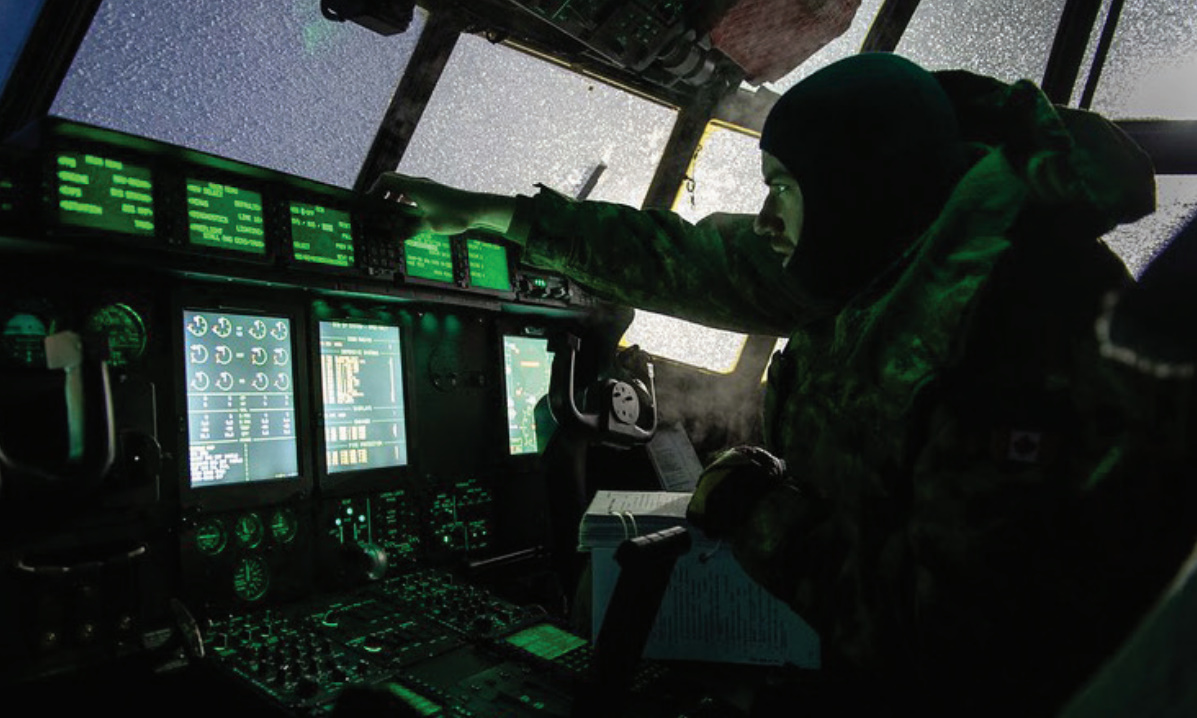
Image credit: Government of Canada (DND/CAF AI Strategy)
A Triple Helix publication

by Dr. Alexander Salt
August 2025
- Introduction
- AI and the Canadian Armed Forces
- Private Sector Perspectives on AI Adoption
- Looking Ahead
- About the Author
- Canadian Global Affairs Institute
Introduction
The question is no longer whether armed forces will adopt Artificial Intelligence (AI), but how deeply it will be integrated into their operations. The Canadian Armed Forces (CAF) and Department of National Defence (DND) have acknowledged this reality by releasing an ambitious AI Strategy in 2024. In response to this challenge, Triple Helix held a conference, aptly titled “AI & Canadian Defence: From Implementation to Innovation” in Ottawa, where it brought together a range of participants from the wider Canadian defence community, including those from the private sector, to discuss and debate the scope and extent to which AI and related emerging technologies will reshape the CAF. Underpinning the multiple discussions across the conference was that AI presents a multifaceted transformational moment for the CAF, which will affect its digital modernization, operational methods, as well as personnel management and culture. Drawing on insights from the conference, this article highlights key themes from its discussions and identifies priority areas for further exploration.
AI and the Canadian Armed Forces
The CAF has identified a broad spectrum of applications for the operationalization of AI, recognizing its potential to significantly enhance various capabilities. Perhaps most significant is the potential to affect command and control (C2) capabilities, as it may allow Canadian commanders to disrupt adversarial decision making cycles (or OODA Loop) by allowing them to make decisions faster. However, beyond conventional combat scenarios, AI may be relevant for other CAF activities, such as streamlining intergovernmental coordination efforts with partners like Global Affairs Canada and the Canadian Border Services Agency. AI holds significant potential to support the CAF in the information domain by enabling real-time tracking of both social media content and legacy media output. Additionally, there remains concerns regarding the responsible and ethical use of AI during operations. Clear and robust guidelines would relieve operational commanders of the burden of determining whether their specific use of AI aligns with accepted standards.
Canada must also understand how potential adversaries are conceptualizing the impact and trajectory of emerging technologies such as AI. Any state or non-state actor is free to leverage AI, as it is a dual-use technology with both military and civilian applications and there are no international treaties limiting its usage. AI’s wide accessibility and scalability allows even smaller global actors to readily acquire related capabilities. This greatly amplifies the potential risk and dangers of the growth of AI in military affairs, particularly from the perspective of responsible and ethical usage of the technology. Canada has a strong international reputation for supporting multilateral endeavors and may have the opportunity to play a greater role in promoting the responsible usage of AI for militaries in such forums as the REAIM Summit. Overall, the Canadian defence community must consider how potential adversaries are acquiring and implementing AI to help inform its own efforts and mitigate against external threats more thoroughly.
The management of data quality must be a central part of any discussion of integrating AI into the Canadian military. The acquisition of new platforms such as River-Class Destroyers and F-35 aircraft as well as new drones and sensors will dramatically increase the volume of data acquired by the CAF. Further, new operational and strategic priorities such as expanding the CAF’s presence in the Indo-Pacific and Arctic will also spike the levels of data the CAF has to process and then analyze for in order to have functional C2 capabilities. The services (Air Force, Army, Navy) are each experimenting with AI to enhance their ability to more effectively leverage this influx of data. To be successful, the CAF must continue to build its Cloud Based Command and Control capabilities, as well as continue to undergo its wider digital transformation. Further, it is essential that the DND/CAF continue to successfully follow through with tangible initiatives outlined in the recent AI Strategy to help streamline wider AI related efforts.
Beyond enhancing C2 and other traditional military operations, AI has the potential to significantly transform how the CAF utilizes its personnel. The introduction of Language Learning Models (LLMs) can potentially free up time and space for CAF personnel conducting business operations. AI, if integrated properly, can act as a force multiplier, allowing the CAF to free its personnel from time consuming labour tasks to focus on more important activities. This impact is particularly salient given the CAF’s ongoing concerns regarding its personnel levels. However, AI’s success here is not guaranteed, as current experimentation with its use for business operations has contained a considerable element of trial and error. For example, security classification issues can prevent using sensitive data with more open AI systems such as Copilot. AI’s integration into the CAF is best understood under the wider context of the increased digitalization of the organization, and during this process mistakes will happen as experimentation increases. However, this should be seen as an acceptable risk, as innovation can be incredibly difficult to achieve under extremely risk-averse conditions.
Private Sector Perspectives on AI Adoption
The private sector has been more aggressive at adopting AI into their organizations than governments. Companies have rapidly developed and acquired LLMs, which have become more commonly part of their standard operating procedures during daily operations. However, this process has not been automatic, it has taken a steady effort of trial and error, including the accelerated use of analytics to help identify where AI can enhance efficiency and increase productivity. Industry professionals generally agree that experimentation is inevitable with emerging technologies; what matters most are the follow-on steps that enable organizations to build on what they have learned. If a firm lacks the internal mechanisms to undergo such efforts, then the integration of lessons learned will not succeed and the company may lose ground to their competitors. Some firms have developed proprietary LLM and AI systems that allow for deeper and more robust customization which they feel allows for greater efficiency. Interestingly, even private sector operations often run into issues using AI due to difficulty with data sharing of confidential information.
Data collection remains a primary challenge, especially for firms working in the defence sector. There are often large quantities of platforms or systems that generate high volumes of data that need to be recorded and stored. Often there is a need to operate with legacy analogue equipment that sometimes even still use paper-based logs, while also relying on newer digital systems. This compounds the challenge of data accumulation, due to the mixed variation of sources. Industry representatives have noted that across NATO there is greater interest in streamlining and modernizing data accumulation and analysis. This process is constantly evolving, requiring careful consideration of key nuances. For example, younger generations entering the workforce have grown up with emerging technology in ways that differ from their older counterparts. Their understanding of technology and preferences for certain interfaces vary, which must be factored in as firms develop modern designs.
AI regulation and governance is an incredibly important related issue. There is a need across the tech sector to continue to build legal and legislative awareness for compliance purposes. This gets particularly complicated from a transnational perspective, as not only do national AI laws differ, but sometimes even regulations can vary within different parts of the same country depending on jurisdictions. The rapid evolution of AI systems requires firms to remain continuously attuned to global research and development trends, not only at the technical level, but also in how these developments intersect with governmental regulations. This awareness also helps companies lobby and inform future regulatory policies.
Regulations also hold considerable relevance for shaping interoperability with allies during AI operationalization. There appears to be an escalating risk of growing differences in how Canada, the EU, the U.S., and others are regulating AI. If these gaps persist, the Canadian defence industrial base will have difficulty marketing their products in foreign markets. Future challenges with procurement are already apparent, as AI’s development trajectory will likely rapidly outpace the rigid structures of current government contracting. Any contract designed for AI in 2025 will be insufficient for the capabilities of 2035, which makes it essential that governments adopt more flexible and adaptive procurement approaches to accommodate this trend.
Across the private sector there is a growing sentiment that cultural change is an essential part of any organizational transformation. There is a need to convince personnel within organizations to get behind the adoption of AI, and sometimes this process is seldom smooth. Often there is a need for an active integration strategy to guide the process, involving both top-down direction and guidance, while also allowing bottom-up driven integration from personnel at the lower levels of organizational hierarchies. From the top-down perspective, leadership should push through the necessary changes, especially during difficult and disruptive parts of the implementation process.
However, organizations have also needed to establish a bottom-up driven acceptance of changes through all levels of personnel to fully integrate this new technology into their standard operating procedures. This bottom-up driven vector may include training personnel to have new skillsets but may also require convincing their mindsets to get behind the digital transformation. Organizations discovered they had to allow learning to unfold at a steady pace but could not effectively rush the process. Furthermore, new internal structures were sometimes needed to support the process, including incentives to encourage personnel to engage with the technology. As their familiarity grew, they often became more comfortable and enthusiastic about its use. Trust needs to be built between the users of AI and the technology. It was also important for leadership to monitor this learning process and make refinements to it when needed.
Although there is considerable industry enthusiasm for AI, its limitations also need to be acknowledged. AI is fully capable of making errors and mistakes. Even when systems such as LLMs are used, it becomes essential to keep humans in the loop, especially for final decisions and outputs. Keeping humans in the process is essential for maintaining quality and accuracy.
Looking Ahead
AI is an emerging and disruptive technology, and this acts as an equalizer of sorts, forcing all states to have similar starting points as they develop and acquire their related capabilities. This context presents considerable opportunities for the CAF to join the forefront of the next generation of military technologies alongside its closest allies. However, achieving this aim requires targeted research and development, paired with an efficient process to integrate the relevant technologies as quickly as possible. The rapid acceleration of AI capabilities will inevitably create challenges as it deepens its implementation across the CAF. Fortunately, the CAF is currently undergoing many of the appropriate internal conversations, as it plots how it can leverage AI. Overall, it is a further positive sign that Canada is taking this issue seriously, however, debates must eventually translate into tangible outputs. The establishment of the DND/CAF Artificial Intelligence Centre (DCAIC) is an excellent first step, but this must be seen as the beginning of the implementation process rather than the finish line.
On the technical front, future efforts must involve expanding and streamlining the integration of AI into more of the CAF’s platforms and systems. Leveraging AI for superior data management as well as C2 capabilities will be essential for future operations and will greatly enhance the CAF’s ability to achieve interoperability with allies while acting as a force multiplier. However, many more enabling capabilities will also need to be integrated, such as Secret Cloud, beyond just AI.
Canada should look to build international partnerships to accelerate research and development of relevant AI systems for the CAF. This may involve finding a way to participate in AUKUS Pillar 2 which focuses on emerging technological cooperation. However, it may involve newer arrangements with different partners in the Indo-Pacific such as Japan or South Korea, or European allies like Norway and Germany, which would allow Canada to diversify its emerging technological defence industrial base. It is important to note that for Canada to collaborate with allies on AI related projects, regulatory harmonization will be necessary to ensure interoperability of outputs. There needs to be a much greater awareness and effort placed for Canada to harmonize with the US and EU on AI regulations to avoid interoperability constraints moving forward.
Culture change underpins every element of the CAF’s digitalization efforts as well as its adoption of AI, and personnel are at the heart of this process. While building digital architecture and procuring cutting-edge systems are essential components, it is equally important to maintain a comprehensive understanding of what digital transformation entails. This must occur from the top down, with senior leadership consistently endorsing the process and providing clear guidance for its next phases. However, senior leaders must always create the time and space for those at the lower levels of the military to participate in the process as well. Junior and midlevel officers as well as non-commissioned officers must all support this process to fully leverage AI to its fullest potential. Not only does leadership need to encourage experimentation to be encouraged, but they must also allow personnel to make mistakes as they try to find new ways to innovate.
About the Author
Dr. Alexander Salt has a PhD from the University of Calgary’s Centre for Military, Security and Strategic Studies and an MA in Political Studies from the University of Manitoba. His dissertation explores to what extent has the battlefield experience of the U.S. military influenced post-war organizational innovation. His research has been awarded the Social Sciences and Humanities Research Council of Canada’s Joseph-Armand Bombardier Doctoral Award, as well as a General Lemuel C. Shepherd, Jr. Memorial Dissertation Fellowship. He has published research relating to international security and defence policy with Strategic Studies Quarterly, Journal of Military and Strategic Studies, Canadian Foreign Policy Journal, and The Canadian Network for Research on Terrorism, Security, and Society. Previously, he was a Visiting Political Science Instructor with Macalester College and has also held positions with the Centre for Defence and Security Studies, as well as the Consulate General of Canada in Dallas, Texas, and the Consulate General of Canada in Minneapolis, Minnesota.
Canadian Global Affairs Institute
The Canadian Global Affairs Institute focuses on the entire range of Canada’s international relations in all its forms including trade investment and international capacity building. Successor to the Canadian Defence and Foreign Affairs Institute (CDFAI, which was established in 2001), the Institute works to inform Canadians about the importance of having a respected and influential voice in those parts of the globe where Canada has significant interests due to trade and investment, origins of Canada’s population, geographic security (and especially security of North America in conjunction with the United States), social development, or the peace and freedom of allied nations. The Institute aims to demonstrate to Canadians the importance of comprehensive foreign, defence and trade policies which both express our values and represent our interests.
The Institute was created to bridge the gap between what Canadians need to know about Canadian international activities and what they do know. Historically Canadians have tended to look abroad out of a search for markets because Canada depends heavily on foreign trade. In the modern postCold War world, however, global security and stability have become the bedrocks of global commerce and the free movement of people, goods and ideas across international boundaries. Canada has striven to open the world since the 1930s and was a driving factor behind the adoption of the main structures which underpin globalization such as the International Monetary Fund, the World Bank, the World Trade Organization and emerging free trade networks connecting dozens of international economies. The Canadian Global Affairs Institute recognizes Canada’s contribution to a globalized world and aims to inform Canadians about Canada’s role in that process and the connection between globalization and security.
In all its activities the Institute is a charitable, non-partisan, non-advocacy organization that provides a platform for a variety of viewpoints. It is supported financially by the contributions of individuals, foundations, and corporations. Conclusions or opinions expressed in Institute publications and programs are those of the author(s) and do not necessarily reflect the views of Institute staff, fellows, directors, advisors or any individuals or organizations that provide financial support to, or collaborate with, the Institute.


Showing 1 reaction