
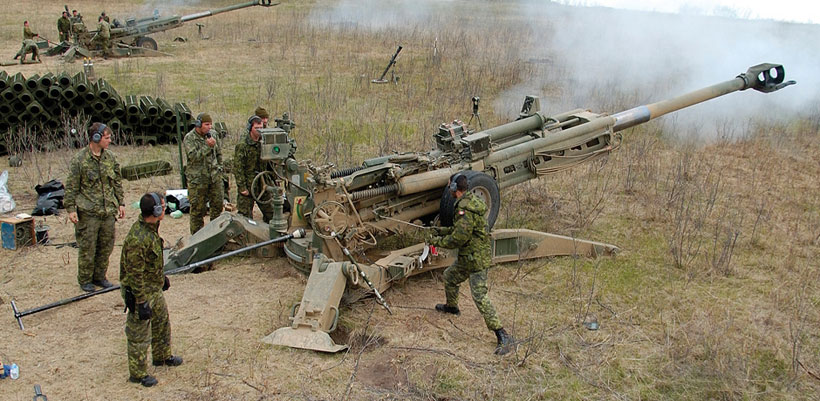
Image credit: Government of Canada
A Triple Helix publication

by Dr. Alexander Salt
August 2025
- Introduction
- Recent Canadian Army Modernization Efforts
- South Korea
- Europe
- Forging the Future of Canadian Land Power
- About the Author
- Canadian Global Affairs Institute
Introduction
Currently, the Canadian Armed Forces (CAF) is in the process of modernizing its various services, the Royal Canadian Navy (RCN), the Royal Canadian Air Force (RCAF), and the Canadian Army, to better respond to current and future threats. In recent years, much of the public attention has focused on high-profile efforts such as NORAD Modernization, acquisitions such as F-35 fighter jets for the RCAF, or the new Canadian Surface Combatant vessels for the RCN. However, there has been relatively little public conversation about the future of the Army’s force structure and equipment needs.
This effort is becoming more urgent due to evolving geopolitical dynamics, particularly the unpredictability of the United States under President Donald Trump’s second administration. President Trump has made a series of highly disruptive decisions and public statements, including NATO criticism and pursuit of a global trade war, sending shockwaves across many of its closest military allies. In response to such rhetoric, some members of the Canadian defence community have argued that Canada may be putting itself at risk by relying too heavily on procuring military equipment from U.S. suppliers.
While some solutions can and likely should be secured using domestic industry, the reality is that not all equipment can be sourced within Canada, especially in the shorter term. As such, international contractors may play an important role in supporting aspects of the Army’s modernization, either by partnering with Canadian firms, or by helping fill gaps where domestic capacity is limited or is still developing. To that end, this article surveys a selection of potential South Korean and European industry partners that could play a greater role in Canadian defence procurement. These partners offer competitive, interoperable platforms for both legacy equipment as well as emerging technological needs. Engaging with these international companies does not preclude building up Canada’s domestic capacity over time; rather, it reflects the urgency of the Army’s requirements and the practical need to draw on external resources where appropriate. By building a more resilient and diversified supplier base, Canada can better align its defence posture while hedging against political and economic uncertainties.
Recent Canadian Army Modernization Efforts
Ongoing geopolitical trends have reinforced the urgent need for accelerated modernization of the Canadian Army. Russia’s unprovoked invasion of Ukraine in 2022 sparked the largest land-based conflict in Europe since the Second World War, resulting in mass casualties and the destruction of thousands of tons of military equipment. The character of the Ukraine-Russia War has continuously evolved, initially starting with maneuvers from Russian armoured columns, then shifting to a war of attrition across frontlines that at times has stretched over 1,000 kilometers. The combat in Ukraine has involved a mix of emerging technologies such as FPV Drones and Artificial Intelligence, which have proven their relevancy on the battlefield at a rapid pace. However, legacy land systems such as mobile howitzers and main battle tanks are also in high demand for the Ukrainian Army. One of the primary lessons learned from this war has been the attritional demands from combat. Ukraine has suffered substantial losses to its older equipment, as well as its Western-supplied replacement platforms. Ammunition expenditure has also spiked for both sides, particularly for artillery shells. This highlights the need for a defence industrial ecosystem, that involves robust domestic supply chains along with international partnerships to continue to supply the Ukrainian Army with the equipment needed to continue the fight.
These trends from the Russian-Ukraine War are also reflected in other global conflicts. For example, during the Red Sea Crisis, the Iranian-backed Houthi movement has launched repeated attacks against international commercial shipping and U.S.-led naval coalition forces. The Houthis have used a variety of mass-produced weapons, including missiles and drones. Their strategy seeks to overwhelm Western naval air defences with the mass use of these munitions. Further, Western strategists increasingly anticipate that any major future conflict in the Indo-Pacific will be highly attritional, requiring significant investment in modernized equipment in mass quantities to ensure an effective response.
The release of the latest defence policy, Our North, Strong and Free, presents some insights into the next steps of the Army’s modernization and equipment priorities. It emphasizes exploring options to potentially upgrade or replace Canada’s current tank and light vehicle fleets, including establishing a light armoured vehicle production program. It commits Canada to acquiring long-range missile capabilities and upgrading its artillery systems. The policy outlines the importance of supply chain resilience and pledges that Canada will build a deeper strategic reserve of munitions. Lastly, the new policy also pledges to acquire new vehicles for operation on ice, snow and tundra conditions.
The government has seemingly been making progress on these equipment acquisitions; this has included releasing a formal Request for Information (RFI) call on 12 March 2025 for its new Indirect Fire Modernization (IFM) programme. The government’s announcement indicates that Canada will procure up to 98 mobile-howitzer systems which will replace the older towed M777 howitzers currently in service. It also includes other equipment such as mortar systems, communication, and fire and control systems. Media coverage indicates that the government is advancing efforts to acquire long-range missile capabilities, with initial reporting suggesting that senior CAF leadership is advocating for the U.S. High Mobility Artillery Rocket System (HIMARS) which has recently seen combat in Ukraine. However, it should be noted that although the HIMARS have demonstrated battlefield success, the Trump Administration’s decision to temporarily freeze Ukraine military assistance restricted their combat effectiveness by depleting access to ammunition. Lastly, in the fall of 2024 Canada signed a new sustainment contract which may keep the current fleet of 103 Leopard 2 Tanks operational until the mid 2030s.
The Canada based contractor that could best support the Canadian Army’s modernization efforts is General Dynamic Land Systems - Canada (GDLS-C) which has been a longstanding industrial partner for the Canadian Army. GDLS-C’s main Canadian focus is the Light Armored Vehicle (LAV) family of platforms. Its most recent variant is the LAV 6.0, which has a highly modular and mission configurable design based around a common chassis and digital architecture. A GDLS PIRANHA chassis equipped with heavier artillery capabilities could make the company a main competitor for the Army’s IFM program.
Prime Minister Mark Carney recently acknowledged Canada's overreliance on U.S. defence suppliers, stating the country “should no longer send three-quarters of our defence capital spending to America.” He linked this shift to the increasingly antagonistic positions taken by President Trump, noting today “the United States is beginning to monetize its hegemony: charging for access to its markets and reducing its relative contributions to our collective security.” Although the current government is undertaking a review, Canada has previously committed to acquiring up to 88 F-35s, and with no viable fifth-generation fighter alternative option, this acquisition appears likely inevitable. Meanwhile, the contract for the new River Class destroyers is already well underway, and although they are constructed by Irving Shipyards, many U.S. defence contractors are heavily embedded within its development. Further, Canada is also currently undergoing discussions about joining the U.S. ‘Golden Dome’, the proposed multi-layered continental missile defence system. Thus, if Canada is serious about diversifying its procurement partnerships and reducing its dependency on U.S. suppliers, it should either bolster domestic capacity or look internationally for new partners.
Overall, Canada has moved in a positive direction in acquiring new platforms for the Army. To that end, Canada will need to identify reliable industry partners which can deliver proven equipment at cost and in a timely manner, while also, when possible, enhancing operational effectiveness via integrating the latest emerging technologies in these new platforms. The following sections of this analysis explore a selection of relevant international defence contractors. It begins by examining several advanced platforms from South Korea, a relatively new partner for Canada in the defence-industrial sector. The discussion then turns to Europe, where Canada can draw from a variety of experienced firms. Should Canada choose to pursue a more internationally balanced procurement strategy, these partners offer credible, politically acceptable, and operationally relevant capabilities for the Canadian Army.
South Korea
South Korea has not been among Canada’s traditional defence partners when it comes to procurement. However, its prominence in the international defence market has been growing rapidly in recent years. As part of this effort, South Korea has launched a significant charm offensive focused on breaking into the Canadian market, featuring official visits to showcase the capabilities of Korean companies across a wide range of military procurements, from submarines to various land systems. The Korean Government has even gone as far as establishing a formal task force to streamline its efforts to promote Korean defence exports into Canada.
One of the largest of these Korean defence firms is Hanwha Aerospace (part of the larger Hanwha conglomerate), which has been expanding its customer base across many of Canada’s military allies, including Australia and several European NATO members. South Korea possesses a thriving defence industrial base with a strong track record of producing high-quality, combat-ready equipment. This capability has been shaped by the country’s unique geopolitical reality where it maintains a de facto state of ongoing sophisticated conflict with North Korea, which maintains a large and capable armed force. Even during periods such as the 1990s, when many Western nations scaled back defence spending following the end of the Cold War, South Korea was compelled to sustain and expand investment in its defence sector. This commitment has resulted in a mature, resilient, and export-ready defence industry.
South Korea and its prominent defence firms such as Hanwha presents an intriguing opportunity for Canada to diversify its defence industrial acquisitions. Hanwha is actively shopping several land-platforms that align with the Canadian Army’s modernization plans. First and foremost is the K9 Thunder mobile howitzer along with the K10 automated munitions carrier which possess a computerized conveyor and loading system to increase automation capabilities and reduce threat exposure to personnel. The K9A1 variant features a tracked mobility system and is equipped to fire standard 155mm projectiles. However, upgraded versions are currently in development to incorporate advanced technologies such as autonomous driving capabilities. In addition, Hanwha is also developing a wheeled variant of the system. The popularity of the K9 has led to the formation of something called the ‘K9 User Club’, where operating states, including several NATO members (Norway, Poland, Finland and Estonia) come together to share lessons learned on their use during operations.
The Australian variant of the K9 can fire standard artillery munitions as well as specialized precision variants while also possessing a semi-automatic loading mechanism that can generate 6-8 rounds per minute of sustained fire capabilities. The Australian K9 is a strong example of how digital modernization can keep traditional legacy platforms such as mobile artillery connected to the digital battlespace. It has been equipped with the Kongsberg digitalized Odin Fire Control System which helps streamline the planning, coordination and launching of live fires as well as integrating sensors and data analysis of target information. The Australian variants of the K9 and K10 are also equipped with digitized Health and Usage Monitoring Systems as well as a suite of Command, Control, Communications, Computers, and Intelligence (C4I) capabilities. Australia acquired the K9 as part of a wider deal with Hanwha that involved contracts for the K9 as well as K10 and the Redback Infantry Fighting Vehicle (IFV). The Redback is described by Hanwha as a “Fifth Generation” land system, possessing an automatic fire suppression system, a suite of onboard digital threat detection systems and logistic trackers. It also includes an overall design architecture that can accommodate future digital system upgrades. As part of the agreement, Hanwha has constructed a joint manufacturing and research and development centre in Australia to produce the fleet of the new vehicles.
Hanwha also produces one of the few international alternatives to the HIMARS system, the K239 Chunmoo Rocket Artillery system, which has recently been sold to Poland and is also being considered by Estonia. As more NATO members acquire the K239, its interoperability into NATO operations will become increasingly streamlined. The K239 offers modular flexibility in munition types, capable of launching tactical ballistic missiles as well as both guided and unguided rockets, unlike the HIMARS, which is limited to U.S.-only approved munitions. In addition, Canada could potentially secure licensing agreements with South Korea to develop or co-produce munitions domestically or in partnership with South Korean firms. This would grant Canada greater sovereign control over its long-range fire capabilities and its related supply chains. In effect, the K239 would allow the Canadian Army to maintain full interoperability with NATO and U.S. forces, while reducing the country’s reliance on U.S. defence suppliers.
South Korea also produces a main battle tank for export, the K2 Black Panther, which is developed by Hyundai Rotem, a subsidiary of the Hyundai Motor Group. Designed in partnership with South Agency for Defense Development, the K2 is currently being exported to Poland as part of massive arms deal. The K2 is armed with a 120mm smoothbore gun and features an autoloader, reducing the required crew to just three, unlike the Leopard 2 and M1 Abrams MBTs, both of which require four crew members. It is also lighter and faster than its Western counterparts. Additionally, it is equipped with a modernized fire control system that includes thermal imaging.
Beyond updated legacy platforms such as artillery, South Korean firms like Hanwha are investing heavily into a next generation Unmanned Ground Vehicles (UGVs). South Korea, like other developed countries has faced challenges associated with population decline, therefore uncrewed systems and technology that emphasizes robotics and automation present a strategic offset to potential shortages in military personnel and recruitment. For example, Hanwha’s Arion-SMET is its baseline UGV and has recently successfully participated in the U.S. Foreign Comparative Testing program to evaluate its capabilities under Indo-Pacific conditions. The Arion-SMET is a compact, modular UGV roughly the size of a small commercial all-terrain vehicle. While its dimensions can vary depending on modular configuration, it typically measures between 2 and 2.5 meters in length and can carry payloads of up to 550 kg. The baseline model features a wheeled chassis capable of reaching speeds up to 40 km per hour. Designed for versatility, the Arion-SMET can transport ammunition, medical supplies, or, thanks to its modularity, be configured as a kinetic weapons platform. As the CAF begins to integrate uncrewed systems into its force structures it should consider a full range of international options.
Overall, as Canada seeks to enhance its land combat capabilities, South Korea’s defence offerings provide a compelling mix of technological innovation, proven track record, and potential for industrial and technological collaboration. Further, Canada stands to benefit from the early adoption of South Korean systems by European NATO allies such as Poland, Estonia, and Norway, which helps validate the equipment’s performance, interoperability, and logistical integration across Canada’s military partnerships. This growing user base also offers Canada opportunities to draw on shared lessons in operations, training, and maintenance.
Europe
Canadian Prime Minister Mark Carney’s first international trip, just days after taking office, was to Europe, where he sought to strengthen ties in response to President Trump’s hostile rhetoric and escalating trade war. Clearly, Canada views Europe as a crucial ally amid shifting global geopolitics. As part of this strengthening partnership, King Charles III announced in May 2025’s Throne Speech that Canada would formally join ReArm Europe. This military-industrial investment agreement with the European Union will enable Canada to manufacture various European military equipment in Canada and integrate partnerships with European defence contractors. There are a number of European defence firms which may be able to assist Canada’s Army modernization needs.
Among potential partners, Germany’s largest defence contractor, Rheinmetall, offers a range of land systems that could support Canada’s Army modernization. For example, the KF41 Lynx, is an IFV that has seen heavy combat in Ukraine. Kyiv is currently exploring options for manufacturing it domestically. The Lynx has a full suite of digital systems and has been designed with open architecture to allow for gradual upgrading. Rheinmetall also produces a wheeled self-propelled howitzer, which has a digitally controlled ammunition handling system and a fully automatic turret; overall the increased automation of this howitzer allows it to be operated by a crew of only two. Rheinmetall also produces a number of UGVs, most prominently the Mission Master series designed for a variety of functions from fire support to medical support.
KNDS produces several vehicles that may be of interest to Canada. KNDS’ RCH 155 Remote Controlled Howitzer has autonomy functionality with its onboard digital systems including both navigation and fire control; further, it also maintains the ability to shoot at moving targets. KNDS along with Rheinmetall also produces the Panzerhaubitze 2000, which fires standard 155mm projectiles at a sustained rate of 10 rounds per minute as well as being capable of firing 3 round bursts. The Panzerhaubitze gained combat experience in Afghanistan and possesses advanced integrated fire control computer and internal GPS navigation system.
Several of KNDS’ BOXER RCT30 IFVs have been deployed to fight in Ukraine. Interestingly, these variants have been equipped with anti-air systems and have been tasked with combating Russian drones while protecting forward deployed forces. KNDS has also recently debut a new UGV, the CENTURIO-X30 designed to provide fire support for infantry.
Although German firms are among the larger exporters of land systems in Europe, other European countries have potential offerings for Canada. These firms increasingly operate through multilateral partnerships, reflecting the interconnected nature of European defence production. Such integration provides Canada with a range of collaborative opportunities when considering future modernization of its Army equipment.
Sweden’s BAE Systems Bofors (A subsidiary of the United Kingdom’s BAE Systems) has developed the Archer mobile howitzer, which is a wheeled system with autoloading capabilities to keep crew sizes down to just 3 personnel. It fires 155mm projectiles at up to a rate of 8 rounds per minute. Furthermore, the Archer’s autonomous operation firing system allows the crew to fire its payload under armored protection. BAE Systems also produces the CV90 IFV, which is in operation with several NATO members. The updated CV90 maintains internal digital sensors for tracking vehicle maintenance and has modular architecture so it is easily upgradable with newer technology.
KNDS France (formerly Nexter Systems) has produced the CAESAR truck-mounted 155mm mobile howitzer system. It fires at a rate of 6 rounds per minute and can travel up to 42km per hour. The CAESAR is interoperable with NATO digital artillery networks and operates with a fully computerized fire control system.
As Canada seeks to modernize its Army and reduce overreliance on U.S. defence suppliers, European defence contractors offer a compelling and diverse range of technologically advanced land systems. With Canada's formal entry into the ReArm Europe agreement, the groundwork has been laid for deeper industrial and strategic cooperation. Europe’s defence contractors all bring proven capabilities, from mobile howitzers, IFVs and UGVs that align with Canadian operational needs and modernization goals while also comfortably meeting NATO interoperability standards.
Forging the Future of Canadian Land Power
Given the growing instability of Canada-U.S. relations, Canada likely needs to consider diversifying its industry partners as it continues to modernize the CAF. The Canadian Army needs to accelerate its modernization efforts, and a number of South Korean and European companies will be relevant choices moving forward given they offer a strong variety of highly capable equipment. By forming new relationships, it will protect the Canadian defence industrial base from wider shocks to international supply chains, something that is particularly valuable given current global economic uncertainty. If an international partner is selected for the next generation of land systems, the government should follow Australia’s example with Hanwha by requiring the construction of a domestic manufacturing and research and development facility in Canada. This would allow for greater control over the supply chain and for enhanced research opportunities for the wider defence industrial base.
Both South Korea and Europe offer unique additional advantages aside from the high quality of their equipment. Canada has identified the Indo-Pacific as a key strategic focus in the coming decades as outlined in the Indo-Pacific Strategy; deepening defence ties with a major Asian state like South Korea would go a long way in helping Canada achieve its wider goals in the region. On the other hand, Europe has longstanding ties with Canadian defence and most European defence contractors are based in NATO states. As such, any defence industrial agreement will be fairly smooth to negotiate due to shared security commitments, regulatory alignment, interoperability prioritization, and existing established frameworks for defence cooperation.
Furthermore, Canada should look to springboard any major land systems procurement into a wider opportunity to engage in technological research and development sharing. Other countries such as the U.K. and Japan have been using opportunities such as their new joint fighter project to do just that.
The next generation of South Korean and European land systems have been upgraded to varying degrees with emerging technological capabilities, keeping traditional legacy systems relevant for the connected battle space. The Canadian Army should also strongly consider investing in the new generation of UGVs. Combat in Ukraine has demonstrated a growing need for uncrewed land systems on the frontlines. Robotics will continue to play a growing role in modern warfare, Canada simply cannot afford to dither too long on deciding if and when to acquire uncrewed land systems. Moving forward purchasing a fleet of UGVs as part of the wider Canadian Army modernization efforts will place the CAF at the forefront of military technological advancement and would give the Army ample time and space to update doctrine and operational approaches accordingly prior to the next major deployment. Failing to do so, will mean the Army will be left behind many of its core allies, and forced to rapidly play catchup later.
About the Author
Dr. Alexander Salt has a PhD from the University of Calgary’s Centre for Military, Security and Strategic Studies and an MA in Political Studies from the University of Manitoba. His dissertation explores to what extent has the battlefield experience of the U.S. military influenced post-war organizational innovation. His research has been awarded the Social Sciences and Humanities Research Council of Canada’s Joseph-Armand Bombardier Doctoral Award, as well as a General Lemuel C. Shepherd, Jr. Memorial Dissertation Fellowship. He has published research relating to international security and defence policy with Strategic Studies Quarterly, Journal of Military and Strategic Studies, Canadian Foreign Policy Journal, and The Canadian Network for Research on Terrorism, Security, and Society. Previously, he was a Visiting Political Science Instructor with Macalester College and has also held positions with the Centre for Defence and Security Studies, as well as the Consulate General of Canada in Dallas, Texas, and the Consulate General of Canada in Minneapolis, Minnesota.
Canadian Global Affairs Institute
The Canadian Global Affairs Institute focuses on the entire range of Canada’s international relations in all its forms including trade investment and international capacity building. Successor to the Canadian Defence and Foreign Affairs Institute (CDFAI, which was established in 2001), the Institute works to inform Canadians about the importance of having a respected and influential voice in those parts of the globe where Canada has significant interests due to trade and investment, origins of Canada’s population, geographic security (and especially security of North America in conjunction with the United States), social development, or the peace and freedom of allied nations. The Institute aims to demonstrate to Canadians the importance of comprehensive foreign, defence and trade policies which both express our values and represent our interests.
The Institute was created to bridge the gap between what Canadians need to know about Canadian international activities and what they do know. Historically Canadians have tended to look abroad out of a search for markets because Canada depends heavily on foreign trade. In the modern post Cold War world, however, global security and stability have become the bedrocks of global commerce and the free movement of people, goods and ideas across international boundaries. Canada has striven to open the world since the 1930s and was a driving factor behind the adoption of the main structures which underpin globalization such as the International Monetary Fund, the World Bank, the World Trade Organization and emerging free trade networks connecting dozens of international economies. The Canadian Global Affairs Institute recognizes Canada’s contribution to a globalized world and aims to inform Canadians about Canada’s role in that process and the connection between globalization and security.
In all its activities the Institute is a charitable, non-partisan, non-advocacy organization that provides a platform for a variety of viewpoints. It is supported financially by the contributions of individuals, foundations, and corporations. Conclusions or opinions expressed in Institute publications and programs are those of the author(s) and do not necessarily reflect the views of Institute staff, fellows, directors, advisors or any individuals or organizations that provide financial support to, or collaborate with, the Institute.


Showing 1 reaction