
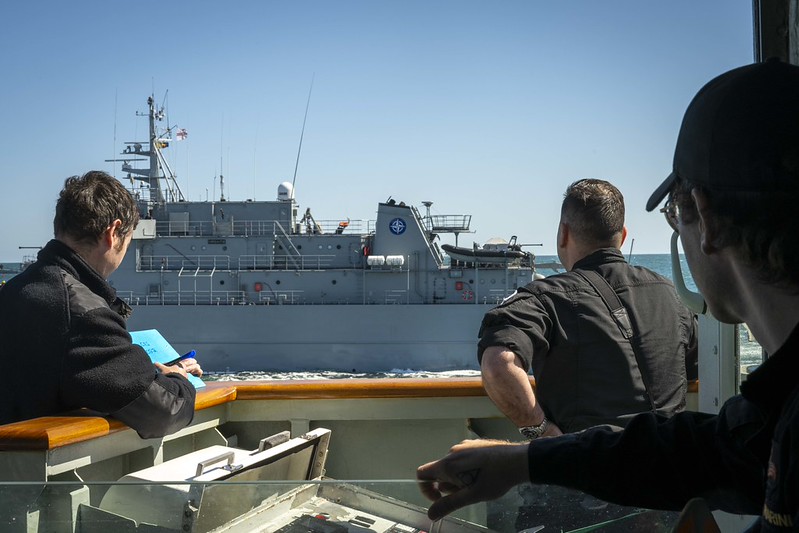
Canadian Armed Forces, Combat Camera
A Triple Helix publication

by Dr. Lilit Klein
January 2026
Table of Contents
- Introduction
- ITAR
- The Challenge of Risking the Special Relationship
- The Challenge of Interoperability
- The Challenge of Limited Ability to Share capabilities and technology
- Conclusion
- Recommendations
- About the Author
- Canadian Global Affairs Institute
Introduction
On June 23, 2025, Canada and the European Union (EU) signed the Security and Defence Partnership (SDP), significantly deepening their security and defence relationship. This marks an important step towards security alliance diversification for Canada, as it actively seeks to decrease its dependence on the United States (U.S.). This diversification to other partnerships beyond the U.S. poses challenges, particularly when heavily involving the defence industry. Traditionally, Canada has been most closely aligned and partnered with the U.S., with which it shares “the most integrated defence supply chain in the world”. Resultantly, the Canadian Armed Forces (CAF) have long focused on interoperability with the U.S. military over other allies. This article explores how an American regulation, the International Traffic in Arms Regulations (ITAR), unintentionally creates a bureaucratic hurdle that affects Canada’s ability to diversify. Though ITAR is not a foreign policy tool the U.S. presently wields to ensure Canadian dependency, the special relationship manifested in ITAR’s Canadian exemption (§126.5) inextricably links the two countries’ defence industries in such a way as to impede Canada’s ability to build security alliances with other states. The special relationship with the U.S. remains a bedrock of the Canadian defence sector, but now poses a conundrum for Canada. It is therefore time to reexamine ITAR’s Canadian exemption in light of the SDP. This article considers three potential challenges that Canada faces: first, that the special relationship enshrined in ITAR is too difficult to risk; second, the issue of interoperability between American and Canadian forces; and third, ITAR’s impact on Canada’s ability to share and invest in capabilities with other allies.
This paper argues that ITAR impacts Canadian security cooperation with Europe in three ways. First, the effect of ITAR on Canadian cooperation with the EU stems not merely from its export control mechanisms, but from the underlying assumptions embedded within the Canadian exemption which codified the special relationship premised on an exclusive U.S.-Canada defence industry alignment, rendering any other partnerships inherently secondary and structurally disadvantaged. This institutionalized interdependence has created a deeply integrated supply chain that may unintentionally constrain Canada’s strategic flexibility. Consequently, the Canadian defence industry faces the challenge of sufficiently disentangling its capabilities from U.S. export controls to fully capitalize on partnerships without American participation.
Second, the Canadian exemption in ITAR has facilitated deep military interoperability with U.S. systems and capabilities, creating an operational dependency that may impede the speed at which the CAF can meaningfully pivot to new partners. This ITAR-enabled integrated supply chain means that Canadian forces have become accustomed to seamless cooperation with their American military counterparts, and from that their platforms, weapons and sensors, at the expense of other potential partners.
Third, ITAR directly constrains Canada’s ability to share defence technology and developments with European partners, as many Canadian capabilities fall under ITAR restrictions through either physical supply chain integration or digital data dependencies. However, this paper will examine emerging technologies as a potentially promising avenue for Canada’s defence industry to diversify and build capabilities independent of the U.S. defence sector, thereby creating new opportunities for European collaboration. Emerging technologies, championed primarily by civilian companies, exist largely outside the U.S.-integrated defence industrial base. This sector thus offers a rare landscape where Canadian innovation flourishes independently of American capabilities.
The European Union is not a new alliance partner for Canada; the two parties share a rich cooperative history. The Strategic and Defence Partnership builds on earlier European-Canadian cooperation, including the 2016 Strategic Partnership Agreement and the 2004 EU-Canada Partnership Agenda. Furthermore, both SDP parties have cooperated through the Comprehensive Economic and Trade Agreement since 2017 and Canada has contributed militarily both through the EU Common Security and Defence Policy (CSDP) since 2003 and the Permanent Structured Cooperation (PESCO) since 2021. The challenge now, however, as remarked by Ursula von der Leyen, is “to go to the next level, to step up the intensity of our partnership”.
As part of the SDP, Canada agreed to collaborate on defence procurement through Readiness 2030 (formerly known as ReArm Europe) as well as participating in Security Action for Europe (SAFE).[1] The two are interlinked; SAFE is Readiness 2030’s first pillar. Canadian companies will participate in Readiness 2030, while SAFE will help the Canadian government procure military equipment. This is important for Canada for three reasons highlighted by Jacob Tucker and Alexander Lanoszka. First, securing access to these financial resources – Readiness 2030 unlocks 800 billion Euros for EU member states’ defence procurement – could enable Canada to boost its defence budget; second, the funding may help invigorate Canada’s underfunded defence sector and; third, engagement with the EU is in line with Prime Minister Mark Carney’s declared objective of broadening Canada’s security alliances and reducing reliance on the United States. On the surface level, the SDP appears to offer Canada a unique opportunity to achieve its strategic objectives. However, ITAR complicates Canada’s ability to fully contribute to Readiness 2030 and SAFE. In what ways may ITAR challenge, or even impede Canada’s ability to fulfill its side of the agreement with the EU?
Canada’s defence partnership with the EU raises fundamental questions about the sustainability of its ITAR exemption, which was designed in an era of a special relationship of defence cooperation between Canada and the U.S. The ITAR framework is borne out of this special relationship which elevated the U.S.-Canada alliance above all others, making it difficult to reconcile with Canada’s contemporary attempt at diversifying its defence partnerships beyond the U.S. This creates an underlying conundrum where the integrated supply chain benefits that have historically strengthened U.S.-Canada relations may be incompatible with Canada’s pursuit of additional “special relationships” with other parties.
[1] On December 1, 2025 the Canadian government announced that negotiations for SAFE participation had concluded, “unlocking billions of dollars in potential defence opportunities for Canadian businesses”.
ITAR
ITAR is a U.S. government regulation – specifically a 1976 Department of State regulation – managing U.S. persons, organizations, and entities that export United States Munitions List (USML) defence articles or related services (including technical data) in the name of national security. ITAR aims to prevent proliferation of U.S. military technology, as John Schaus and Elizabeth Hoffman underscore “to actors who may pose a threat to the United States”. Rather than serving as a foreign policy tool, ITAR functions as a U.S. government regulation governing its own industry. The U.S. State Department relies on self-reporting and monitoring through Enterprise Resource Planning (ERP) software and the Blue Lantern Program, with U.S. customs serving as chief enforcer. When violations occur, penalties are imposed directly on the offending corporation or individual. Re/export or retransfer is handled either by the original American exporter, or the U.S. Directorate of Defense Trade Controls.
ITAR impacts Canada due to the Canadian Exemption, reflected in the Code of Federal Regulations Title 22 Paragraph 126.5. Canada’s special treatment originated in 1954 when 22 CFR sec. 76.36 specified that U.S. exports to Canada do not require licensing approvals. Canadian exemptions to U.S. regulations are thus historically enshrined and even predate ITAR. In the past, Canada benefited substantially from this arrangement. Despite the additional regulatory hurdles, Kristina Obecny and co-authors contend that industry representatives approach ITAR regulations as an “accepted part of the business” and a bureaucratic challenge rather than an obstacle to cooperation. However, with the shift in geopolitics and Canada now diversifying to other partnerships, the cost-benefit analysis on Canada’s ITAR exemption as well as its reliance on the U.S.’s defence industry m.t be reconsidered.
Although it now appears commonplace to assume that the Canadian exemption to ITAR is assured, there is precedent proving the opposite which signals that it might not be guaranteed in the future either. On April 12, 1999 the State Department revoked Canada’s ITAR exemption; Canada would not regain it until May 30, 2001. A 2002 U.S. General Accounting Office report recounts that this occurred because unauthorized exports to nations of concern had occurred, detailing three diversions and sixteen attempted diversions. To remedy this situation, Canada adjusted its export control laws and regulations to include all the same items on the USML and established the Controlled Goods Program; a registration and compliance program to regulate its access to controlled goods and technologies. This regulatory response constitutes a quasi-form of self-monitoring as the same categorizations now apply within Canada as in the United States. Paul Esau argues that this represented “effectively indigenizing U.S. laws by enforcing Canadian companies’ compliance with the ITAR” (18), a process that Ottawa later reinforced with the 2011 Enhanced Security Strategy. This historical precedent demonstrates that losing its ITAR exemption would be very serious for the Canadian defence industry and that the Government of Canada will consider drastic measures to retain its exemption.
As much as ITAR may be an imposition on Canada, it is (perhaps even more so) one for the United States. ITAR’s criticism is mainly internal. First, the Potomac Institute highlights that ITAR is both counterproductive to the flow of information among allies and partners, and superfluous because alternative regulatory frameworks that safeguard sensitive information already exist. Second, ITAR also is a major impediment to the speed of deployment within alliances and has hindered countries in coming to Ukraine’s aid in a swift manner, for instance. Third, ITAR has been cited as an impediment to AUKUS and a general burden to alliances. While one must differentiate the SDP (which does not include the U.S.) from AUKUS (which includes the U.S. but not Canada), these mounting criticisms and limitations of ITAR from within the U.S. suggest that the regulatory framework may be ripe for reconsideration from within, which creates an opportune moment for Canada to reassess its own relationship with the export regulation.
The Challenge of Risking the Special Relationship
The Government of Canada recognizes the United States as “Canada’s largest trading partner for its [defence] industry” noting also that the two countries share “the most integrated defence supply chain in the world.” The special relationship between Canada and the United States is grounded in the Canadian exemption to ITAR, which the American government argues is rooted in “the unique geographic relationship and strong economic trading partnership” as well as “a mutual interest in the defence of North America.” The special relationship gives rise to several questions. First, does the SDP itself risk that special relationship and how will the latter impact Canada’s cooperation with the EU? And second, has the special relationship already eroded and if so, what would that mean for Canada?
The Canadian exemption to ITAR indirectly embeds assumptions of prioritized U.S.-Canada defence alignment. Canada’s broadening of defence allies is therefore inherently risky because diversification challenges the prioritized relationship the ITAR exemption assumes will remain constant. This creates a strategic dilemma because Canada benefits from the special relationship with the United States. The most prominent example of this is the 1958 NORAD agreement, which ensures American defence of Canadian air space. Can NORAD survive without ITAR? Views differ. The Canadian-American special relationship has proven beneficial for both parties and led to a highly integrated supply chain in addition to the special bureaucratic relationship (such as the ITAR exemption). This special relationship has long-standing roots and was notably reinforced by the 1956 Defence Production Sharing Agreement and more recently, USMCA. The U.S. has something to offer to Canada that Europe simply cannot replace and that goes beyond military and industrial power alone – the unique ability to quickly come to Canada’s aid due to geographic proximity. Having a special relationship with a democratic superpower comes with the benefit of unexpendable protection. However, this very dependence illustrates how ITAR constrains Canadian strategic options. The tangible benefits of the special relationship come at the cost of the flexibility to pursue partnerships that may serve Canada’s evolving national, economic, and defence interests.
Precisely why Canada is diversifying its security partnerships becomes more important to this account, given the tradeoffs. In June 2025, Carney argued that Canada had become too reliant on the U.S. and that “we should no longer send three-quarters of our defence capital spending to America.” The Prime Minister further commentedthat “the old relationship we had with the United States, based on the deep integration of our economies and close cooperation on security and defence, is over.”[1] The “trade war”[2] has damaged this relationship significantly. Dani Belo and Joshua Hayes note that despite uncertainty regarding whether tariffs will be implemented, the situation will negatively impact cooperation in the long-term, which will be especially problematic for the critical mineral supply chain. And Canada has already started pursuing Europe as a partner for this supply chain. Canada’s military exports to countries other than the U.S. are increasing; in 2024, 70% of permits were issued to Europe.
Despite its disillusionment with the current U.S. administration, Canada is clearly not interested in losing its main ally. This appears to be more a potential diffusion of alliances away from heavy dependence on one. Intensifying defence cooperation, especially procurement, with Europe does not constitute a pivot away from the U.S. as much as it is a diversification, suggested by Canada’s plans to purchase F-35s.[3] The decision on the purchase of additional F-35 fighter jets beyond the sixteen Canada is committed to is considered by some experts as Ottawa’s pivotal strategic question.[4] Furthermore, Canada requested twenty-six M142 High Mobility Artillery Rocket systems from the U.S., another high-ticket purchase at $2.4 billion.
A key challenge for Canada’s investments in European force development, therefore, is how to balance Ottawa’s diversification objectives with assuaging its American partner, so as to preserve the special relationship and a heavily integrated supply chain. It is reasonable to assume that Canada might have to provide the U.S. additional assurances to ensure that this special relationship is not damaged, and that its ITAR exemption will not extend the special relationship to other parties. Notably, Canada is diversifying to the EU, and most EU member states are part of NATO and thus are also treaty allies of the United States. Canada is not diversifying towards a challenger of the American-led rules-based international order and Canada’s cooperation with Europe might actually benefit the U.S. in the long run, too, because it assists in allies’ burden-sharing with the U.S., long a complaint of both Democratic as well as Republican administrations. However, ITAR’s Canadian exemption does not recognize this nuance: it fails to distinguish between exports to fellow allies versus and exports to potential adversaries.
It is crucial to reflect on how the SDP might impact Canada’s relationship with the U.S., and potentially its ITAR exemption. On the one hand, as the Senate of Canada maintained in 2018, requiring export permits to the U.S. (translating to the end of the ITAR exemption) would “erode” Canada’s defence industry and increase its dependence on the U.S. On the other hand, the special relationship may have changed with lasting consequences, and “the current geopolitical situation demands that Canada be equipped with sovereign defence capabilities”. It is time to ask whether ITAR is an artifact of its historical context, and no longer as beneficial as it once was. The Canadian exemption in ITAR presupposes a continued special relationship between these two North American powers that elevated its alliance above others and that, thus, it is difficult to reconcile with a changing relationship between the two powers.
The ITAR exemption shapes supply chain integration that constrains strategic flexibility. Canada’s defence industry thus might face disentanglement challenges to benefit from non-U.S. partnerships, which will be discussed in the next two sections. Admittedly, the SDP is rather young and the bilateral agreement around SAFE has just been reached in December 2025 and so its effects on the special relationship remain unclear. Two avenues to watch is whether the U.S. will, first, react negatively to Canada establishing another special relationship in the defence sector and whether it will consider that mutually exclusive to its own; and second, whether the U.S. will continue to trust Canada to self-monitor potential ITAR breaches (through its Controlled Goods Program) once it starts exporting more heavily through the SDP. This sheds light on the fundamental underlying conundrum of co-dependency: the Canadian exemption (and the integrated supply chain on a whole) was designed in such a manner as to suggest that neither party foresaw a future in which a defence partnership might include the supply chain of partner, the U.S., but not the other, Canada.
[1] The recent release of the U.S. National Security Strategy appears to underscore this shift, with Canada’s former NATO ambassador Kerry Buck subsequently recommending that the federal government accelerate deepening defence cooperation and anchor it in NATO.
[2] “Trade war” is a disputed term; while Canada has commonly referred to the situation as such, the U.S. has disputed this characterization.
[3] It is important to note that Carney initiated a review of the F-35 purchase in Spring 2025, however, by December 1, 2025, no firm decision has been made.
[4] Peter Jones. September 17, 2025. “Buying the F-35 Could be Canada’s Biggest Strategic Mistake”, The Walrus. https://thewalrus.ca/buying-the-f-35-could-be-canadas-biggest-strategic-mistake/.
The Challenge of Interoperability
The Canadian exemption in ITAR facilitates deep military interoperability primarily with American systems, leading to operational dependencies on the U.S. that may impede the CAF’s ability to pivot equally to other military alliance partners. Danford Middlemiss and Denis Stairs highlight that interoperability with the U.S. has always been prioritized over that with other partners. Canada’s ITAR exemption indirectly may have encouraged the CAF to prioritize interoperability with the U.S. over other potential partners – a logical outcome when export controls rendered U.S. systems more accessible and when combined operations were the norm. One might reasonably question whether Canada-EU interoperability will truly prove difficult to achieve, given that virtually all EU members are themselves U.S. allies who have attempted to pursue interoperability with American systems as well. However, this paper points to three challenges which highlight how interoperability may be a concern for the SDP. First, interoperability within NATO has remained a challenge. Second, the CAF is likely more interoperable with U.S. forces due to NORAD with its binational command structure, and third, CAF has struggled with interoperability in general, even with the U.S.
NATO very narrowly defines interoperability as “the ability for allies to act together coherently, effectively and efficiently to achieve tactical, operational and strategic objectives.” Ostensibly, CAF and EU members’ militaries should be interoperable based on NATO’s Standardization Agreements (STANAGs) and the Connected Forces Initiative (CFI) which aim to ensure that equipment and logistics are mutually compatible. However, this narrow focus means that NATO membership alone does not address the practical interoperability barriers beyond technical compatibility. Critically, countries can share identical weapons systems and adhere to commons standards yet still face barriers to working together effectively. Indeed, STANAGs have achieved notable technical interoperability among NATO members, establishing common calibers for munitions as well as other shared procurement standards that have facilitated material compatibility across allied forces. This technical foundation has proven robust enough that non-NATO EU members often procure NATO-standardized equipment to maintain compatibility, as evinced by the seamless and swift integration of Finland and Sweden into NATO structures.
Yet, the paradox is striking – despite shared NATO membership among Canada, the U.S., and many EU nations, and despite the baseline of technical standardization, genuine interoperability remains elusive compounded by the absence of effective metrics to even assess progress. Whereas interoperability among NATO allies remains a stated priority, the gap between policy commitment and operational reality suggests that implementation has remained somewhat of a perennial goal. Additionally, Canada has begun investing in interoperability with Europe, such as through Formation Europe (FE) which serves as a coordination hub for CAF and NATO, providing procedural assistance necessary for CAF personnel to participate effectively in international collaborative settings. Another interoperability challenge in the future is that there is not one united European Union military, but rather different 27 EU member states’ forces, most but not all of which are NATO members as well. EU members, too, struggle with interoperability with one another. Thus, some EU countries might be able to achieve more interoperability with Canada than others.
Both the 2017 defence policy Strong, Secure, Engaged and the updated 2024 Our North, Strong and Free highlight interoperability as a central focus in Canada’s planning process and capability enhancement efforts to facilitate smooth coordination with allies such as NATO or the Five Eyes (FVEY) nations. The 2023 Digital Campaign Planlikewise focuses on interoperability, particularly with the U.S., FVEY countries, and NATO. Interoperability’s salience is increasing with the reemergence of great power challenge, as Alexander Salt argues. The SDP speaks to Canada and the EU’s alignment on the current state of the international order, as well as great power competition, and other significant international crises which demand multilateral response. The partnership is built on both a perception of a changing international environment and shared values and norms between the two parties. Though the United States has long served as Canada’s primary ally and security guarantor, Canada is now increasingly diversifying its strategic partnerships, both towards Europe through the SDP, and perhaps also with Asian partnersin the near future.
Interoperability is significant to the cooperation foreseen in the SDP. The SDP represents a fundamentally different level of partnership from Canada’s previous military collaborations with Europe. While Canada and the EU member states have cooperated successfully in the past, these engagements relied on procedural coordination. The SDP, however, envisions mutual investment in each other’s defence industries, with Readiness 2030 and SAFE both encouraging European procurement of Canadian capabilities and vice versa. The SDP strives toward new levels of defence industrial enmeshment beyond what was needed for traditional coalition operations. Will Europeans hesitate to invest in Canadian capabilities that are tied up with ITAR restrictions and require U.S. backing for full operability?
Canada and the U.S.’s interoperability is shaped not only by ITAR and the integrated supply chain, but also through close cooperation through NORAD and the special relationship discussed in the previous section. In contrast to NATO’s narrow definition of interoperability as procedural coordination, the U.S. and Canada have achieved a deeper level of technical and equipment compatibility, facilitated by their special relationship and Canada’s ITAR exemption. In this changing international environment, Salt notes, one of the dangers of remaining overly reliant on interoperability with the U.S. is that it may grow hesitant to share, even with Canada, access to its digital infrastructure.
Digital capabilities present a particularly acute challenge for Canadian military autonomy that extends beyond the physical supply chain. Recent government data reveals the extent of this dependency. In September 2025, only months after the nadir in Canadian-American relations, Ottawa spent $1.3 billion on cloud services provided by U.S. companies, including for mission-critical defence applications such as for aircraft coordination and maintenance. Canadian digital capabilities often rely on U.S. software, maintenance, and data sharing that fall under ITAR restrictions. This means that the CAF are currently still heavily reliant on the U.S. in that domain. To fully capitalize on the SDP, Canada needs to modernize its digital infrastructure by achieving greater independence from ITAR-restricted U.S. systems – a challenge that becomes even more critical as emerging technology, with specific interoperability concerns, often rely on digital interoperability.
Notably, the CAF have struggled with interoperability, even with the U.S. and resultantly this issue has been a prominent topic in the major defence strategy publications of the past few years. If Canada struggles with interoperability despite ITAR-facilitated integration and decades of close cooperation with the U.S., CAF may – particularly in its current budgetary condition – face challenges achieving interoperability with European partners who lack a similar structural advantage.
The Challenge of Limited Ability to Share capabilities and technology
Procurement is top of policymakers’ minds in Canada, where the Liberal government recently launched the Defence Investment Agency (DIA) which, inter alia, focuses on “build[ing] sovereign capabilities” and cooperation with allies. ITAR directly limits Canada’s ability to share defence technology with European partners, creating the export dilemma that the Honorable Perrin Beatty and his co-authors describe:
[ITAR] severely constrain Canadian firms’ ability to pivot to EU markets. ITAR’s ‘Canadian exemption’ (Paragraph 126.5) permits limited technology transfer to Canada but explicitly blocks re-exports to third countries like EU members… creating somewhat of a catch-22: Canadian firms risk U.S. sanctions if they prioritize EU partnerships but lose competitiveness if they maintain the status quo (8).
Due to both the integrated supply chain and related ITAR restrictions, much of Canadian defence technology and capabilities are not under simply Canadian, but also U.S. regulations.
While emerging technologies represent a promising avenue for independence, they currently face significant ITAR challenges. ITAR has been scrambling to regulate emerging technology at the speed with which new technology is being developed and used. In a time of uncertainty about the classification of emerging technologies, ITAR has tended towards over-restriction. This chokes both American and Canadian defence innovation. Dual-use capabilities are a subsection of emerging technologies that have faced exceptional challenges under ITAR, as Peter Jenkins stresses, adding that the inclusion of even one minor restricted component can subject that entire product to the export controls, meaning that companies must effectively develop separate regulatory pathways for restricted and unrestricted activities to maintain compliance when selling to third country markets. Emerging technologies therefore face quite a battle – one that is particularly difficult for smaller companies with limited legal budgets and regulatory expertise. Unlike more established defence contractors, emerging technology companies, which are often start-ups, may be forced to divert scarce resources away from innovation to navigate these complex export control frameworks, potentially hiring specialized legal counsel to determine precisely which components trigger ITAR restrictions.
Still, emerging technologies, particularly those developed by civilian companies, offer Canada its best opportunity to build ITAR-independent capabilities. Perrin Beatty and his co-authors recommend Canada build sovereign capabilities that lessen ITAR constraints, particularly in AI and space technologies. Similarly, Lieutenant-Colonel Karen Motambault reasons that Canada’s ongoing challenges with ITAR regulations highlight the importance of cultivating Canada’s high-tech sector which will enhance Canada’s autonomy while reducing vulnerability to ITAR. One advantage of emerging technologies, and the majority of the dual-use sector, in this day and age, is that civilian technology companies drive defence innovation. While the centrality of civilian companies may pose a challenge for funding, it may work in favor of circumventing ITAR, as these capabilities are not developed for military use originally. Additionally, the Canadian dual-use market is one of significant potential, and Canadian companies are keen to attract investment that the SDP is set up to bring. At a recent regional marine industry event, companies ranging from small businesses to the Canadian aviation giant CAE Inc. all highlighted their commitment to Canadian sovereignty. Civilian technology is also less likely to be dependent on the integrated defence supply chain and thus may develop capabilities that are fully Made-in-Canada. Civilian companies developing dual-use technology might therefore be promisingly at the heart of future Canadian-European security cooperation.
Conclusion
This paper highlights ways in which Canada’s ITAR exemption may likely impact Canada’s cooperation with the EU through three interconnected challenges: embedded assumptions of prioritized U.S.-Canada defence alignment that constrain Canada’s strategic flexibility; operational dependencies as the CAF has become accustomed to cooperation with the American military; and direct restrictions on Canada’s ability to share defence technology with the EU. These challenges may create obstacles for the SDP’s success. Canada’s contributions to SAFE and Readiness 2030 may be hampered by interoperability limitations that favour U.S. systems, while the SDP’s emphasis on investment in each other’s defence industries presupposes that Canada move away from its unintentional prioritization of the U.S. alliance. Investment in Readiness 2030 might risk straining the special relationship with the U.S., ITAR restrictions may limit Canada’s ability to export capabilities to European allies, and over-classification of emerging technologies could stifle the development of EU-exportable Canadian innovations, potentially driving European defence investment toward markets less constrained by U.S. export controls.
Recommendations
- The SDP is likely only the beginning of Ottawa’s diversification of defence industry cooperation to Europe, as well as to East Asian security partners. Preparing for the inevitable, Canada should therefore assemble an expert panel to (a) examine which of its capabilities are particularly constrained by ITAR and (b) determine which sectors it has the industrial base as well as digital sovereignty to manufacture independently of ITAR-related restrictions. The expert panel should include a multitude of stakeholders and perspectives: industry representatives, industry associations, academics, as well as policymakers to achieve the best possible recommendations.
- Canada should consider its interoperability with the European market before investing in European defence capabilities. Interoperability challenges are not unique to Canada-EU cooperation; European nations face interoperability issues among themselves, and NATO struggles with alliance-wide standardization. Rather than treating Canada-EU interoperability as an isolated concern, Canada and its European partners should launch a multinational study, through NATO, to scrutinize systemic interoperability barriers across the wider Western alliance. This broader approach would benefit all members, as solutions developed to bridge the Canadian and European systems could simultaneously address intra-European fragmentation and broader transatlantic integration challenges. A NATO-led initiative would also provide the institutional framework and collective resources needed to tackle interoperability more comprehensively, ultimately strengthening the entire alliance’s operational readiness rather than replicating interoperability silos such as the kind of exclusive relationship between Canada and the U.S.
- Canada’s recent investments in modernizing the CAF’s digital systems represent important progress, yet must be strategically directed to ensure interoperability with allies. While the $560 million committed to “Strengthening Digital Foundations” in the 2025 budget is a promising start, the newly established Defence Investment Agency should ensure that these investments prioritize systems and standards compatible with European allies, not just U.S. platforms. This means developing procurement criteria that evaluate how new digital capabilities will foster multi-partner interoperability rather than deepening existing bilateral relationships. The government’s concurrent investments in Canada’s quantum ecosystem and emerging technologies offer opportunities to leapfrog legacy constraints, but only if interoperability requirements are embedded in funding criteria from the outset. Given the scale and complexity of these modernization efforts, Canada may consider pursuing a multilateral framework with European partners to agree on the joint development of digital capabilities and standards. This approach would distribute the development costs, accelerate implementation timelines, and ensure interoperability is not an afterthought, ultimately leading to more resilience of the transatlantic digital infrastructure.
- Canada must reassure the United States on its ITAR exemption to avoid jeopardizing this critical bilateral relationship, as occurred during the 1999 crisis. Canada could propose a formal bilateral review process via a structured forum where both nations can address technology transfer concerns, update obsolete frameworks, and align on shared priorities. This mechanism would assure the U.S. of Canadian transparency during its diversification efforts and demonstrate Canada’s continued commitment to the partnership through concrete policy dialogue rather than ad hoc reassurances. Canada must strike the right balance between upholding its sovereignty and strengthening its individual capability (which would also make it a better ally) while nurturing its essential security partnership with the U.S. Heavy investment in NORAD modernization would also demonstrate Canada’s continued commitment to North American defence and signal that diversifying partnerships does not diminish the bilateral relationship.
- Despite new federal investment resources available to small- to medium-sized companies developing emerging- and dual-use technologies, industry conferences reveal that these companies still struggle to navigate the complex regulatory and funding landscape. The Canadian government should therefore invest in simplifying access to these opportunities to enable companies capable of building exclusively Canadian capabilities to actually secure the resources they need.
- The government’s recent launch of both the Regional Defence Investment Initiative (RDII), backed by $357.7 million, and the Defence Investment Agency demonstrate a strategic commitment to strengthening sovereign capabilities through modernized procurement. Together, these initiatives create an opportunity to systematically identify which emerging technologies are critical to Canada’s data sovereignty and national security at large. By leveraging the RDII’s regional investment capacity alongside the DIA’s procurement focus, the government could establish a framework for prioritizing domestic development and acquisition of sovereignty-critical technologies, particularly in areas such as AI or quantum.
About the Author
Dr. Lilit Klein holds a PhD in Political Science from the University of British Columbia (UBC) and an MSc in International Relations Theory from the London School of Economics (LSE). Her research focuses on international security, with particular interests in international order, gray zone conflict, threat psychology, and transatlantic cooperation. Dr. Klein’s dissertation examined how moral intuitions shape experts’ conceptualizations of international order via an interview study of fifty-three high-ranking interviewees in the U.S. and Canadian national security communities. Her research establishes that moral foundations influence their notions of change, progress, and threat and substantiates that moral intuition shapes scholars’ theoretical orientations and practitioners’ foreign policy positions. Her work advances research bridging the gap between academics and practitioners. Dr. Klein’s recent publications with the Konrad-Adenauer-Stiftung Ottawa’s Atlantic Spotlight Series address transatlantic security cooperation and resource partnerships, including analyses of Canada-EU defence ties and the German-Canadian Critical Minerals Partnership.
Canadian Global Affairs Institute
The Canadian Global Affairs Institute focuses on the entire range of Canada’s international relations in all its forms including trade investment and international capacity building. Successor to the Canadian Defence and Foreign Affairs Institute (CDFAI, which was established in 2001), the Institute works to inform Canadians about the importance of having a respected and influential voice in those parts of the globe where Canada has significant interests due to trade and investment, origins of Canada’s population, geographic security (and especially security of North America in conjunction with the United States), social development, or the peace and freedom of allied nations. The Institute aims to demonstrate to Canadians the importance of comprehensive foreign, defence and trade policies which both express our values and represent our interests.
The Institute was created to bridge the gap between what Canadians need to know about Canadian international activities and what they do know. Historically Canadians have tended to look abroad out of a search for markets because Canada depends heavily on foreign trade. In the modern post-Cold War world, however, global security and stability have become the bedrocks of global commerce and the free movement of people, goods and ideas across international boundaries. Canada has striven to open the world since the 1930s and was a driving factor behind the adoption of the main structures which underpin globalization such as the International Monetary Fund, the World Bank, the World Trade Organization and emerging free trade networks connecting dozens of international economies. The Canadian Global Affairs Institute recognizes Canada’s contribution to a globalized world and aims to inform Canadians about Canada’s role in that process and the connection between globalization and security.
In all its activities the Institute is a charitable, non-partisan, non-advocacy organization that provides a platform for a variety of viewpoints. It is supported financially by the contributions of individuals, foundations, and corporations. Conclusions or opinions expressed in Institute publications and programs are those of the author(s) and do not necessarily reflect the views of Institute staff, fellows, directors, advisors or any individuals or organizations that provide financial support to, or collaborate with, the Institute.


Showing 1 reaction