
by Shannon Joseph
October 2025
Table of Contents
- Introduction
- Rich, But Not Energy Rich
- A Business Case, A Security Case, An Opportunity for Credibility
- A Time-Sensitive LNG Opportunity for Canada
- About the Author
- Canadian Global Affairs Institute
Introduction
Japan, Korea and Taiwan (JKT) are three of the world’s wealthiest economies, each is a significant economic and security player in the Indo-Pacific. The three countries are also democracies situated in a region marked by geopolitical tensions - an increasingly assertive China, a nuclear-armed North Korea and a warring Russia – all posing regional security risks. JKT are obliged to navigate these risks, including through their energy supply strategies. However, despite their wealth and their leadership in international manufacturing and technology, they all share a vulnerability: they are energy poor.
This vulnerability was highlighted when Russia invaded Ukraine in February of 2022, triggering a chain of events that led to an energy price spike and global scramble for liquefied natural gas (LNG). Europe attempted to cease its use of Russian piped gas and many countries in Asia found themselves outbid for existing contracts, unable to compete with Europe as spot prices reached highs of $91 USD/MMbtu and $70 USD/MMbtu on the EU’s Title Transfer Facility (TTF) and Japan Korea Marker (JKM) respectively (this was up from a pre-pandemic range of $5 to $9/MMbtu).
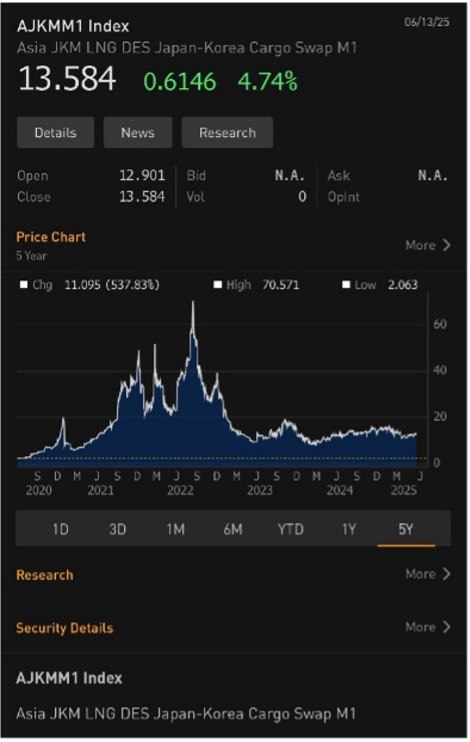
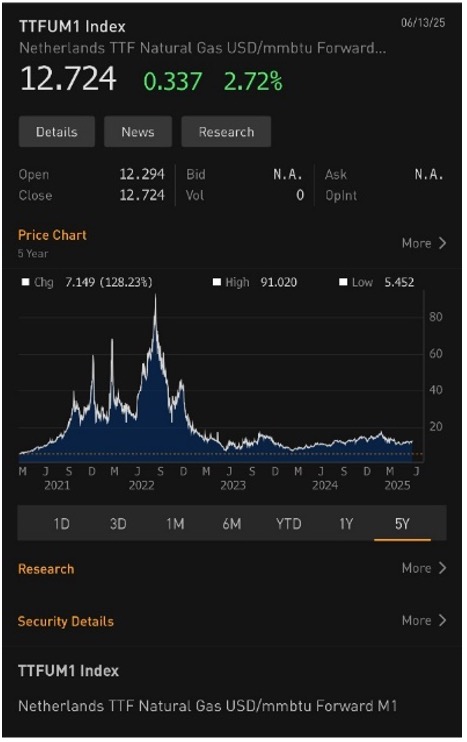
Figures 1 and 2: Asia JKM LNG Cargo Swap and EU TTF for natural gas – five-year average
JKT had long-term energy supply contracts with Russia for coal, oil and natural gas – but since the war in Ukraine, they have worked to reduce their dependence on Russia by pursuing supplier diversification. Europe has also significantly diversified its energy supplies and, three years into the conflict, continues to work towards energy decoupling from Russia. Qatar and the United States have been the biggest beneficiaries of the global shift away from Russia. At the time of writing, the two countries represent 40% of global LNG supply, with the US displacing Australia as one of the top two global suppliers before the Ukrainian war.
The election of U.S. President Donald Trump in late 2024 also created disruption as the new administration moved quickly to shake up its international trade relationships. Countries with trade surpluses or perceived asymmetrical tariffs towards the United States were targeted with severe “corrective” tariffs. JKT were amongst those targeted – as Japan and Korea each had trade deficits of roughly $66 billion with the United States, and Taiwan’s was $74 billion. Buying more US energy and investing in US energy projects have been presented as ways to address trade imbalances. And they have faced strong pressure from the United States not only to buy more US energy but to support US energy projects, including the proposed Alaska LNG.
Canada has also been targeted by the U.S. and in response to various actions by the Trump administration, has been scrambling to diversify its trading relationships. Energy has been a key element of this trade outreach. Canada’s west coast offers a significant trade advantage over the US Gulf Coast exports bound for Asia, which have to travel through a congested Panama Canal. But with pressure on potential energy customers to “buy American” or face tariffs, Canada will need to act decisively if it wants to be an energy solution provider to the world. And JKT should naturally place high on our list of preferred recipient markets.
That said, despite record levels of public support for natural gas infrastructure in Canada, there remains debate about the value proposition of Canada growing its production and export of LNG to markets like Japan, Korea and Taiwan. Questions include: Do countries still need our natural gas? Is it good for the environment? Or bad? Do we really need to decide now?
To answer these questions, this paper draws on reports, public announcements and key informant interviews with representatives of Japan, Taiwan, and Korea. It will provide a picture of what Canadians need to understand about three of the world’s most important energy customers and the broader Indo-Pacific as we seek to “Build Baby Build.”
Rich, But Not Energy Rich
Japan is the third largest economy in the world, a leading manufacturer of automobiles, electronics and other goods. Korea is the world’s second largest manufacturer of semiconductors and a world leader in nuclear technology, shipbuilding and electronics. Taiwan produces 70% of the world’s semiconductors, and 90% of the world’s most sophisticated semiconductors, playing a vital supply chain role in some of the world’s most important and emerging information technologies.
This manufacturing leadership depends on reliable, affordable energy, particularly reliable electricity. Because of very limited domestic energy sources, Japan, Korea and Taiwan, import, respectively, 90%,84.6% and 96% of the energy they use. For these countries, energy trade and partnerships are a foundation of both economic stability and geopolitical security. Japan, Korea and Taiwan have all set the goal to be net zero by 2050.
Japan:
In 2024, Japan published its 7th Strategic Energy Plan, laying out the country’s approach to meeting its energy needs and net zero by 2050 goal, in a new age of geopolitical uncertainty. Unlike previous plans, the latest strategy’s two main scenarios reflect the country’s new posture of planning for uncertainty. Japan has identified a number of outcomes the plan must deliver – referred to as the three E’s+S: Energy Security, Economic Efficiency, Environment and Safety.
The plan anticipates final energy consumption in Japan to decrease by 15% between 2022 and 2040, although electricity demand for new end-uses, including artificial intelligence (AI) is expected to increase byas much as 20%. The first scenario of the plan reflects an aggressive emissions reduction pathway, which anticipates a decline in natural gas use of about 10%. The second scenario, or “Risk Scenario”, is more conservative and assumes slower integration of wind, solar, hydrogen and CCS. In the Risk Scenario, Japan’s LNG demand in 2040 is expected to be roughly 74 million tonnes per year, up from the current 65 million tonnes per year of LNG. New LNG supply is needed to fill the roughly 9 million-tonne gap, just over half of LNG Canada Phase I production at 14 million tonnes per year. Moreover, as existing term contracts for LNG begin to expire, new term LNG supply contracts will be necessary to cover existing volumes, in addition to filling the gap.
It is worth noting that nuclear energy once made up a significant portion of Japan’s electricity supply. However, since the 2011 Fukushima disaster, nuclear power faces challenges, particularly with the local prefectures in which nuclear power facilities are located, with only 14 of 36 facilities, including three under construction, operating at the time of writing.[i] If the government is unable to meet its nuclear power generation targets, currently set at 20% of the electricity supply (up from 8.5% in 2023), Plan B, with its greater reliance on natural gas, will become the more likely path. Japan’s onshore and offshore geography severely limits the potential contributions of wind and solar power to its energy mix.
Today, coal-fired electricity represents about 30% of the country’s electricity mix, and the plan includes a phase out of “inefficient facilities by 2030” and lays out a role for low-emission ammonia to reduce the emissions intensity of remaining facilities. JERA, Japan’s largest power producer, released its 2035 Growth Strategy in 2024. It lays out a vision that seeks to reduce the emissions intensity of its coal-fired power plants through ammonia blending, moving these facilities toward ammonia-only in 2040. Consistent with this aim, it will develop LNG-fired power instead of new coal-fired power, curbing new emissions growth. Finally, it will explore renewables expansion, hydrogen blending with LNG and other initiatives to ensure power stability and affordability, while bending the emissions curve.
The strategy highlights that “low-emission thermal power (from LNG) has a critical role to play” in enabling renewables integration, as found in other research on the role of LNG in reducing power sector emissions. Maintaining diverse, reliable LNG supplies is therefore identified as a pillar of JERA’s approach – creating opportunities for Canada.
But JERA is not alone in its interest in diverse LNG suppliers. To achieve the first “E” of “energy security”, the Japanese government is pursuing multiple suppliers of energy to ensure the country is not excessively dependent on any one country. Since 2022, Japan has secured new LNG supply agreements with Oman and the United States. The country also has an open call for ammonia suppliers, which has yet to be filled. In June 2025, with the completion of LNG Canada Phase I, Canada shipped its first LNG cargoes to Asia, adding a new dimension to an energy trade relationship that had been dominated by propane. Even before these first cargoes were sent, Japan and Canada used the opportunity of the 2025 G7 Leaders Summit in Kananaskis to agree in principle to enhanced cooperation on energy, defence and intelligence sharing. It reflects the reality that for Japan, the energy challenge remains.
Korea:
In 2025, Korea released its 11th Basic Plan for Supply and Demand of Power. The plan, which is refreshed every two years, includes some notable changes, including a significant increase in the role of renewable energy – via offshore wind – out to 2038. Both nuclear power and LNG will play important roles in meeting demand growth and ensuring energy resilience. Korea, the world’s 3rd largest LNG importer, is expected to grow its LNG imports between now and 2038 to meet new sources of demand and to enable wind and solar power integration.
[i] Interview with Tatsuya Terazawa, CEO and Chairman Institute of Energy Economics Japan, June 2025.
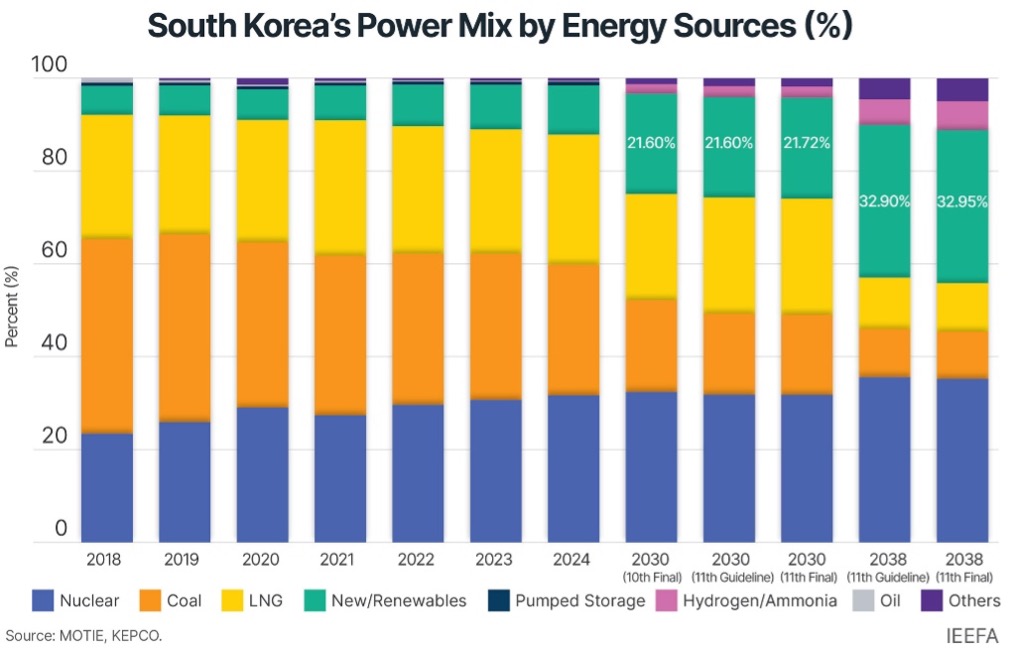
Figure 3: Outlook for shifts in Korea’s electricity supply mix.
In his interview for this paper, H. E. Woongsoon Lim, Ambassador of the Republic of Korea to Canada, highlighted some key numbers. Korea, with its population of 50 million and its sizable economy, has important energy needs and sees energy as linked to its economic, environmental and security goals. As a major importer of all forms of energy, Korea will need an additional 11GW of new electricity generation before 2038 to support its manufacturing ambitions and new technology integration. It also hopes to reduce coal power’s role in the electricity system from 31.4% in 2023 to 10.1% in 2038 and to completely eliminate coal use by 2050. Like Japan, LNG is seen as critical to enabling coal phase-out and renewables integration.
Korea received its historic first shipment of Canadian LNG on July 17, 2025; KOGAS is a joint venture partner of LNG Canada. The country also hopes to see further growth in Canadian LNG exports and is highly supportive of LNG Canada Phase II, and this support is reflected in its communications with the government of Canada. Significantly, the Government of Canada signalled its strong support of the project by adding it to a list of priority major projects in September 2025.
Taiwan:
Taiwan also has its plans for energy and has been in pursuit of new partnerships to ensure security of supply. The plan includes energy transition principles, which, like Japan’s three Es, provide transparency on how the country plans to move forward. Its main elements are: promote green energy, increase natural gas, reduce coal-fired, and achieve nuclear free. In the power sector, this plan aims to achieve 20% wind and solar integration by 2025, with natural gas at 50% and coal reduced to 30% by 2030.
In its 2022 Net Zero Road Map, Taiwan presented its assumptions about required future energy demand overall and for electricity in particular to achieve net zero. While aspiring to flatten both demand curves, new energy requirements for increased manufacturing and artificial intelligence (AI) integration will be significant considerations. By some estimates, AI could double electricity demand in Taiwan, which is currently expected to grow at an annual rate of 2.5% from 2024 to 2028, according to Taiwan’s Ministry of Economic Affairs.[i]
Taiwan sees LNG as a major part of its energy strategy and establishing its new energy mix but despite being Canada’s 5th largest trading partner, no Taiwanese company is a partner in any of Canada’s LNG projects. The path for Taiwan to access Canadian LNG directly is unclear. Today, Taiwan’s largest supplies are fromAustralia (40.2 percent), Qatar (27.9 percent), and the United States (9.8 percent), with uncertainty growing with the Australian supply.
An important reality for all three countries is that their energy-related goals – manufacturing growth, AI integration, coal phase out – are highly subject to external forces. As a consequence, finding ways to make their energy systems resilient to external forces is a key consideration for Japan, Korea and Taiwan and a driver in their foreign policy approach.
It is as a partner in energy resilience that Canada may have a true competitive advantage.
[i] Interview with H.E. Dr. Harry Tseng, Representative to Canada, Taipei Economic and Cultural Office, October 31, 2024
A Business Case, A Security Case. An Opportunity for Credibility
US Pressure on Japan and Korea to buy more US LNG and to invest in US LNG projects like Alaska LNG remains a major factor as Canada seeks a greater foothold in the global LNG market. In July 2025, Korea agreed to invest $350 billion in US energy projects in exchange for tariff relief.
Similarly, Taiwan, which currently receives 10% of its LNG from the US, was close to finalizing an agreement in August 2025 to purchase 30% of future Alaska LNG production. The deal bears similarities with a recent US deal with Japan, whose reciprocal tariff was reduced to 15% in return for providing up to $550 billion in financial support for investments in the US.
Over the long term, Canada’s place in this and the place of Canadian LNG remain important questions.
According to all three countries, and despite ongoing pressure from the United States, accessing LNG from Canada remains a priority communicated by the representatives of the Japanese, Korean and Taiwanese governments.
Japan: regional leader on energy
At the highest levels, Japan continues to signal the importance of Canadian LNG and call for diverse energy suppliers even as negotiations with the United States continue with respect to increased energy purchases and investment in the U.S..
In a 2025 article, Japan’s Ambassador to Canada pointed to the significance of Canada finally beginning to “export liquefied natural gas to Asia-Pacific countries, including Japan.” He highlighted that at this time of “harsh geopolitical realities,” where economic and energy security are central, these exports marked a “historic” beginning for Canada as a “future energy superpower,” and “reliable new (energy) supplier to the Asia-Pacific.”
Security, including for the wider Asia Pacific region, remains a critical part of Japan’s role and strategy as a Group of Seven (G7) country in the region. Today, roughly one-third of Japan’s LNG procurement is sold to neighbouring Asian countries. Japan has also invested heavily in energy infrastructure in multiple countries in the region – from Thailand, to Vietnam, to the Philippines. They have helped build power plants, pipelines, and LNG intake facilities. These activities by Japan can be seen as a regional counterpoint to China, whose “belt-and-road” initiative has allowed it to secure critical infrastructure and influence in the region and globally. A notable example was the control, until recently, by Chinese companies of the entry and exit of the critical and congested Panama Canal.
As a major supplier of LNG to Japan, Canada could be a key partner in efforts to draw countries towards the democratic world and away from China. This would be in Canada’s interest, but it requires acting quickly to demonstrate readiness to respond to the timing that Japan is looking for. That timing is now, particularly for LNG, a proven technology with established supply chains and distribution infrastructure.
“Starting in 2029, the long-term contracts that Japan and Korea have with Russia to supply LNG will begin to expire, and those countries will be seeking new partners. Having Canada ready to deliver for these countries would be an important security, economic and environmental contribution that Canada can make.”
- Tatsuya Terazawa, Chairman and CEO, Institute of Energy Economics, Japan
Korea: pivotal player in a challenging context
“Korea needs stable LNG suppliers in the new context of geopolitical uncertainty, and we are excited to see Canadian LNG coming in 2025. Canada has many advantages, including being a geographically closer supplier to Korea.”
- His Excellency Woongsoon Lim, Ambassador of the Republic of Korea to Canada
Korea is also looking to include ammonia in its energy portfolio to reduce the emission intensity of its coal-fired plants during their remaining operating life. In 2024, they issued the first of two calls for suppliers for ammonia, with specific targets for price, emissions profile and other requirements. Only about 10% of the call was met, according to some, because it was difficult for suppliers to meet the price requirements of the bid.
Blue ammonia made from natural gas in Canada, and benefiting from local carbon capture, could play a role in responding to both environmental and price requirements. Time will be of the essence if a Canadian project is to succeed in supplying ammonia to Korea.
A key point emphasized by the Ambassador was that while Korea is part of the economically vibrant Northeast Asian region, it is an area that is “highly combustible.” He expressed the role that a strong and stable South Korea could play in countering the continued threat of North Korea and the instability driven by both Russia and China. Having reliable energy is seen as central to this stability and to the country’s economic and military strength.[i]
“History tells us that when Korea is strong, the region tends to be more stable and more prosperous; when Korea is weak, there is a history of war breaking out. Energy security is critical not just for the Korean economy but for its security in general.”
- His Excellency Woongsoon Lim, Ambassador of the Republic of Korea to Canada
Taiwan: Tech partner of the democratic world
Taiwan plays a central role in the global (increasingly digital) economy as the manufacturer of 70 % of the world’s semiconductors and 90% of the most advanced chips. For the democratic world, Taiwan’s energy security is closely connected to having data systems that are insulated from the Communist Party of China. With the explosive growth of data centres and other systems to support AI, this unique role for Taiwan will only grow in significance.
This type of sensitive manufacturing requires large amounts of heat and a continuous supply of significant amounts of high quality, reliable electricity.
Today, over 97% of Taiwan’s energy, for all end uses, including electricity production, is imported. The majority of its electricity is generated with coal and natural gas, which is low cost and has the added benefit of acting as a heat source. Today, Australia is a large supplier of both to Taiwan.
“[Today] The most important source of power supply [in Taiwan] is actually natural gas, which makes up 41.5% of the total power demand, and this is followed by coal – at 40% - very high. And renewable energy is 10.5% and nuclear power is only 5.5%.”
- Dr. Harry Tseng, Representative to Canada, Taipei Economic and Cultural Office
“And we (Taiwan) are the fifth largest importer in the world. If Canada can quickly expedite your capacity for LNG export, and if we can align with each other - if your export plan can align with Taiwan's need - you can become a very important energy supplier to Taiwan.”
- Dr. Harry Tseng, Representative to Canada, Taipei Economic and Cultural Office
Taiwan has in common with neighbours Japan and Korea that the land area required for wind and solar power to be dominant electricity sources is not available, either because of mountainous terrain (e.g. Japan), other land uses (e.g. Korea), or small territory (e.g. Taiwan). Geography and geopolitics also limit their offshore options. Even as all three countries expand their use of these technologies, physical limits due to intermittency, lack of system inertia, and lack of sufficient storage, reinforce the importance of international energy partnerships for baseload and dispatchable power.
In the case of Taiwan, a country under constant threat from neighbouring China, the issue of supply chains for its energy sources and technologies is a direct security concern. Taiwan’s LNG intake facilities are on the side of the island facing mainland China, putting supplies at blockade risk. China also controls over 80% of supply chains related to wind, solar and battery technology, making their increased uptake challenging.
In chip production, even a brief power failure can destroy entire batches of product – reliability is a central consideration. Given Taiwan’s role in the supply chains for these and other information technologies, reliable energy and energy partners are needed to protect that role.
“Watch very carefully what may happen in the Taiwan Strait because China always tries to intimidate Taiwan, and nobody wants to see Taiwan be controlled by China because then the supply chain of the world will be in danger.”
- Dr. Harry Tseng, Representative to Canada, Taipei Economic and Cultural Office
[i] Interview with H.E. Woongsoon Lim, Ambassador of the Republic of Korea to Canada, January 2025
A Time-Sensitive LNG Opportunity for Canada
In 2022, when Russia’s invasion of Ukraine created a global energy disruption, Canada, the world’s 5th largest natural gas producer, lacked the infrastructure, the investment environment, and political will to be a player in the initial scramble for new natural gas suppliers.
Under pressure from our European allies, Canada committed to modestly increasing oil and gas exports – by 300,000 barrels per day – to address global supply needs. Public requests for Canadian LNG came from European and Asian leaders, most notably German Chancellor Olaf Scholz and Japanese Prime Minister Fumio Kishida. Ultimately, Canada’s support to its allies at the time was largely symbolic and reflected the prevailing ambivalence of Canada’s political leaders about being a global oil and natural gas supplier. This ambivalence was crystallized in a famous quote from the period by then Prime Minister Justin Trudeau, that there was “no business case” for new LNG from Canada.
The presidency of Donald Trump proved more decisive in shifting Canada’s position on energy, its economy and trade diversification. Significant tariffs on steel, aluminum and automobile-related exports, and calls for Canada to become “the 51st State,” transformed the political climate. This political shift contributed to electoral success for the federal liberal party, resulting in a re-elected Liberal government led by former Bank of Canada Governor Mark Carney. His priorities have included removing internal trade barriers, diversifying our exports (especially energy exports) away from the United States and building new trade infrastructure in an accelerated way. Provincial governments also moved into action, notably British Columbia, which published a list of priority projects that included energy infrastructure. Calls to “build now” were advanced in civil society, including from Canada’s energy CEOs before and after the 2025 federal election, as well as from various Indigenous leaders. This new alignment between key players may prove sufficient for Canada to seriously pursue a global energy trade agenda.
This alignment could not have come sooner.
Three of the most important economies in the Asia-Pacific are looking for new LNG suppliers as their energy demand continues to grow. An important milestone for this is 2029, when long-term contracts between many Asian countries and Russia begin to expire. If Canada wants to take over as a major supplier to the region, we need the port, pipeline and upstream permitting issues in our country to be addressed in short order.
Based on their domestic energy plans and comments from the interlocutors approached in this study, Japan, Korea and Taiwan want to see rapid action from Canada to enhance LNG export capacity:
“We are great friends (Canada & Japan) (…), but it is a pity that our relationship between Canada and Japan is not as strong as it could be. I was unaware before I took this role that there was no Canadian LNG coming to Japan, but you have so much LNG, propane, ammonia and critical minerals. There is a lot more we can do between Canada and Japan.”
- Tatsuya Terazawa, Chairman and CEO, Institute of Energy Economics, Japan
“We want to do more with Canada for enhanced energy cooperation. Not just the Korean government but also the Korean business community. They want to do more with Canadians [on energy].”
- His Excellency Woongsoon Lim, Ambassador of the Republic of Korea to Canada
“LNG is something we are talking to Canada [about] - very attractive, full of capacity, full power potential, [we are] waiting for you to build up your capacity to include more exporters [and countries] that you can export to.”
- Dr. Harry Tseng, Representative to Canada, Taipei Economic and Cultural Office
But JKT will not wait forever.
At the time of writing, LNG Canada Phase I, a 1.87 bcf/day project, has started shipping LNG – with Japan and Korea as customers – and there is ongoing interest and discussion in the possible Final Investment Decision (FID) for LNG Canada Phase II. Phase II would bring on another 1.87 bcf/day and could be completed by 2030. Cedar LNG and Woodfibre LNG, which combined would add 0.7 bcf/day, are under construction and progressing well towards first shipment in 2027. The Prince Rupert Gas Transmission line (PRGT) has received its approval of “substantive start,” a critical milestone on the path for the Ksi Lisims LNG project, with a possible additional 1.6 bcf/day, to continue its progress to FID. Ksi Lisims LNG receivedits joint British Columbia and Federal environmental assessment certificate in September 2025. It is notable that many of these projects and their associated pipelines involve important Indigenous ownership or participation.
In Canada, provinces have constitutional responsibility for natural resource development, and the federal government enters the picture where linear infrastructure crosses provincial borders or for projects of a certain size. This dual jurisdiction has sometimes meant longer project timelines, particularly where provincial and federal requirements lead to process duplication. This globally unique governance structure helps explain in part why Canada can struggle to approve and build major projects.
Recent efforts to change this picture have included new laws in the provinces of British Columbia and Ontario to enable accelerated approvals of projects. The federal government also adopted the Building Canada Act, with the same goal. These bills and their rapid passage have been welcomed by some and condemned by others. In particular, many Indigenous organizations have expressed concerns that their rights may be unconstitutionally impacted by these bills.
While the Building Canada Act allows the federal government to suspend or accelerate the provisions of many federal acts to move major projects more quickly, this leaves Canada with a highly discretionary policy environment, not a clear “rule of law” framework for major projects. Restoration of that framework could be advanced by making specific policy changes identified by industry in their “Build Canada Now” initiative and letter to Prime Minister Carney, but the government has not expressed an interest in this approach. The focus to date has been on the creation of a list of priority projects.
Despite these areas of uncertainty, political support in Canada to build energy infrastructure, to become a “clean and conventional energy superpower,” and to diversify our trade away from the United States is higher than it has been in over a decade, in every province and territory. Holding this new centre will require focus from all parts of society.
Outside pressure from US President Donald Trump was critical in creating this new centre. To maintain it, positive motivation from our potential energy customers will also be vital – reminding the Canadian public and decision makers why Canadian LNG has an important role in the world. Playing this role and strengthening Canada’s international standing as a global energy supplier might even help us repair our now weakened relationship with the US: friendship through strength?
Moving forward, the following should remain top of mind:
- Japan, Korea and Taiwan see energy security as intimately tied to national security. Having energy when it is needed means being capable of responding to military threats from North Korea (Japan, Korea) or from China (Taiwan). Therefore, it matters that Canadian LNG is only eight days from Asian ports by ship, instead of 42 days through the congested Panama Canal. Having diverse and, where possible, democratic suppliers is also seen as important and enables resilience to geopolitical risks. Canada has the resources to displace large global energy players like Russia and to mitigate China’s energy influence on its neighbours. Moreover, the protection of supply chains for semiconductors and other critical information technologies is a key security concern for Canada and can be supported by greater Canadian energy exports
- Access to Canadian LNG supports these countries with their emission reduction goals – Japan, Korea and Taiwan all have a goal to be net zero emissions by 2050. However, with limited land and offshore options, as well as the inherent limitations of large-scale wind and solar (intermittency, lack of support for system inertia, etc), ensuring the availability of baseload power from natural gas makes integration of these technologies possible. Their combination is also critical to coal displacement and the reduction of criteria air contaminants associated with coal. Canadian LNG is very emissions-competitive with other international suppliers. Coal displacement in these and other large Asian economies would be Canada’s most significant contribution to global emissions reduction.
- Time is of the essence; the conversation on new energy suppliers is happening now, even though many of the new shipments will only be needed in 2029 when long-term contracts with Russia begin to expire. We need to act with speed if we want a strong global showing as an international LNG and, eventually, (blue) ammonia supplier. LNG projects, pipelines, carbon capture and related infrastructure are serious, multi-year engineering projects even with full political support. We currently have a record of being unreliable – Japanese and Korean investors have both lost money working on Canadian projects. They have now had a first success – after sixteen years – LNG Canada’s first shipment of LNG cargoes in June 2025. The success of all the projects currently in progress – LNG Canada Phase I and II, Cedar LNG, Woodfire LNG, Coastal Gaslink Phase II, and Ksi Lisims LNG, which received its environmental approvals in Fall 2025 – will be a vital signal that Canada is once again ready and able to deliver for our allies.
Energy security and being an energy superpower are not something that can be achieved overnight. But having a strong consensus in Canada is needed to advance both our domestic goals and international aspirations. It is notable that all of Canada’s major LNG projects and related infrastructure have significant involvement or ownership by local Indigenous nations. Involvement in these projects has delivered transformative benefits for many of these nations and enabled greater investor confidence. Many First Nations owners or their organizations are reaching out internationally to talk about their desire to help with the world with energy and uplift their peoples and all Canadians. These new experiences and the emerging Indigenous/International and Indigenous/Indigenous dialogues on models for resource development will also play a key role in building projects in Canada and in helping our allies.
Canadians should know that we needed to have taken many of the steps we are taking now to build 10 years ago, and we are only acting now. There is more to do to continue to build confidence in Canada and to ensure that our projects continue to secure FIDs. Industry has put these needs on the table, and those serious about “build baby build” should be very serious about this list. One-off project acceleration for a limited number of projects is no substitute for being a rule-of-law jurisdiction where proponents of many complementary projects can know how they can successfully proceed, independent of government intervention. Our allies are waiting – let’s end the wait.
About the Author
Shannon Joseph is a sustainable development and public affairs professional with over 15 years of experience that includes environmental engineering, municipal sustainability program management, the upstream oil and gas industry and Indigenous relations. She is motivated by the strong conviction that energy is about people and that abundant, affordable, low-emission energy is a pre-condition for growing the middle class, protecting the environment and in Canada, advancing reconciliation.
Currently serving as Chair of Energy for a Secure Future, Ms. Joseph spent close to 10 years in progressively senior roles at the Federation of Canadian Municipalities, including as Senior Manager of Research and Development with its Green Municipal Fund and as the founding Director of the Municipalities for Climate Innovation Program, a $75 million capacity building and granting program focused on climate change mitigation and adaption at the community level. Most recently, Ms. Joseph served as Vice-President, Government Relations and Indigenous Affairs for the Canadian Association of Petroleum Producers (CAPP). She led work related to federal policies affecting Canada’s upstream oil and natural gas industry, including the Impact Assessment Act (Bill C-69), United Nations Declaration on the Rights of Indigenous People’s Act and various climate change focused policies. An important part of this work involved building relationships with Indigenous organizations in support of ongoing economic reconciliation in Canada.
A member of the Order of Engineers of Quebec, Ms. Joseph holds a Bachelor of Engineering degree from McGill University and Master of Applied Science in Civil Engineering from the University of Toronto. Ms. Joseph is currently a member of the board of directors of Tamarack Valley Energy. She has also served on the Boards of Directors of the Canadian Environmental Grantmakers Network (now Environmental Funders Canada) and the Energy Council of Canada and was a member of the Advisory Council for the University of Ottawa’s Positive Energy initiative
Canadian Global Affairs Institute
The Canadian Global Affairs Institute focuses on the entire range of Canada’s international relations in all its forms including trade investment and international capacity building. Successor to the Canadian Defence and Foreign Affairs Institute (CDFAI, which was established in 2001), the Institute works to inform Canadians about the importance of having a respected and influential voice in those parts of the globe where Canada has significant interests due to trade and investment, origins of Canada’s population, geographic security (and especially security of North America in conjunction with the United States), social development, or the peace and freedom of allied nations. The Institute aims to demonstrate to Canadians the importance of comprehensive foreign, defence and trade policies which both express our values and represent our interests.
The Institute was created to bridge the gap between what Canadians need to know about Canadian international activities and what they do know. Historically Canadians have tended to look abroad out of a search for markets because Canada depends heavily on foreign trade. In the modern post-Cold War world, however, global security and stability have become the bedrocks of global commerce and the free movement of people, goods and ideas across international boundaries. Canada has striven to open the world since the 1930s and was a driving factor behind the adoption of the main structures which underpin globalization such as the International Monetary Fund, the World Bank, the World Trade Organization and emerging free trade networks connecting dozens of international economies. The Canadian Global Affairs Institute recognizes Canada’s contribution to a globalized world and aims to inform Canadians about Canada’s role in that process and the connection between globalization and security.
In all its activities the Institute is a charitable, non-partisan, non-advocacy organization that provides a platform for a variety of viewpoints. It is supported financially by the contributions of individuals, foundations, and corporations. Conclusions or opinions expressed in Institute publications and programs are those of the author(s) and do not necessarily reflect the views of Institute staff, fellows, directors, advisors or any individuals or organizations that provide financial support to, or collaborate with, the Institute.


Showing 2 reactions