
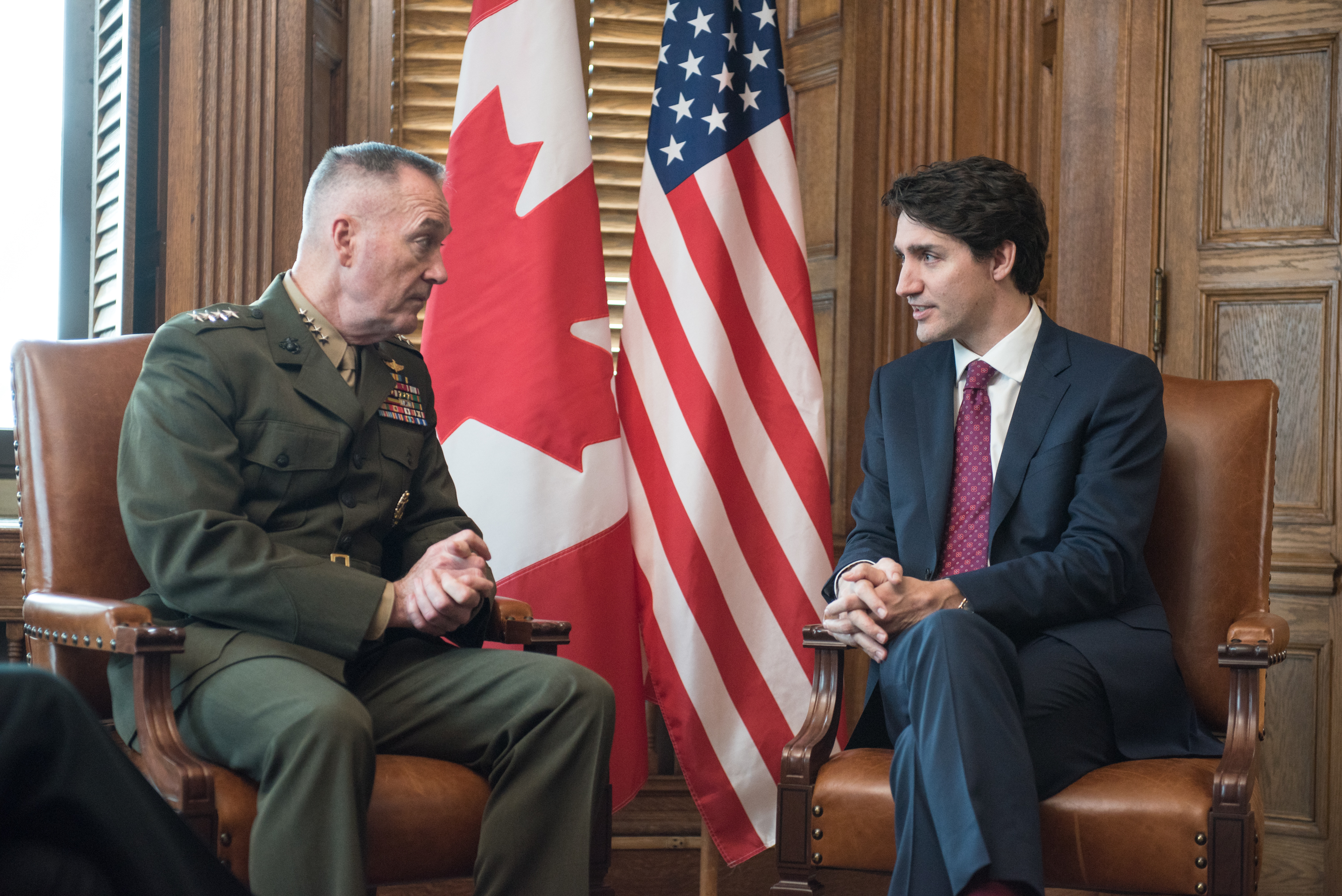
 Photo By Sgt. James K. McCann, U.S. Army
May 2026
Table of Contents
- Introduction
- Enhanced Integration
- Strategic Autonomy
- Allied Diversification
- About the Author
- Canadian Global Affairs Institute
Introduction
The Trump administration’s foreign policy presents a considerable challenge to Canada’s traditional defence posture. President Trump’s public statements, such as his remarks concerning the annexation of Canada and Greenland, are unprecedented behaviour from a sitting U.S. president in the modern era. These developments have established the necessary conditions for Canada to reassess its defence cooperation with the U.S. and other allies.
In response to this challenge, the Canadian Global Affairs Institute hosted a roundtable discussion with various academic and industry stakeholders to discuss the future of Canada–U.S. defence relations. Its objective was to help identify where Canada and the U.S. could deepen their relationship; where Canada needs to develop sovereign capabilities; and where Canada needs to expand cooperation with other allies. Drawing on insights from the roundtable discussions, this article highlights key themes and identifies priority areas for further exploration. Ultimately, Canada must develop a more strategic mindset, while engaging in a continuous and pragmatic self‑evaluation of its defence priorities.
Enhanced Integration
A primary course of action available to Canada is deepening its defence ties with the U.S. Given the historical relationship, and shared interests centered on continental defence concerns, closer cooperative efforts with the U.S. offer several strategic advantages for Canada.
Most debates surrounding Canada–U.S. relations are longstanding, and current discussions evaluating the impact of the Trump administration must be historically contextualized. For example, the issue of Integrated Air and Missile Defence (IAMD) dates back to the 1980s. Given historical trends and geographic proximity, it is difficult to envision Canada moving significantly outside the U.S. orbit. Simply put, the durability of Trump’s policy positions remains uncertain, making caution preferable to reactionary responses. However, some participants urged that we cannot necessarily assume that they will end either, arguing that some positions may become easily entrenched within the U.S. political system.
Uncoupling, even partially, from existing U.S. defence frameworks will carry severe risks. For example, if a major procurement project is cancelled or even paused, it can lead to broader program stalls within the Department of National Defence (DND), the Canadian Armed Forces (CAF), and potentially other departments. This can undermine financial investments, damage connections with industry, hurt organizational morale, place additional strains on procurement personnel, and ultimately degrade the CAF’s capabilities. In short, Canada cannot afford sudden or reactive changes to its defence plans without incurring substantial costs and risks. This does not mean that Canada cannot pursue alternative international defence partnerships, but any decision to do so must account for the potential consequences and the opportunity cost of exiting relationships.
Preliminary assessments of the second Trump administration’s approach to global affairs suggest a desire to prioritize resources for the Indo‑Pacific and homeland defence, which de facto means a de‑emphasis on the European theatre, even with the U.S. expression of ongoing commitment at the 2025 NATO Summit in The Hague. Canada, however, will likely remain focused on its NATO commitments, notwithstanding any American change within the alliance. Within this context, the CAF must decide whether it should follow the U.S. lead and shift some of its strategic and operational focus toward the Indo‑Pacific.
However, an area that will certainly require enhanced integrative efforts is continental defence, where both Canada and the U.S. maintain strong incentives to deepen ties due to shared objectives. Canada should explore ways to gain more direct influence on U.S. continental defence planning and decision‑making, which may include establishing new formal mechanisms to assist in that process. Current bilateral defence structures for the maritime and cyber domains may no longer be optimal for current-day threats and require formal review. Canada should advocate for the integration of Canadian civilian‑oriented institutions such as the Coast Guard and Transport Canada to formally participate in U.S. NORTHCOM to help streamline the strategic diversification of Arctic capabilities beyond the military domain. Further, other national security organizations such as CSIS should also start participating in U.S. SOUTHCOM to enhance situational awareness on security matters related to narcotics and human smuggling, while gaining a better understanding of U.S. perspectives on continental matters.
Canada could also improve its military exchange relationship with the U.S. For example, expanding cooperation with the U.S. National Guard’s State Partnership Program. The National Guard frequently engages in disaster relief operations, and two different state units operate F‑35s out of civilian airports, which presents an interesting learning opportunity for CAF personnel. Similarly, deeper collaboration with the U.S. Army Corps of Engineers could help improve the CAF’s infrastructure development and civil‑military operations, which would be particularly valuable for Arctic‑related activities. In general, Canada should not always conceptualize the U.S. as a unitary actor and should look for subnational opportunities at the organizational and state level to harness collaboration.
Historically, the integration of emerging technologies into the CAF is deeply connected to the U.S. defence industrial ecosystem. This bilateral relationship has granted Canada access to world‑class technology but has also limited sovereign control of defence capabilities. Potential upcoming procurement opportunities, such as joining the Golden Dome/Continental Shield system, will have significant implications for the government’s new procurement and industrial reforms and may offer Canadian industry new opportunities to participate in continental defence efforts.
Beyond continental defence, Canada can also better manage its relationship with the U.S. for expeditionary operations. Canada can offer greater value to the U.S. by stepping into leadership roles when the U.S. cannot, for example by engaging more with fellow middle powers such as South Korea and Poland, where Canada’s presence may be more welcome due to the more balanced nature of the relationship compared to their interactions with the United States. By undertaking this effort, Canada could enable the United States to reallocate resources elsewhere, while simultaneously expanding its own global security footprint.
It is unlikely that Canada will be able to operate unilaterally abroad, nor is it likely that it could conduct major combat operations without the support of the U.S., and this reality extends to the rest of NATO. While Canada may be willing to deepen its integration with European partners, this does not guarantee their reliability. As one participant noted, Europe often prioritizes searching for new customers for its defence industrial base rather than developing new operational partners. A pivot towards Europe as Canada’s closest defence partner would require a fundamental reassessment of CAF infrastructure, supply, training, and even doctrine. Others questioned how fully unified the EU was on defence matters, suggesting that there were likely greater divergences among member states on these issues. Overall, the U.S. is likely to remain Canada’s most important defence partner for the foreseeable future.
Strategic Autonomy
Another course of action for Canada is to pursue a defence posture that emphasizes strategic autonomy. Instead of deepening ties with the U.S. or other allies, this path emphasizes strengthening domestic and sovereign capabilities to reduce reliance on external partners.
While Canada often aspires to play a significant role in global security, it has historically failed to invest at a level that matches its ambitions. This funding gap will affect any attempt to diversify its defence partnerships. Canada must internally address some of the fundamental and basic defence investments before pursuing grander military objectives. For example, several CAF bases suffer from severe maintenance problems. Basic equipment shortages are also common, which harms readiness. These problems require urgent attention, and meaningful changes in Canadian defence policy cannot unfold until they are resolved. Further, the siloed nature of Canadian bureaucracy among various departments continues to undercut any effective whole‑of‑government response to managing Canada–U.S. defence relations.
In particular, the inadequacy of the CAF’s equipment is undermining Canada’s ability to contribute to continental defence and other operational commitments. Canada must accelerate procurement processes to ensure the CAF is able to respond to threats to North America. This extends beyond purchasing new exquisite systems and includes improvements to logistical support systems and relevant infrastructure. In addition to new military equipment, there is also a need to shift resources to cybersecurity, space‑based capabilities, and Arctic infrastructure, as these are areas where Canada already possesses a strategic advantage for continental defence.
Challenges in the Arctic require a whole of government response beyond just the DND and CAF. Strengthening Northern infrastructure and enhancing civil capabilities will mean less dependence on foreign assistance during a crisis. To better facilitate this whole‑of‑government approach, Canada should consider establishing a centralized national operations centre to handle emergencies.
Strengthening Canada’s continental position also requires investing in self‑reliance through investments in domestic industry and the development of intellectual property (IP) capacity. Currently, Canada’s IP terms are commercially restrictive, and the formation of flexible, mutually beneficial industry agreements is needed to support commercialization.
A new national security strategy is required that connects defence to economic security, as well as boosts public awareness of such issues. Canada needs to better articulate its Arctic defence objectives, especially in the context of current reforms to the U.S. military’s geographic command structures. Building a stronger national and bipartisan consensus on these issues within Canada would help ensure enhanced long‑term continuity.
Canada’s defence bureaucracy is highly risk‑averse, and its system is not conducive to bold policy choices, especially those that challenge standard operating procedures or traditional approaches. This can have negative, tangible effects on the military, such as accepting sub‑optimal equipment via rapid procurement in response to short‑term funding uncertainty. Any new decisions regarding Canada’s international partnerships, as well as its internal procurement system, must be policy‑driven with a clear mandate and not be constrained by internal bureaucratic processes. Most government departments are highly siloed in operation, resulting in poor integration between defence and broader national security policy areas.
The Canadian defence bureaucracy must significantly modernize its public relations and strategic communications approaches. Transparency is lacking, with valuable information often inaccessible to external stakeholders. The government should improve its public narrative framing of defence decisions, especially high‑profile ones, such as the rationale for purchasing F‑35s. The status quo approach involves episodic communication campaigns on isolated topics, and this is insufficient to effectively manage the public relations side of defence. The DND and CAF should undertake a formal strategic communications review and implement a new approach that sustains dialogue with the public on key defence issues on an ongoing basis.
Public opinion data suggest that economic security is a major concern for most Canadians, and thus narratives that connect defence needs to domestic investments will likely find a receptive audience; this also suggests that procurements involving domestic Canadian firms will be positively received. Similarly, procurements that can be marketed publicly in non‑militarized terms, such as Arctic Intelligence, Surveillance and Reconnaissance (ISR) capabilities, are likely to receive broader public support.
Major procurement decisions that involve the formation of longstanding international partnerships, such as the current submarine program, should align with long‑term strategic foreign policy objectives, not just the technical specifications of equipment. These decisions will shape Canada’s future relations with key regions, including Europe and the Indo‑Pacific. As such, they may require more direct input from senior political leadership at the policy level, rather than being left solely to civil servants overseeing competitive bidding processes. Essentially, Canada must first decide which partners it wants to work with, then focus on procurement and interoperability issues as secondary considerations.
Canada needs to strengthen and more clearly define its defence industrial ecosystem in order to maximize domestic capabilities. The government should be more aggressive in embedding Canadian firms within allied supply chains. Canada should target government investments in areas of comparative technological advantage so that it can position the country’s research and development to lead globally in select sectors. Cementing Canada’s leadership in a group of key technology sectors, such as ISR, satellites, uncrewed systems, as well as sustainment and airlift capabilities, will give Canada additional leverage as it interacts with allies. In turn, industry must meet the government’s requirements in competitive procurement processes.
Lessons learned from international allies such as Australia may offer guidance for Canada’s pursuit of sovereign capabilities. The United Kingdom is another example for guidance, especially in terms of how it manages defence‑industrial relations. Canada requires a more efficient defence‑industrial ecosystem, especially as it looks to rapidly build new capabilities in regions like the Arctic. The government must better understand integrated supply chains and what defines a “Canadian” company, as many multinationals with significant domestic operations are still classified as foreign. The government needs to simplify its contracting practices, as there is too much civilian‑sector regulation, especially regarding dual‑use technologies. A future procurement system must be more agile and less constrained by rules designed for non‑military contexts. The demands of national defence must be treated differently from those of departments outside the national security environment.
The Royal Canadian Air Force (RCAF) should consider adopting a posture that involves dispersing assets and decentralizing operations, thus allowing for more rapid deployments. By spreading aircraft across a wider array of airbases and airfields, it can enhance its responsiveness to a variety of missions and help make additional platforms available for future NATO or continental defence missions, thus giving the government greater flexibility in decision‑making. The Army should explore acquiring lighter, more mobile platforms to facilitate rapid deployments in the future. Lessons from the Latvian NATO Battle Group demonstrate the importance of interchangeability for supply‑chain logistics, which would also be relevant for continental defence missions.
The CAF’s thinking on expeditionary operational ambitions cannot be divorced from its continental defence needs. The CAF should prioritize the development and acquisition of capabilities essential to defending North America and maintaining Canadian sovereignty. Once these are established, strategic planning should focus on how such capabilities can also enable overseas deployments. These types of capabilities thus serve dual purposes, bridging homeland defence and international deployments, which allows the CAF to “double dip” its capabilities across multiple mission sets. This approach will not only improve procurement and national autonomy but also strengthen Canada’s relationship with allies, including the U.S. Rapid short‑term procurement, potentially involving commercial off‑the‑shelf (COTS) contracting, is needed to ensure the CAF is fully operational by the 2030s, while a longer‑term focus should shift toward building sovereign Canadian capabilities.
Allied Diversification
Finally, Canada could adopt an approach to defence that emphasizes diversifying its international partnerships beyond the United States. Strengthening ties with like‑minded allies in Europe or in the Indo‑Pacific would enhance strategic flexibility and reduce overreliance on any single partner. This approach could also open new avenues for defence procurement, joint research and development efforts, and operational coordination.
Canada’s approach to continental defence should do more to include other North American countries such as Denmark via Greenland, Iceland, and Mexico. For example, Canada could assess the degree to which CAF ISR‑related capabilities might operate over external Arctic areas such as Greenland, while gaining a clearer understanding of how Denmark’s approach to the High North differs from that of the U.S. Building closer relations at the military and civil level with other Arctic powers, such as the Scandinavian states, will help Canada achieve its continental security goals. For example, Canada can collaborate closely with Finland on joint icebreaker efforts, and Denmark on northern basing.
Canada’s defence diplomacy, which includes its personnel exchange programs, requires reassessment. The majority of the CAF’s personnel exchanges are with the U.S. military, which potentially limits exposure to operational practices and strategic cultures from other allies. Canada should adopt a more strategic and purposeful approach to military exchange programs to broaden experiences and to gain specialized skill sets. Canada should have greater transparency and awareness of existing exchanges and defence diplomacy mechanisms. A review of the existing out of Canada postings of all personnel types is warranted to ensure the apportionment of positions is optimal for 2025.
Currently, the CAF is very dependent on U.S. cryptographic systems, GPS, and intelligence infrastructure, which is a potential critical vulnerability. Canada should consider exploring other options for intelligence sharing and assess the potential reliability of other international partners in Europe and the Indo‑Pacific. In relation to this, the future of the Five Eyes (FVEY) intelligence alliance is uncertain; if the United States continues down a unilateralist path, it could effectively become “Four Eyes.” Canada should consider developing similar arrangements with other countries, such as Japan and South Korea.
However, global multilateralism is experiencing fragmentation; the EU, for example, remains difficult to engage with strategically. AUKUS is currently undergoing a period of internal review, and Canada’s potential role within it remains undefined. Canada must determine how it can contribute positively to existing multilateral mechanisms and discover what new benefits can be extracted from them. Concurrently, as Canada deepens its interoperability with new and existing partners, this increases the risk of entanglement in future global conflicts, and a degree of transparency is therefore required to manage public understanding of these risks.
Canada has much to learn from non‑U.S. allies, particularly Australia and the United Kingdom, when it comes to building a modernized defence industrial base. The Polish Armament Group presents an interesting model that embeds foreign industry as a pillar of its national defence strategy. Canada could potentially even learn from non‑traditional partners; for example, Indonesia’s focus on sovereignty and strategic autonomy may offer intriguing insights for Canada’s current situation. Overall, diversifying Canada’s diplomatic relationships will have positive effects on Canada’s global security posture.
Canada should also consider diversifying its partnerships for future expeditionary operations. This should include a reassessment of how best Canada can contribute to NATO, paired with a new plan for expanding the country’s operational presence in the Indo‑Pacific. Underpinning this should be an effort to reduce overreliance on U.S. support by developing the capacity to operate independently or alongside other partners when necessary. Doing so would enhance strategic flexibility, reinforce national autonomy in deployment decisions, and contribute to more resilient and adaptable force planning. Canada should also identify niche contributions that it can offer in different theatres; for example, allies have already expressed interest in Canadian sensors, Arctic operational capabilities, and space‑based capabilities. This will assist Canada in identifying what value it can offer allies, which will make them more receptive to future integrative efforts.
In the Indo‑Pacific, Australia should be prioritized as Canada’s leading non‑U.S. defence partner. There is already considerable operational familiarity between the CAF and its Australian counterparts, and their shared FVEY obligations help streamline intelligence sharing. Both countries will soon be operating similar platforms, including the F‑35, P‑8, and Type‑26 derivative warships, and there are multiple opportunities for collaboration on emerging technologies such as advanced sensors and autonomous systems. Further, for both Australia and Canada, the looming threat of China offers a unifying common objective.
Canada should also consider expanding defence relations with Japan in the Indo‑Pacific. The Japanese Self‑Defense Force is already operationally well integrated with the U.S. military, and thus Japan offers Canada not only the opportunity to diversify its defence relationships but also to do so in a way that still demonstrates value to the U.S. within its regional security architecture. Japan’s own concerns about China also align with Canada’s strategic priorities for the Indo‑Pacific. In the future, Canada might also consider basing forces in Japan, including P‑8 Poseidon aircraft, as Japanese airfields would provide very valuable operational positioning for participation in joint operations for regional deterrence efforts. Additionally, as China continues to invest heavily in long range fires capabilities, Canada should consider such threats in its regional expeditionary planning and make sufficient investment in forward deployed IAMD capabilities.
Finally, Canada should develop more region‑specific strategies to guide its expeditionary military operations. This will help the CAF link its available capabilities to inform more realistic policy decisions. Historically, Canada has prioritized simply participating in international coalitions, but this is insufficient for the challenges of the contemporary global strategic environment. Instead, Canada must ensure its deployments generate meaningful and tangible effects, as this will help it demonstrate greater value to allies. The CAF remains fairly sheltered and very dependent on the U.S. for enabler capabilities and the capacity to sustain long‑term deployments beyond current commitments. This restricts Canada’s ability to make any significant pivot to more ambitious expeditionary operations alongside other partners. Canada’s shortage of core enabling capabilities will also prevent Canada from commanding many expeditionary coalition forces. If Canada wants to assume more prominent roles, it must bring greater enabling and kinetic effector capabilities to remain relevant in future operations.
About the Author
Dr. Alexander Salt has a PhD from the University of Calgary’s Centre for Military, Security and Strategic Studies and an MA in Political Studies from the University of Manitoba. His dissertation explores to what extent has the battlefield experience of the U.S. military influenced post-war organizational innovation. His research has been awarded the Social Sciences and Humanities Research Council of Canada’s Joseph-Armand Bombardier Doctoral Award, as well as a General Lemuel C. Shepherd, Jr. Memorial Dissertation Fellowship. He has published research relating to international security and defence policy with Strategic Studies Quarterly, Journal of Military and Strategic Studies, Canadian Foreign Policy Journal, and The Canadian Network for Research on Terrorism, Security, and Society. Previously, he was a Visiting Political Science Instructor with Macalester College and has also held positions with the Centre for Defence and Security Studies, as well as the Consulate General of Canada in Dallas, Texas, and the Consulate General of Canada in Minneapolis, Minnesota.
Canadian Global Affairs Institute
The Canadian Global Affairs Institute focuses on the entire range of Canada’s international relations in all its forms including (in partnership with the University of Calgary’s School of Public Policy), trade investment and international capacity building. Successor to the Canadian Defence and Foreign Affairs Institute (CDFAI, which was established in 2001), the Institute works to inform Canadians about the importance of having a respected and influential voice in those parts of the globe where Canada has significant interests due to trade and investment, origins of Canada’s population, geographic security (and especially security of North America in conjunction with the United States), social development, or the peace and freedom of allied nations. The Institute aims to demonstrate to Canadians the importance of comprehensive foreign, defence and trade policies which both express our values and represent our interests.
The Institute was created to bridge the gap between what Canadians need to know about Canadian international activities and what they do know. Historically Canadians have tended to look abroad out of a search for markets because Canada depends heavily on foreign trade. In the modern postCold War world, however, global security and stability have become the bedrocks of global commerce and the free movement of people, goods and ideas across international boundaries. Canada has striven to open the world since the 1930s and was a driving factor behind the adoption of the main structures which underpin globalization such as the International Monetary Fund, the World Bank, the World Trade Organization and emerging free trade networks connecting dozens of international economies. The Canadian Global Affairs Institute recognizes Canada’s contribution to a globalized world and aims to inform Canadians about Canada’s role in that process and the connection between globalization and security.
In all its activities the Institute is a charitable, non-partisan, non-advocacy organization that provides a platform for a variety of viewpoints. It is supported financially by the contributions of individuals, foundations, and corporations. Conclusions or opinions expressed in Institute publications and programs are those of the author(s) and do not necessarily reflect the views of Institute staff, fellows, directors, advisors or any individuals or organizations that provide financial support to, or collaborate with, the Institute.
Showing 1 reaction