
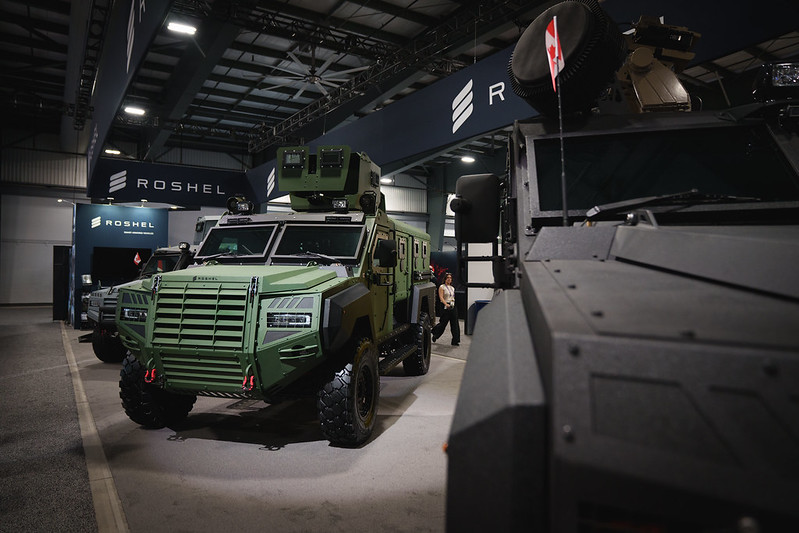
 Image: CADSI
by Jordan Miller
September 2025
Table of Contents
- Introduction
- The Current State of Defence Procurement in Canada
- Defence Production: A Broader Idea
- Why Change to Production?
- Changes for a Digital Era
- How to make this happen?
- Conclusions
- About the Author
- Canadian Global Affairs Institute
Introduction
Canada is poised to increase its defence spending soon. In June 2025, Prime Minister Carney committed to reaching the NATO target of 2% of GDP on defence spending by the end of fiscal year 2025-26. To meet these commitments in a timely fashion, Carney announced a campaign promise to establish a single defence procurement agency to centralize and accelerate defence procurement processes, and to buy equipment and solutions from Canadian companies wherever possible to reduce dependency on foreign suppliers. This idea combines accelerating the pace of procurement with keeping as much of the estimated $32 billion in new defence spending over the next four years on a cash basis in Canada as possible. The composition of Cabinet has aligned with this promise, with Stephen Fuhr named as the Secretary of State for Defence Procurement, presumably to play a significant role in transitioning to a single-agency model for Canada.
There is some skepticism that a new defence procurement agency or approach will deliver on its ambitions. Defence experts, Canadian companies, and opposition critics alike expressed their skepticism on execution of a such an ambitious plan, as similar election promises were made in 2015 and in 2019 for a dedicated defence procurement organization that never materialized.
Addressing the challenges with defence procurement is essential to procuring military equipment and solutions in a timely manner. However, Canada should also be examining ways to address the broader issue of defence production, including more actively managing industrial capacity to produce the materiel and equipment Canada needs, supply chains for minerals, resources and components, and the innovation and commercialization pipeline to sustain advancements in defence technology. Procurement is fundamentally about buying; production is about the whole supply chain and aggregate national capacity. Procurement must be addressed. However, without prioritizing the development of industrial capabilities that support current and future defence requirements, Canada risks improving its ability to buy defence solutions without addressing dependency on other nations over the medium and long term.
Procurement and production should be considered together because expanding Canada’s military ambition and committing to ReArm Europe should not be met with increased industrial dependence on other nations to sell us platforms and solutions. NATO members agreed to increase the target for defence spending to 5% of GDP by 2035 at the Hague Summit in June 2025, with 3.5% of that on defence expenditure and the other 1.5% on infrastructure, civil resilience measures, and building defence industrial capacity. Increasing dependency in a time of increased spending escalating could seriously narrow Canada’s policy choices for national defence and thereby undermine our sovereignty.
The Current State of Defence Procurement in Canada
There are many existing obstacles to timely defence procurement in Canada, and to reforming it. A June 2024 report from the House of Commons Standing Committee on National Defence outlined the problems with defence procurement in Canada. Most notably, the report identifies the bureaucratic complexity of number of steps and rigidity or process; bottlenecks for moving procurements forward; lack of transparency on process and criteria; request for proposals documents that can be hundreds of pages long; risk aversion from the bureaucracy to deviate from standard practice; and a shortage of personnel to drive procurements through a system with so many structural and procedural limitations. The same report included testimony about the potential benefits of centralizing defence procurement in a single agency because the current diffusion of responsibility between National Defence, Public Services and Procurement Canada, Industry Canada, and Treasury makes coordination and leadership more challenging than it would be under a single bureaucratic entity. Alternatives like putting the Privy Council Office in a leadership and coordination role have been discussed, though it is not clear if this function alone would be enough to overcome the procedural and resourcing issues in the current procurement enterprise.
The creation of a single defence procurement agency may accelerate the pace of procurement if the existing issues are resolved in the process. If bureaucratic processes can be streamlined and simplified, greater transparency established, a common-sense risk framework established and implemented, and enough personnel made available, a single department may address these issues. However, the structural issues could sustain the overall challenges without broader reform.
Many of Canada’s allies and partners have centralized their defence procurement, with different organizational and structural models. In the United States, the Department of Defense manages procurement within the same department that employs force, with respective sub-organizations representing the interests of each service (army, navy, air force, etc.). India, Mexico, New Zealand and Finland have a similar centralized model within their defence departments; and Australia, France, Germany, the United Kingdom, Japan, the Netherlands and many others have centralized defence organizations (separate from the military) to manage procurement. There is strong precedent for approaches other than those being used by Canada currently, with more of the decision-making and administration authorities for procurements resting within a single department—whether separate from the military or not. At a minimum, Canada should embrace a model that provides greater centralization of procurement functions to address the impacts of diffuse authorities discussed above. Any approach to centralizing procurement in Canada would need some customization to ensure responsibility to Parliament and accountability for financial expenditure to Treasury and Finance Canada.
Defence Production: A Broader Idea
In the Liberal Party’s platform for the 2025 election, the ‘Secure’ section focuses on investments in national defence and security through the Canadian Armed Forces, the Canadian Coast Guard, and through research initiatives, and on strengthening the domestic defence industry. However, as discussed earlier, the focus of a previous announcement was about establishing a defence procurement agency, not a defence production agency.
There is precedent for Canada to focus on production, though it dates back to the Korean War. The last time Canada empowered a single department or agency to do Canada’s defence production was during the Korean War with the Department of Defence Production (DDP). The DDP was responsible for equipping the armed forces with everything it needed and the means to create and sustain the industry. The DDP had the mandate to ensure that “Canada had the production capacity and materials needed to support the government’s rearmament program.” This was effectively a mandate that enabled government to ensure the private sector had enough factories and industrial production capacity, and enough capital, raw materials, and human capital to deliver on Canada’s defence materiel needs.
The DDP was modeled on the Department of Munitions and Supply from the Second World War, when a single department served as the coordinating authority for production of all wartime production for Canada and for allies like the United States, the United Kingdom, and the Soviet Union. From 1951 to 1969, the DDP had an expansive mandate with four core subject areas: 1) buying defence solutions for the military, 2) ensuring the defence industry had the capacity to deliver on the needs of the military, 3) an export function to support allies and partners, and 4) an innovation base to develop and commercialize new military capabilities, and sustain technology advancements within the defence industrial base. In short, DDP was responsible for the whole ecosystem of defence production; innovation, production for today and for surge requirements for tomorrow, and exports.
For today’s challenges, Canada does not necessarily need to rebuild such a broad mandate. However, the broad categories are the correct ones. To modernize this concept, digital, cyber, space and dual-use technologies should be included alongside manufactured products.
Why Change to Production?
There are many reasons why Canada should be taking a defence production approach. First, taking a defence production approach will enable Canada to reduce dependence on foreign suppliers and prioritize areas for investment—or consciously accept certain dependencies with foreign suppliers. For example, Canada has down-selected two companies—one German and one South Korean—for the delivery of submarines because Canada does not have that domestic industrial capability. Canada invested heavily in Canadian shipyards to execute on the National Shipbuilding Strategy (NSS) that has delivered the Arctic Offshore Patrol Vessels, the Joint Supply Ships, and soon the River-class destroyers for the Royal Canadian Navy. The NSS was a choice to build and sustain that defence industrial capability in Canada for surface vessels, but not for submarines.
Canada should measure expectations as to how much dependencies can be reduced. Canada allegedly spends 75% of its capital expenditure on American suppliers. Though its difficult to independently verify that figure, the point is that Canada relies heavily on American suppliers. The combination of the volume of dependency and the complexity of supply chains means that Canada will likely never reach a situation where there are no dependencies on foreign suppliers. For the River-class destroyers, inputs like radar, sensors, battle management systems, ammunition like missiles and torpedoes, etc., will require foreign suppliers. Moreover, global supply chains for major products are so complex that even the United States does not reportedly have full transparency on their defence supply chains. The point is not that taking a defence production approach will enable Canada to eliminate its dependencies on foreign suppliers; but by prioritizing certain areas, it will enable Canada to reduce dependency in some areas, and consciously accept dependency in other areas. This will hopefully simplify some procurements by making clear where Canada has domestic producers, and just as importantly, where it does not and therefore will need foreign partners. This approach requires conscious choices about what Canada will do at home, and where it accepts and manages the risk of dependency.
Second, a defence production approach involves managing prolonged output capacity rates, and presumably the ability to either stockpile materiel or surge production. The most notable recent example was the artillery ammunition shortages in Canada, impacting both the Canadian Armed Forces and Canadian donation to Ukraine. In 2023, Canada was asked to continue providing ammunition for Ukraine and by 2024 had invested in expanding capacity; however, it would take three years for investment in production capacity to surge actual output. Media reports indicated that ammunition shortages were a combination of shortages of critical inputs, like minerals and explosives, and the need for hundreds of millions in capital investment to increase production capacity. This means that the current shortage is not because of domestic technical inability to produce ammunition, but a lack of long-term planning to ensure appropriate raw inputs and industrial capacity were available to surge capacity on a months-long horizon, not a years-long horizon. If we look to the legacy of the DDP, production capacity was actively managed to ensure that Canada could meet the needs of the war in Korea and for high-readiness under the threat of confrontation with the Soviet Union throughout the 1960s. A defence production approach is about managing outputs, and also ensuring that Canada has sufficient sources of input and industrial production capacity to meet surges in demand. The current approach has left Canada short of ammunition, and short of what it can donate in support of Ukraine’s war effort.
The third reason is related to the second. If Canada took a production approach, some of our production capacity could be used to supply our NATO allies—especially with Canada’s commitment to play a role in ReArm Europe. NATO has many standardization agreements (STANAGs) in place to foster interoperability between NATO members for things like ammunition, rail gauges, and standardized lexicon to limit the technical barriers to NATO members working together in multi-national operations. When Canada has capacity that is being unused or underused, that capacity could be used to support allies. Moreover, support to allies could be explicitly planned as part of a defence production approach in key sub-sectors of interest to allies and partners. During the Second World War, Canada was a massive contributor to allies by producing ammunition, vehicles and weapons. Canada could make a significant contribution to NATO through ReArm Europe by focusing domestic industrial capacity for a wide range of ammunition types, sub-systems and components, or any other material product that all NATO members need. Canada’s reputation with NATO and NATO members has been undermined in recent years due to reluctance in reaching the 2% spending target, and the NATO Secretary General has also called upon all members to increase their defence industrial bases to increase outputs to defend against future threats. By actively managing Canada’s defence production of STANAG materiel, we could better meet our own defence and security needs and deliver capacity for other NATO members as part of our contribution to the alliance.
Fourth, if NATO members are expected to reach 5% of defence spending by 2035—and 1.5% of that is for supporting activities that include building defence industrial capacity—Canada will be making progress toward the 5% target with all additional investment in the industrial base. Additional industrial capacity—provided the investments are in key areas where the Canadian Armed Forces need capabilities—will be useful to surging direct spending on 3.5% while keeping as much of the defence spending in Canada as possible. Both types of spending will help sustain jobs and innovation in the defence sector across Canada.
Lastly, taking a defence production approach will allow government to clearly state what it wants from the defence industrial base beyond simply a list of planned procurements. Those procurements are essential for Canada’s defence, but as discussed, they are not sufficient if Canada takes a production approach. Production will clearly signal to the domestic defence industry which industrial capacities are most important, signal innovation and commercialization priorities, and state priority partners for nation-to-nation export relationships. Our North, Strong and Free makes clear that Canada will publish a national security strategy every four years. It will do so specifically to get away from the current approach of undertaking “policy reviews on an episodic and unpredictable basis,” to make the reviews regular and systematic. The same should happen for defence production, as Canada’s military needs evolve. A review of Canada’s defence industrial needs should follow the same cadence through a defence production approach. Presumably, because of geopolitical and strategic conditions, Canada will update its national security strategy. A new strategy will require revisiting defence production priorities to ensure they are still sufficient to meet Canada’s strategic needs for its national defence and for NATO partners.
Changes for a Digital Era
The DDP concept is from the 1951 and was suitable to meet the needs of largely conventional warfare with clear battle lines. The principles of the DDP concept still apply today for things like armoured vehicles, ships, ammunition, etc. However, two significant evolutions in the defence industrial base require some rethinking of how we define what technology qualifies as “defence production.” First, the importance of digital technologies to the defence enterprise means that “production” will blend physical production with intangibles like software development—particularly for cybersecurity. Military reliance on secure, global transmission of real-time data means physical sensors, computers and data centres. It also means having the people and labs for software, cybersecurity, and systems integration services and solutions. A production concept should cover the intangibles that enable the defence digital enterprise. Computing relies on rare earth minerals and manufacturing capacity. Canada has some of those natural resources, and any discussion about defence production must include Canada’s aggregate sourcing of rare earth minerals and the factories to turn them into finished goods—whether domestically or abroad.
The second evolution is considering dual-use technologies as part of Canada’s defence production base. Production of armoured vehicles, warships, ammunition, etc. are clearly for defence purposes. However, militaries are increasingly reliant on many technologies that originated for commercial purposes. Much of the space enterprise relies on dual-use technologies. Things like satellite communications and downstream data processing largely come from commercial applications. Cybersecurity, AI and quantum products and solutions are also largely developed with commercial applications in mind. In Ukraine the term “drone” no longer means large, medium altitude fixed wing platforms that cost millions; the term generally means a commercially sourced quad-copter that costs a few thousand and are treated as disposable on the battlefield. The centrality of dual-use technologies to current and (likely) future armed conflict means that many dual-use technologies should be considered as part of defence production. This means that investment in sub-sectors with dual-use application will provide benefits to military, civil and commercial customers in areas where there are clear use-cases and application for defence and non-defence use. Determining which sub-sectors offer the best balance of benefits to Canada will require further consideration.
How to make this happen?
Moving Canada from a procurement mindset to a production mindset will be a complex undertaking. In the discussion about procurement, we identified the key departments involved in procurement. For defence production, there are many more actors within the Government of Canada today that could be considered part of the previous DDP mandate that spans procurement, industrial capacity, exports, and innovation and commercialization.
Industry Canada has knowledge on what Canada’s private sector produces and has incentive programs like the strategic innovation fund to incentivize commercialization in sub-segment of strategic relevance. Similar programs exist for small-medium businesses—especially for those working in digital technologies. However, these programs are not currently explicitly connected to any defence priorities.
For exports, the Canadian Commercial Corporation (CCC) is the lead for government-to-government sales, especially for aerospace and defence. Trade commissioners embedded in embassies abroad can assist Canadian companies with market intelligence, and accessing people and networks abroad; though this service is not dedicated to defence (nor, reasonably should it be). For research and development support, DND has Defence Research and Development Canada (DRDC) that partners with industry and academia to support science for defence, and its role also includes advising the Department on defence and security issues. The National Research Council has similar mandate, with more dual-use potential in areas like aerospace, automative, digital technologies, human health and medical devices, and quantum and nanotechnologies.
The point is not that all these things must necessarily be integrated into defence production. The point is that that if we look to DDP’s historical mandate as a structural model for moving toward a defence production approach, there are capabilities within the Government of Canada now that deliver on that mandate. The complexity of organizational change to move all these components into a new department or entity would be significant, and perhaps too complex to be worth the effort; especially with Canada seeking rapid changes to procurement to meet the 2% of defence spending goal. Decisions around this would require careful consideration of the costs and benefits, and effort required.
Conclusions
Defence procurement is clearly in need of fixing. However, Canada should adopt a broader defence production approach. This will deliver benefits to the Canadian Armed Forces through more active management of what Canada can produce domestically for military use. It will deliver benefits to Canada globally by identifying where Canadian defence production can support allies and partners. It will also benefit Canada’s defence industry by making priorities for production, exports, and commercialization clear, and providing clear signals and incentives for self-investment. Making updates to those priorities in tandem with policy updates would allow changes in policy to connect back to the defence industrial base. Taking a defence production approach will also provide the structure to allow Canada to clearly differentiate procurements, stockpiles and industrial capacity, and the innovation and commercialization efforts to keep Canada’s relevant on and on the leading edge of technology—especially for digital, dual-use, and cyber solutions.
Over the medium term, taking a defence production approach will enable Canada to quickly understand where surge is possible should NATO spending targets increase to 5% of GDP. By having a clear understanding of Canada’s defence production capabilities and capacity, faster choices can be made about what solutions are available in Canada and which ones will need foreign producers.
The world learned from the 2022 invasion of Ukraine that we cannot quickly surge defence production capability and capacity once a crisis has begun. With rising global tensions, Canada should move toward a production mindset to include procurement, the defence industrial base, and innovation capacity. This is not an argument for nationalizing production—as Canada basically did during the Second World War. It is an argument to begin more actively managing the defence production enterprise, taking stock of where Canada is a global leader, identifying dependencies and gaps, and making informed decisions about what Canada must do domestically for defence production, and where it can assume some risk though a network of partners and allies.
A defence production approach will enable Canada to better manage itself in the face of global uncertainty by building and sustaining defence industrial depth at home and keep as much of the benefits of increased spending at home. Choices today about reforming defence procurement and production will have lasting impacts. Canada has the opportunity to make changes for a more systematic approach for defence production, that harnesses the defence industrial base as a tool of national power.
About the Author
Jordan Miller is a PhD candidate at the Royal Military College of Canada, and is writing on Ukraine's use of English-language information operations. He works in the defence and space industry, is a regular contributor to think tanks, writing on defence policy, space, and the war in Ukraine.
Canadian Global Affairs Institute
The Canadian Global Affairs Institute focuses on the entire range of Canada’s international relations in all its forms including trade investment and international capacity building. Successor to the Canadian Defence and Foreign Affairs Institute (CDFAI, which was established in 2001), the Institute works to inform Canadians about the importance of having a respected and influential voice in those parts of the globe where Canada has significant interests due to trade and investment, origins of Canada’s population, geographic security (and especially security of North America in conjunction with the United States), social development, or the peace and freedom of allied nations. The Institute aims to demonstrate to Canadians the importance of comprehensive foreign, defence and trade policies which both express our values and represent our interests.
The Institute was created to bridge the gap between what Canadians need to know about Canadian international activities and what they do know. Historically Canadians have tended to look abroad out of a search for markets because Canada depends heavily on foreign trade. In the modern post-Cold War world, however, global security and stability have become the bedrocks of global commerce and the free movement of people, goods and ideas across international boundaries. Canada has striven to open the world since the 1930s and was a driving factor behind the adoption of the main structures which underpin globalization such as the International Monetary Fund, the World Bank, the World Trade Organization and emerging free trade networks connecting dozens of international economies. The Canadian Global Affairs Institute recognizes Canada’s contribution to a globalized world and aims to inform Canadians about Canada’s role in that process and the connection between globalization and security.
In all its activities the Institute is a charitable, non-partisan, non-advocacy organization that provides a platform for a variety of viewpoints. It is supported financially by the contributions of individuals, foundations, and corporations. Conclusions or opinions expressed in Institute publications and programs are those of the author(s) and do not necessarily reflect the views of Institute staff, fellows, directors, advisors or any individuals or organizations that provide financial support to, or collaborate with, the Institute.


Be the first to comment