
 Photo by: NATO
by Jahara Matisek
July 2026
Table of Contents
- Introduction
- The Limits of Production-Centric Resilience
- A Circular Defence Industrial Base: From Extraction to Regeneration
- Operationalizing Lifecycle Sovereignty to Make Canada a Dependable NATO Pillar
- Conclusion: From ‘Buy Canada’ to being a Pillar of the Alliance
- About the Author
- Canadian Global Affairs Institute
Introduction
In October 2025, Beijing imposed sweeping export controls on heavy rare earth elements and related high-technology materials, a move widely viewed as an assertion of strategic leverage over critical industrial input. Those measures were paused weeks later following high-level diplomatic engagement, offering a temporary reprieve for factories and firms. Yet the pause did not dismantle China’s broader export control architecture; licensing regimes and regulatory discretion continue to shape global access to materials essential for permanent magnets, radar systems and advanced defence applications. The episode reinforced a reality rooted in China’s comprehensive 2020 Export Control Law, which was used in 2023 to impose targeted licensing on gallium and germanium, and an outright ban on rare earth processing technologies to the West. This escalating campaign makes it clear: Canadian and broader Western reliance on a single, state-controlled source for defence critical minerals is a strategic vulnerability that temporary diplomatic relief cannot eliminate.
Against this backdrop, Canada’s new Defence Industrial Strategy (DIS) and the creation of the Defence Investment Agency (DIA) mark a significant recalibration in how Ottawa approaches sovereignty. The DIS commitment to award 70% of defence contracts to Canadian firms, leveraging a sector that already contributes nearly $10 billion to Gross Domestic Product (GDP) and employs over 81,000 people, signals a fundamental shift. Canada, like the United States and other Western countries, is waking up to the harsh reality that industrial capacity is a core element of strategic infrastructure – and the Iran War is exposing the difficulty of sustaining certain weapon systems and munitions. In an era defined by supply chain coercion and great power competition, production is power; dependence is a strategic liability. Recent tensions in US-Canada defence cooperation, including Washington’s pause in participation in the Permanent Joint Board on Defense, only sharpen the point: Canada’s industrial strategy must be designed to make it a more capable partner, not a more isolated one. The central question is not whether Canada should build more at home, but how to design that capacity for durability. And with the Prime Minister advocating ‘Buy Canada’ as part of industrial base rejuvenation, this will only work with concrete steps, not performative nationalist speeches.
This is why Canada must move beyond a production-centric view of sovereignty. The real challenge now is how Ottawa can encourage and foster the entire industrial lifecycle that makes military capability possible (e.g., extraction, processing, sustainment, and end-of-life recovery). This article argues that by designing a circular defence industrial base, Canada can strengthen its autonomy while also making itself a more dependable and resilient pillar within NATO’s distributed industrial ecosystem. To demonstrate this, the analysis will first deconstruct the limits of a purely production-focused policy before detailing the stages of a circular industrial model and outlining actionable policy recommendations for its implementation.
The rationale for this shift is that since 2020, a series of global events has exposed that efficiently optimized supply chains actually lack resilience. COVID-19 disruptions to supply chains, export controls on critical materials and chemicals, semiconductor bottlenecks, and the weaponization of economic interdependence illustrate that supply chains are vital to maintaining sovereignty. For Canada, it’s more than just an abstract threat. A system in which 69 cents of every defence procurement dollar go to the other Five Eyes allies and where billions in approved funding have gone unspent due to delays, has created systemic risks for Canada’s broader industrial base. Shifting to a model in which 70 cents of every procurement dollar stays inside Canada will require a major 180-degree turn: a structural rehaul of industry, regulation and societal views on the value of a robust industrial base.
Inaction will result in digging a deeper hole. A 2024 Department of National Defence report found that 54% of the Royal Canadian Navy fleet is unserviceable for operations due to sustainment challenges and manpower issues. While the Canadian Armed Forces is facing recruitment deficits, the more relevant industrial constraint is the availability of qualified welders, machinists, engineers, technicians, cyber-specialists and advanced manufacturing workers needed to sustain production and repair capacity. This human capital deficit is the primary bottleneck in transforming Canadian industry from a ‘build-once’ model to a high-tempo sustainment and regeneration hub. This industrial skill gap, rather than just a military personnel issue, directly limits Canada’s ability to surge production in a crisis.
This is also especially problematic with Halifax-class frigates and Victoria-class submarines. This reality, combined with chronic underinvestment and slow procurement, means that Canada’s industrial dependence has become a pressing matter of national security. Given the unpredictable behaviour of its southern neighbour and the ongoing wars in Europe and the Middle East, Canada is at a crossroads, forced to balance its autonomy with its dependability as a NATO ally.
Consequently, Canada’s pivot toward industrial sovereignty is a prudent, necessary choice, but it also means looking past the factory floor. Final assembly is just the visible part of a much deeper industrial ecosystem. If the underlying layers, from material processing to sustainment, remain domestically fragile or externally concentrated, then sovereignty exists only on paper. The real challenge, and opportunity, is for Canada to build the entire circle of the defence industrial base.
The Limits of Production-Centric Resilience
There is a quiet temptation in industrial policy debates to treat the share of domestic production as a proxy for sovereignty. Raise the percentage, announce new contracts, celebrate assembly lines – and resilience is magically achieved. But industrial systems do not obey political decisions. A platform assembled in Canada is still critically dependent on foreign processing, externally sourced inputs, or fragile sub-tier suppliers. If Canadian industrial sovereignty is defined only at the point of final assembly, it risks becoming symbolic rather than structural.
A production-centric approach focuses on where equipment is built, not on securing its underlying material and industrial flows. Consider the F-35 fighter jet, a program in which Canadian industry is a key partner. While this generates significant domestic revenue, the platform’s core systems are a case study in foreign dependency. For example, the high-performance permanent magnets in the F-35’s electric actuators and radar systems are almost entirely reliant on rare earth elements processed in China. This illustrates the central vulnerability: even when a country contributes to a platform, the most strategically sensitive nodes often lie elsewhere. Upstream processing facilities are where material purity and refinement capacity determine whether inputs are usable at all. With China refining around 90% of the world’s rare earths and producing 98% of its gallium, it has established critical chokepoints in nearly every advanced Western defence system.
Time horizons compound this vulnerability. In Canada, a new mining project can take over a decade to move from discovery to production, a timeline completely misaligned with budget cycles and the urgent mineral supply chain threat China poses to the Canadian and allied defence industrial base. This mismatch creates the infamous ‘valley of death’ for Canadian innovators. The government’s own IDEaS program, designed to foster innovation, has struggled to transition promising technologies into procured capabilities precisely because long-term procurement priorities are not aligned with the innovation cycle. Another example of this disconnect is in Ontario, where Ottawa and Queen’s Park committed over $30 billion in public subsidies for massive EV battery assembly plants, prioritizing easily quantifiable near-term metrics like immediate job creation and finished battery output over secure mineral sourcing. When policy emphasizes near-term production metrics without addressing long-cycle upstream dependencies, it risks reinforcing short-term visibility while leaving structural fragility intact.
Moreover, resilience is not about the origin of parts; it is about the durability of the industrial ecosystem that supports them. Canada’s defence sector is composed of 92% small and medium-sized enterprises (SMEs), which provide specialized castings, materials and services. Unfortunately, they are highly vulnerable to the volatile ‘boom-and-bust’ cycles of defence contracting. A far more accurate indicator of resilience than production statistics is industrial capacity for sustainment. The Royal Canadian Navy (RCN) faces immense challenges to source parts for the Victoria-class submarine fleet because Canada is the sole operator and only one company provides parts, which demonstrates how a lack of sustainment depth can cripple a capability.
Looking forward, the industrial base faces an even greater dual challenge: managing the costly sustainment of the aging Halifax-class frigates through their retirement while simultaneously developing the far more advanced industrial capacity required to support their replacement, the new River-class destroyers. These ships will be the most advanced warships ever operated by Canada, and their lifecycle support will represent a true, multi-generational industrial effort. A system that can meet this dual sustainment demand is more sovereign in practice than one that merely assembles equipment domestically.
For Canada, the implications are clear: domestic production is a necessary condition for industrial sovereignty, but it is not sufficient. Without deep control over upstream processing, supplier depth, and a robust sustainment infrastructure, a production-centric policy risks delivering visible output without durable industrial resilience. The next step in Canada’s strategy must extend beyond production quotas toward structural control of the entire industrial lifecycle.
A Circular Defence Industrial Base: From Extraction to Regeneration
If production-centric policy captures only the visible surface of industrial power, a more durable approach requires examining the full lifecycle of capability. Defence systems are not just made in one building. They start in the mines and raw materials – mostly from China – move through stages of processing and refining – also usually controlled by China – and are manufactured into usable parts that are integrated into platforms, sustained in service, and eventually dismantled or recycled. Sovereignty, in this sense, is not static. It becomes more about the ability to manage material and industrial flows across the entire five-stage cycle as seen in Figure 1 below.
Figure 1: The Circular Defence Industrial Base
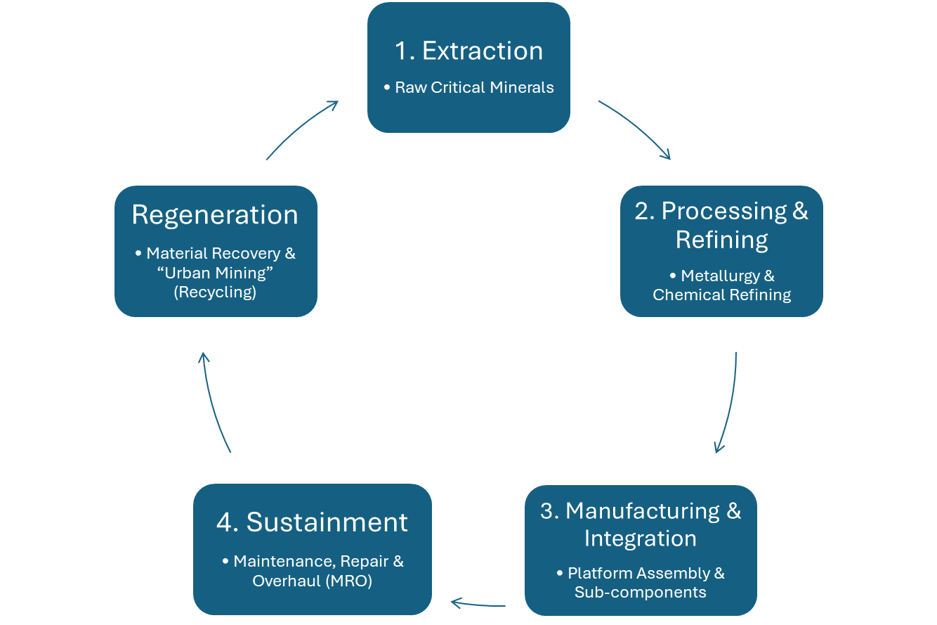
Traditional ‘production-centric’ policies usually focus exclusively on Stage 3 (Manufacturing). However, achieving industrial sovereignty requires managing material flows across the entire lifecycle, mitigating critical vulnerabilities in upstream extraction and processing (Stages 1 and 2) while leveraging downstream regeneration (Stage 5) to feed materials back into the supply chain.
The circular defence industrial base first starts with extraction of minerals. Canada possesses a significant natural resource endowment, ranking among the top five global producers for 14 of the 31 minerals on its critical list. However, raw extraction alone confers limited leverage. For example, while Canada is a major producer of nickel and cobalt, a significant portion of these raw materials is exported for processing and then re-imported in a refined, usable form. This ore processing gap is the second, and often most geopolitically sensitive, stage: processing. Refining, separation and advanced metallurgy convert raw inputs into industrial feedstock. Control at this stage determines whether a country merely possesses resources or can translate them into economic and military power.
The third stage, manufacturing and integration, is the most visible element of defence production. This is where components are fabricated and systems are assembled into final platforms. Canada’s National Shipbuilding Strategy (NSS) shows this stage in action. As one of the largest procurement initiatives in Canadian history, the NSS is investing tens of billions of dollars to have its three Canadian shipyards – Irving in Halifax, Seaspan in Vancouver and Davie in Lévis – build the next generation of naval and coast guard fleets. This stage is obviously vital, but it rests on the assumption that the preceding industrial base layers of extraction and processing are secure enough to provide the material inputs actually to make the ships on time, on budget.
Beyond production is the fourth stage of sustainment. This is the maintenance, repair, overhaul (MRO) and lifecycle support that keeps equipment operational. This stage is often more economically significant and industrially demanding over the long term than initial manufacturing. Canada’s world-class aerospace MRO sector is a prime example of a successful sustainment ecosystem. As a global leader in areas like helicopter and turboprop engine MRO, this sector contributes over $34 billion to Canada’s GDP and employs a highly skilled workforce of 225,000 people, with a deep network of specialized suppliers. It shows that Canada has the capacity to build and maintain a durable and effective industrial ecosystem. In contrast, the maritime sector is much more fragile. While the In-Service Support (ISS) contracts to maintain Canada’s 12 Halifax-class frigates are valued at over $7.5 billion, creating a significant industrial footprint, the fleet’s low readiness rates reveal a deeper problem. This mismatch illustrates the ‘hollow force’ risk: fielding modern platforms but lacking the industrial depth and capacity to keep them serviced and deployed. While the Royal Canadian Navy (RCN) suffers a shortage of sailors that leaves ships stuck in port, the more relevant constraint for the defence industrial base is the shortage of qualified welders, machinists, engineers and marine technicians required to sustain repair capacity. A lack of sailors is a military readiness crisis; a lack of skilled tradespeople is an industrial crisis.
The final stage, often overlooked, is regeneration. End-of-life dismantling, recycling and material recovery return industrial inputs back into the production cycle. While Canada has some capacity in this area, such as the ship-breaking facility at Port Colborne, Ontario, this stage represents a massive, largely untapped strategic opportunity. In a world of long mining timelines and concentrated processing, regeneration is a form of strategic industrial insurance. The European Defence Agency provides a clear model here with its MICRAM project, as does the Pentagon with grants to companies to develop recycling capacity; both are developing technologies to recover critical raw materials and rare earths from end-of-life electronics for use in new high-tech defence applications. Such ‘urban mining’ shortens supply chains and reduces exposure to external disruptions. While recovered materials usually cost more due to the labour-intensive disassembly of complex military hardware and the specialized refining required to meet strict military-grade purity standards, such diversification of mineral and rare earth inputs is a ‘minor tax’ to pay to avoid being economically coerced by China.
Taken together, these stages form a closed industrial loop. Weakness at any point introduces systemic fragility. A country may assemble ships (manufacturing) yet depend on foreign-processed steel (processing). It may extract raw nickel (extraction) yet lack the capacity to turn it into specialty alloys. It may build equipment yet outsource its dismantling and material recovery (regeneration). Industrial base sovereignty becomes cracked wherever a step is not maximized, and de-risked from adversarial threats like China. For Canada, adopting a circular framework provides a disciplined way to identify which nodes require national control, which can be embedded within trusted alliances, and where regeneration can reduce long-term vulnerability.
Operationalizing Lifecycle Sovereignty to Make Canada a Dependable NATO Pillar
Operationalizing Canada’s industrial sovereignty requires alignment of efforts with the needs of the NATO alliance, pursuing strategic specialization to become an indispensable, reliable partner. This approach involves securing critical nodes within the allied industrial base, a goal that directly supports NATO’s Defence Production Action Plan (DPAP) and fulfills a key objective of the Defence Industrial Strategy (DIS): the diversification of Canada’s defence relationships. Achieving this depends on Ottawa pursuing five mutually reinforcing lines of effort: (1) becoming a secure source of processed materials; (2 deepening the industrial ecosystem through smart procurement; (3) leading in industrial regeneration; (4) embedding these strengths within the broader NATO industrial network; and (5) investing in digital infrastructure and human capital to enable a modern industrial base.
First, Canada must focus on being a secure source of processed materials for the entire alliance. Upstream processing and advanced metallurgy offer the most significant leverage, as value and strategic control accrue at the refinement stage. By transforming its raw resources into high-purity inputs, Canada can become a trusted supplier. Ottawa has already committed $222 million to this goal through its Critical Minerals Infrastructure Fund. Moreover, projects like the Nechalacho mine in the Northwest Territories and the Saskatoon rare earth processing facility are the first steps. By scaling these facilities to produce materials like neodymium-praseodymium (NdPr) oxide (needed to make magnets in F-35s and naval motors), Canada can be a major foundational pillar of critical alliance-wide supply chains.
Second, procurement policy can be aligned to create industrial ecosystem depth that benefits both Canada and its allies. The new Build-Partner-Buy framework in Canada’s Defence Industrial Strategy provides the blueprint. Most importantly, the ‘Partner’ pillar encourages co-development and co-production with trusted allies. When Canada procures a platform like the P-8A Poseidon, it also secures long-term sustainment work, as seen in the partnerships established with companies like CAE, GE and L3Harris, turning a purchase into a decades-long industrial collaboration. This approach provides Canadian sub-tier suppliers with the predictable demand needed to invest and scale, positioning them as qualified suppliers for shared allied platforms.
Third, Canada should invest to become a NATO leader in industrial regeneration. Advanced material recovery from end-of-life equipment shortens supply chains and insulates the alliance from supply shocks. Canada can take a leading role by adopting and scaling concepts already being tested in Europe. For instance, the European Defence Agency’s (EDA) IOTA 2 project is developing a Digital Product Passport (DPP) for military body armour to track materials and enable recycling. By creating similar DPP systems and developing advanced recovery facilities, Canada could offer circular supply chain services across the alliance, turning allied waste streams into a secure source of critical materials.
Fourth, these specialized national strengths can be deliberately embedded within a broader NATO distributed industrial ecosystem. The goal is for Canada to become the alliance’s indispensable provider for specific capabilities. This means specializing in areas of natural advantage like cold-weather testing and sustainment of Arctic-capable equipment, and then offering these services to all allies. It also means using the new Defence Investment Agency (DIA) to pursue joint procurement with partners, aggregating demand alongside DPAP recommendations. This distributed model, where Canadian industrial sovereignty is layered with allied integration, is the most effective path forward. By aligning its industrial strategy with alliance needs, Canada evolves into a critical producer of security, reinforcing NATO warfighting ambitions with a matching industrial base.
Finally, Canada must build the foundational human infrastructure and digital capabilities that enables a modern industrial base. On the human front, the industrial base cannot be resilient if the manufacturing workforce is understaffed. While the personnel shortages of the Canadian Armed Forces are a readiness issue, the primary industrial base bottleneck is a lack of qualified welders, machinists, engineers and technicians. Thus, any industrial strategy must be paired with a national workforce development plan, beyond the meager March 2026 proposal of $94.5 million over five years with the Sectoral Workforce Solutions Program (SWSP). Ottawa should scale successful models like the National Shipbuilding Strategy and its partnerships with colleges and unions to build the next generation of skilled trades and technical experts that are needed for military readiness and industrial capacity.
On the digital front, Canada should lead in building a secure ‘digital backbone’ by mandating ‘digital twins’ for new platforms like the River-class destroyers (made by Irving Shipbuilding) and adopting Digital Product Passports to track critical components. While applying these digital models to new platforms like the River-class destroyers is complex, given that key sub-systems and intellectual property are controlled by US prime contractors, based on earlier RCN procurement decisions, the effort remains essential. This provides visibility over the entire supply chain, counters the threat of counterfeit parts, and enables a true circular economy. As NATO is already developing digital twins for predictive maintenance and planning, Canadian leadership in this area would make it a pivotal partner in a digitally interoperable alliance.
Conclusion: From ‘Buy Canada’ to being a Pillar of the Alliance
Canada’s industrial pivot is overdue and strategically sound. In the era of supply-chain coercion, long lead times, and upstream chokepoints, the old assumption that sovereignty can be outsourced while readiness remains intact no longer holds. Achieving sovereignty in the context of deglobalization and decoupling means making supply chains secure from adversarial coercion. Raising domestic production is a start, but it is not the same thing as building resilience. A country can assemble more at home and still remain dependent where it matters most.
Operationalizing a circular, lifecycle approach to the defence industrial base gives Canada the best way of strengthening its role within NATO, meaning Ottawa should pursue these four policies:
- Launch a ‘Mine-to-Magnet’ Critical Minerals Initiative: Go beyond funding raw extraction and invest aggressively in domestic processing and metallurgy. Prioritize scaling up facilities to produce high-value materials (such as specialized alloys and gallium nitride (GaN) for advanced radars and semiconductors), positioning Canada as the most reliable supplier of these strategic inputs for the entire NATO industrial base.
- Mandate ‘Lifecycle Procurement’ through the Defence Investment Agency: Reform procurement criteria to evaluate bids on the strength of their full lifecycle plan. This includes the use of Canadian sub-suppliers for sustainment, plans for end-of-life material regeneration, and the mandatory use of Digital Product Passports to maximize supply-chain transparency from origin to recycling.
- Establish a National Defence Workforce and Skills Strategy: Collaborate with provinces, industry and academic institutions to create a dedicated strategy to address shortfalls in the Canadian Armed Forces and to ensure there is a dedicated pipeline of skilled workers that can seamlessly join the defence industry. This means dramatically scaling up apprenticeships, funding specialized high school and college programs for marine and aerospace technicians, and creating incentives for careers in the defence sector.
- Apply to NATO for Canada to host a new NATO Centre of Excellence for Arctic Materiel Technology and Sustainment: While Norway already has a NATO Centre of Excellence for Cold Weather Operations, this Canadian centre would be dedicated to the industrial and technological challenges of the High North. It would be a NATO hub for MRO, and also testing, validating and developing standards for equipment and weapon systems designed to function in extreme cold. This provides a distinct, high-value contribution that complements existing NATO structures and leverages Canadian industrial expertise for Arctic warfighting.
By moving beyond a narrow focus on domestic production quotas and instead specializing in strategic nodes, such as critical mineral processing to advanced material regeneration, Canada can de-risk its vulnerabilities while simultaneously becoming an indispensable pillar of NATO’s collective industrial resilience. However, Ottawa must remain realistic about implementation. The 70% domestic spending target should be treated as a forcing mechanism – not a rigid requirement – to facilitate the deepening of Canadian industrial participation and sustainment capacity, especially given the Canadian Armed Forces’ requirement for top-tier capability, which often necessitates American-sourced platforms. Furthermore, because much of this allied integration will run through national procurement rules, bilateral agreements and European Union defence-industrial regulations, NATO should be treated as the strategic framework.
This is the true meaning of moving beyond Buy Canada: it is a strategic shift toward building specialized capacity that underwrites alliance security. Ultimately, a circular defence industrial base offers Canada a path toward genuine, structural sovereignty that benefits the entire alliance. A more resilient Canadian industrial base would not weaken North American defence cooperation; it would make Canada a more credible contributor to it. By securing its upstream materials and downstream sustainment, Canada can finally transition from a consumer of security to an indispensable guarantor of it. Canadian industrial durability must become concrete rather than symbolic gestures. By designing a defence industrial system capable of producing capability, sustaining and regenerating it, Canada can strengthen Arctic security, reinforce NORAD commitments, enhance its credibility as an ally, and ensure its industrial sovereignty is structural. Canada cannot chase the allure of building it all at home, instead, an enduring industrial ecosystem is needed that empowers the entire alliance. It is time for Ottawa to build an industrial base fit for a contested world.
About the Author
Jahara Matisek, PhD, is a US Air Force command pilot, senior fellow at the Payne Institute for Public Policy, and a visiting scholar at Northwestern University. The views in this article are his own and do not represent those of the US Air Force, Department of War, or any part of the US government.
Canadian Global Affairs Institute
The Canadian Global Affairs Institute focuses on the entire range of Canada’s international relations in all its forms including trade investment and international capacity building. Successor to the Canadian Defence and Foreign Affairs Institute (CDFAI, which was established in 2001), the Institute works to inform Canadians about the importance of having a respected and influential voice in those parts of the globe where Canada has significant interests due to trade and investment, origins of Canada’s population, geographic security (and especially security of North America in conjunction with the United States), social development, or the peace and freedom of allied nations. The Institute aims to demonstrate to Canadians the importance of comprehensive foreign, defence and trade policies which both express our values and represent our interests.
The Institute was created to bridge the gap between what Canadians need to know about Canadian international activities and what they do know. Historically Canadians have tended to look abroad out of a search for markets because Canada depends heavily on foreign trade. In the modern post-Cold War world, however, global security and stability have become the bedrocks of global commerce and the free movement of people, goods and ideas across international boundaries. Canada has striven to open the world since the 1930s and was a driving factor behind the adoption of the main structures which underpin globalization such as the International Monetary Fund, the World Bank, the World Trade Organization and emerging free trade networks connecting dozens of international economies. The Canadian Global Affairs Institute recognizes Canada’s contribution to a globalized world and aims to inform Canadians about Canada’s role in that process and the connection between globalization and security.
In all its activities the Institute is a charitable, non-partisan, non-advocacy organization that provides a platform for a variety of viewpoints. It is supported financially by the contributions of individuals, foundations, and corporations. Conclusions or opinions expressed in Institute publications and programs are those of the author(s) and do not necessarily reflect the views of Institute staff, fellows, directors, advisors or any individuals or organizations that provide financial support to, or collaborate with, the Institute.


Showing 1 reaction