
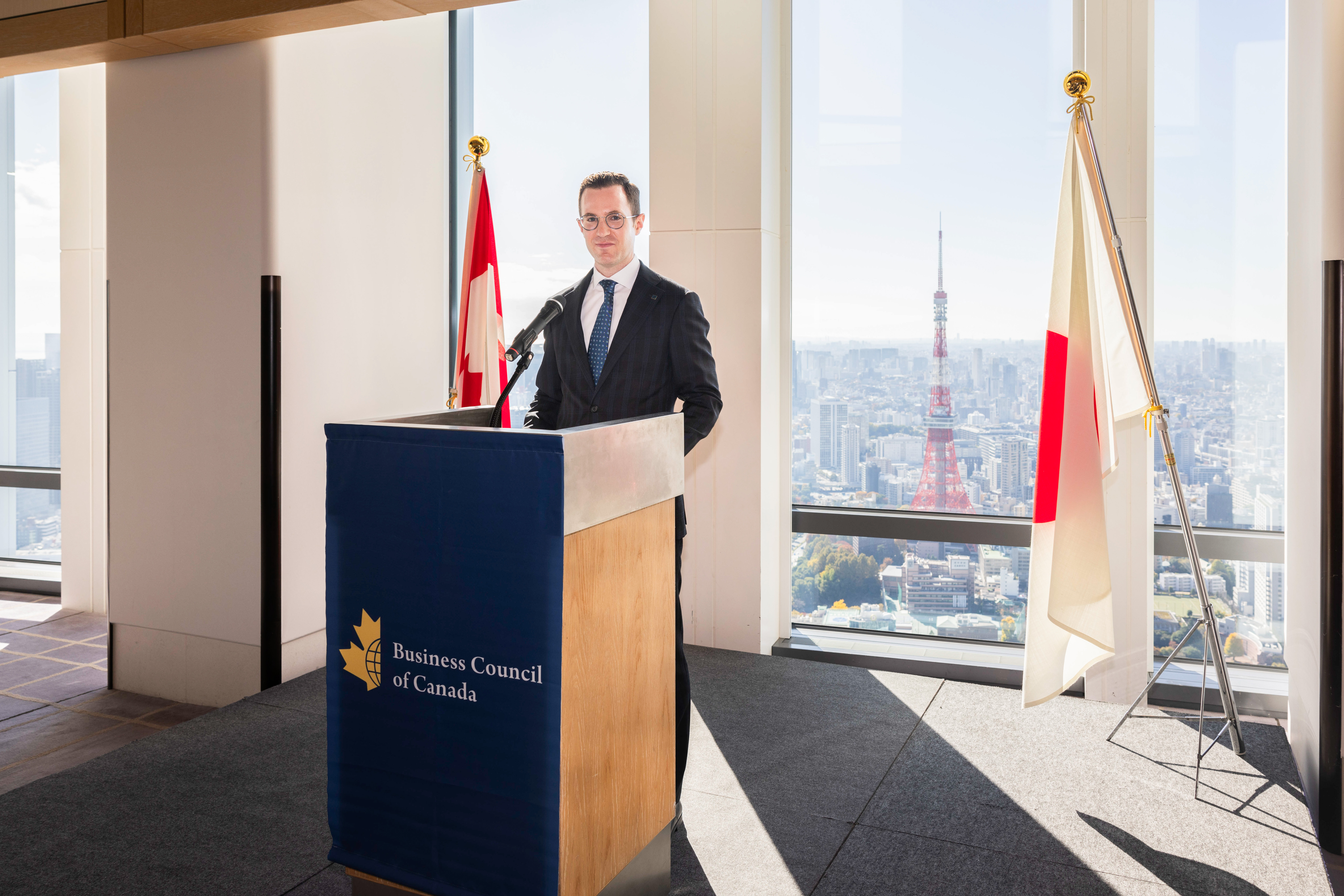
Image: Business Council of Canada
by Trevor Kennedy
October 2025
Table of Contents
- Introduction
- Canadians in Asia
- Enhanced Visibility
- Close the Knowledge Gap
- Towards the Future
- About the Author
- Canadian Global Affairs Institute
Introduction
A year ago, I moved with my family from Ottawa to Tokyo to establish a permanent Asia-Pacific footprint on behalf of the Business Council of Canada. It has been a challenging, exciting, and overall rewarding experience so far.
To say this has been an interesting time to be in the region feels like an understatement. The past 12 months have been a period of momentous change both within Canada and globally, with wide-reaching implications for Canada’s regional efforts and ambitions.
Over the course of the last year, I had the opportunity to travel to most major regional markets including India, Australia, China, South Korea, and across Southeast Asia, often with delegations of Canadians. Being on the ground and seeing Canada in action, and participating in Canada’s efforts directly, has provided a unique perspective. I am seeing first-hand the positive effects of Canada’s efforts to build stronger ties in the region, in addition to recognizing where there is room for improvements, and how our country is viewed by our partners.
Here are my takeaways and suggestions based on what I have learned so far.
Canadians In Asia
Rarely a week goes by that business delegations, political leaders, or others, do not pass through Tokyo. And if not here, I often see Canadians travelling elsewhere in the region. Canadians deserve credit for their willingness to get on an airplane and fly 10+ hours across the world, and often at great expense.
While some Canadians are travelling here, there are many more living and working across the region full time in support of stronger economic ties than just a few years ago.
Canada is fortunate to enjoy a strong and active network of chambers and business councils across every important market. These groups vary in size and activity, but all make meaningful contributions by engaging and holding together the Canadian business community in each market.
Since the release of Canada’s Indo-Pacific Strategy in 2022, Canada’s official regional presence has expanded dramatically. In addition to extra diplomats and other federal officials, Canadian provinces and their investment attraction agencies have scaled up their presence across key markets in the region. Export Development Canada has rapidly built an extensive network of new offices which should help it to support Canadian companies as they seek to diversify. The Asia Pacific Foundation of Canada has also recently established its first Asia office in Singapore, which should lead to more activities in the region and help to build stronger ties with its local partners. Finally, the Business Council of Canada was the Canadian national business association to establish an office in the region last year, of which I am incredibly proud to be a part. I believe we are making an important contribution to Canada’s broader efforts to build greater economic and cultural ties with key partners.
Enhanced Visibility
While there are many more of us here, we need to be more strategic and opportunistic to ensure Canada is on the minds of our partners. It is an unfortunate reality that Canada can easily be overlooked. We will not be automatically welcomed as a regular fixture in the region without ongoing effort and creativity, and we may need to elbow our way into important national and regional dialogues. A big part of my focus this past year has been to explore and identify gatherings where Canada can be part of broader regional conversations.
There are many existing important bilateral forums and gatherings in the region, but whenever Canada is not the focus, we are rarely visible. We need to reach beyond our traditional networks if we want to elevate our standing and be viewed more frequently as a partner. By comparison, I have witnessed a significant uptick in European activity in the region over the past year, both at an EU level and among the U.K.- and EU member-state level across various summits, gatherings and other important events. This deeper engagement extends to civil society and Europe has managed to position itself as a key partner to much of Asia in an uncertain world. Australia often receives a nod as well. It will continue to be a struggle to get Canada on the radar based on our current approach.
To be clear, Canada has a strong network, including many business and political leaders with deep personal connections to Canada. But our existing networks are usually already closely linked to Canada. We are often preaching to the choir, so to speak. As an organization, the Business Council of Canada will continue to explore where we can play a role and hopefully amplify Canada’s position by working to reach new audiences and key decision makers. We hope others will join us in this effort.
Close the Knowledge Gap
For those who have worked in or studied Asia-Pacific policy in Canada, it is often a shared experienced to feel frustrated by how little is known or understood about the region within Canada, despite its importance to Canada’s economy. We have a lot of work to do to improve Asia awareness in Canada, however, we should not overlook the need to improve Canada awareness in Asia as well.
We have a great reputation, for the most part. But as an economic partner, Canada’s strengths – e.g., natural resources, agriculture, financial services, fashion, and technology – are not well known outside of our traditional circles.
Whenever discussing Canada’s strengths in the region, I often find the other party tends to be unaware of what we have to offer as a country, even if they are in urgent need of what we could provide, whether it be goods or services. For instance, Canada is a relatively new player to the region when it comes to exporting natural gas, oil, or other valuable resources. Even the policy and business communities of intricately linked markets to Canada, such as Japan or South Korea, do not really know that we produce these resources, and even less so that we have gained access to the regional market through the LNG Canada project or the Trans Mountain pipeline.
While trade diversification has been a long-time focus for policymakers in Canada, it is also now a priority for countries across this region. Complicated factors, such as unstable shipping routes, competition for natural resources, in additional to growing uncertainty around trade rules, have left regional economies scrambling for diversification opportunities, often with a focus on enhanced resiliency. While some markets provide more opportunities than others, Canada, overall, can be an important diversification partner for Asia.
Wherever Canada is well understood, it has been encouraging to see a high degree of interest. Countries and businesses in this region are looking for solutions and for partners that can address concerns in a timely, reliable, and affordable manner. Canada is well positioned in most cases.
As a country, we need to be more aggressive in promoting our goods and services, as well as explaining to Canadian businesses unfamiliar with the region where they can benefit in specific markets.
Towards the Future
This Fall marks the third anniversary of the release of our Indo-Pacific Strategy. This was a historic policy document for Canada and set in motion a significant shift in government and private sector resources toward the goal of strengthening economic ties with this diverse, complex, and lucrative region.
It is clear to me that we are making slow, but steady, progress. However, the greatest risk to our success is our own disengagement. Canada’s reputation across Asia is that we come and go. As an official once said to me, Canada’s engagement can feel like a “drive by shooting.” Beyond major delegations where we have a substantial impact, Canada can feel absent, or worse, we fail to move forward with commitments we made to each market.
It will be helpful if in the months ahead Canada reaffirms its commitment and focus on the region. Prime Minister Carney will have an opportunity to do this when he makes his first visit this fall to attend APEC and ASEAN Summits. But beyond these major summits, those of us on the ground, and those who are willing travel, will need to keep up the engagement and ensure we are working strategically at building more meaningful and resilient ties.
It can sometimes be difficult to be optimistic given the various global challenges we face, but I do have a sense of optimism for Canada in the region. There is a mutual interest in building stronger ties, even more so than when I first arrived. I look forward to continuing to be a part of this effort.
About the Author
Trevor Kennedy is the Vice President - Trade and International Policy of the Business Council of Canada. He leads the council's work on Canada's international trade and investment ties. He advises and executes the council's trade policy initiatives, liaising with Canadian policymakers, foreign officials and international business networks representing key partners, primarily in North America, the Indo-Pacific and Europe.
Prior to joining the council in 2016, Trevor was a Trade Policy Officer at Global Affairs Canada. He also worked with the Asia Pacific Foundation of Canada as a Junior Research Fellow focused on trade policy. He has lived and worked in Japan with the Japan Exchange (JET) Programme and speaks Japanese.
Trevor is a fellow with the Canadian Global Affairs Institute. He holds a Master of Arts in Asia Pacific Policy Studies from the University of British Columbia and a Bachelor of Arts in International Relations from St. Thomas University, New Brunswick.
Canadian Global Affairs Institute
The Canadian Global Affairs Institute focuses on the entire range of Canada’s international relations in all its forms including trade investment and international capacity building. Successor to the Canadian Defence and Foreign Affairs Institute (CDFAI, which was established in 2001), the Institute works to inform Canadians about the importance of having a respected and influential voice in those parts of the globe where Canada has significant interests due to trade and investment, origins of Canada’s population, geographic security (and especially security of North America in conjunction with the United States), social development, or the peace and freedom of allied nations. The Institute aims to demonstrate to Canadians the importance of comprehensive foreign, defence and trade policies which both express our values and represent our interests.
The Institute was created to bridge the gap between what Canadians need to know about Canadian international activities and what they do know. Historically Canadians have tended to look abroad out of a search for markets because Canada depends heavily on foreign trade. In the modern post-Cold War world, however, global security and stability have become the bedrocks of global commerce and the free movement of people, goods and ideas across international boundaries. Canada has striven to open the world since the 1930s and was a driving factor behind the adoption of the main structures which underpin globalization such as the International Monetary Fund, the World Bank, the World Trade Organization and emerging free trade networks connecting dozens of international economies. The Canadian Global Affairs Institute recognizes Canada’s contribution to a globalized world and aims to inform Canadians about Canada’s role in that process and the connection between globalization and security.
In all its activities the Institute is a charitable, non-partisan, non-advocacy organization that provides a platform for a variety of viewpoints. It is supported financially by the contributions of individuals, foundations, and corporations. Conclusions or opinions expressed in Institute publications and programs are those of the author(s) and do not necessarily reflect the views of Institute staff, fellows, directors, advisors or any individuals or organizations that provide financial support to, or collaborate with, the Institute.


Showing 1 reaction