
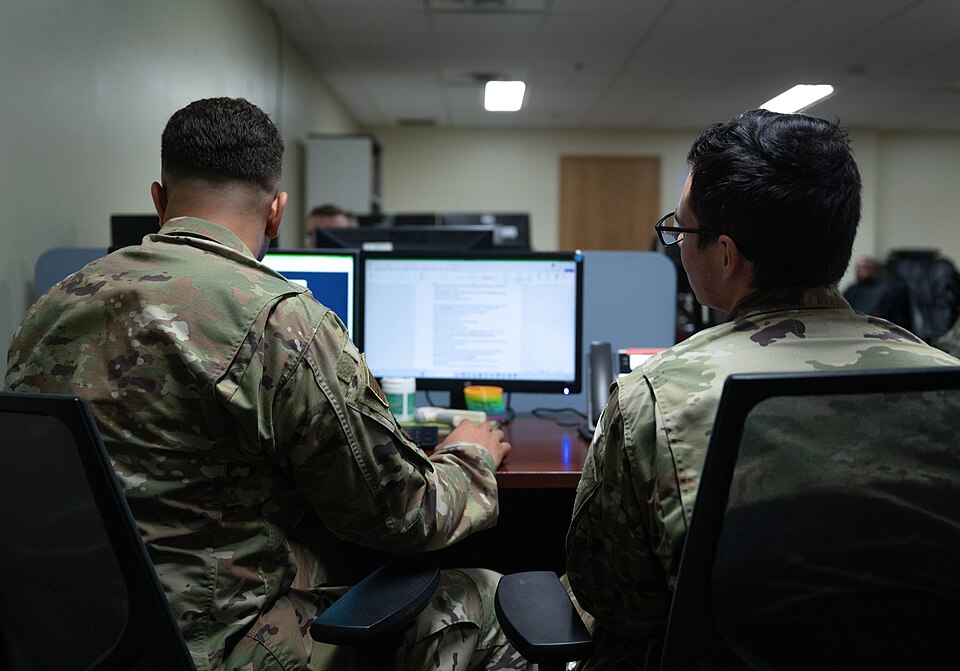
Photo by: Senior Airman Jamal Berry II
by Dr. Jeehye Kim
August 2026
Table of Contents
- Summary
- Background
- Canada–Japan Cybersecurity Cooperation: strategic, high-level
- Canada–ROK Cybersecurity Cooperation: operational, working-level
- Implications for Canada
- About the Author
- Canadian Global Affairs Institute
Summary
- The North Pacific is home to many of the world's most digitally connected economies, all of which depend heavily on supply chains, telecommunications infrastructure, and undersea cables that are vulnerable to state-sponsored and hybrid cyber threats. The February 2025 Bybit theft, in which the North Korean hacker group Lazarus stole $1.5 billion in Ethereum tokens in the largest single cryptocurrency theft on record, illustrates both the scale of DPRK cyber-enabled sanctions evasion and the broader risks posed by malicious cyber activity. Such cybercrime is a critical concern for Canada, not only because it generates illicit funds that finance activities directly threatening Canada's national security, such as North Korea's nuclear and ballistic missile programs, but also because it increases the vulnerability of Canada's financial system to sophisticated money laundering schemes.
- Although both partnerships support Canada's Indo-Pacific Strategy, Japan and Korea differ on focus: Japan currently leads the way as one of Canada's primary strategic partners on cyber governance and critical infrastructure resilience while South Korea has become one of Canada’s operational partners in digital and defence technology collaboration. Understanding these complementary strengths can help Canada prioritize its future cyber defence initiatives with both partners.
- Canada’s cybersecurity cooperation with Japan is centred on norm-building among like-minded democracies, an extension of shared G7 membership and Japanese leadership in regional security architecture such as the QUAD and Free and Open Indo-Pacific (FOIP) strategy. By contrast, Canada’s cooperation with South Korea on cyber security has been either specifically addressing North Korean cyber crime, or linked to industrial and commercial applications that benefit from South Korea’s world-leading expertise in semiconductors manufacturing.
Background
Canada has significantly expanded cybersecurity cooperation with both Japan and South Korea since the inception of its Indo-Pacific strategy in 2022. Canada-Japan cooperation has moved from framework to practice in just under a year: the March 2026 Canada–Japan Comprehensive Strategic Partnership significantly elevated bilateral defence ties by institutionalising a whole-of-government framework that expands operational interoperability, joint exercises, coast guard and maritime cooperation, cybersecurity collaboration, and defence industrial integration. The January 2026 Equipment and Technology Transfer Agreement (ETTA), which facilitates defence co-development and controlled technology transfers, and the July 2025 Security of Information Agreement (entered into force January 2026), have already established shared standards for protecting classified information. The June 2026 Team Canada trade mission further advanced practical implementation.
For South Korea, the signing of the Security and Defence Cooperation Partnership (SDCP) in October 2025 was a major milestone because it institutionalized Canada–ROK defence relations through a formal governance dialogue and significantly broadened the scope of cooperation to include cyber, artificial intelligence, space security, Arctic-related discussions. This milestone was reinforced by the February 2026 Agreement on the Protection of Military and Defence Classified Information signed during the bilateral 2+2 ministerial meeting, which established common standards for classification equivalence, access control, and use restrictions, thereby streamlining information sharing and facilitating deeper defence technology and industrial cooperation.
The strategic nature of Canada’s cybersecurity cooperation with Japan is exemplified by its foundational scope of the bilateral SIA (2025) and its flagship cyber exercise, the MASAKARI 25, which was the first of its kind to improve practical cyber integration between the two nations. Conducted under Canada’s Operation HORIZON, it brought together the Canadian Armed Forces Cyber Command (CAFCYBERCOM) and the Japan Self-Defense Forces Cyber Defense Command (JCDC) and complemented Canada's participation in multilateral cyber exercises such as the NATO Cyber Coalition. MASAKARI 25 was significant because it transformed Canada–Japan cybersecurity cooperation from strategic dialogue into hands-on collaboration that strengthened interoperability and laid the foundation for a more institutionalized bilateral cyber partnership that supports both national defence and economic security.
Meanwhile, the Canada-ROK cybersecurity cooperation has been more operational in character, as indicated by the bilateral GSOMIA (signed in 2026) that emphasizes intelligence sharing over norm building, and two global cyber exercises last year. A Canada-ROK unified team participated in LOCKED SHIELDS in May 2025, and the Canadian Armed Forces Cyber Command (CAFCYBERCOM) participated in the Allied Power Exercise (APEX) in September 2025 that was co-hosted by South Korea’s National Cyber Security Center (NCSC) and NATO’s Cooperative Cyber Defence Centre of Excellence (CCDCOE), where training and practice occurred in a larger, multinational setting with limited opportunities for high-level coordination.
Canada–Japan Cybersecurity Cooperation: strategic, high-level
- Regional military deterrence: Cooperation is primarily military in nature in order to protect physical critical infrastructure assets including energy grids and transportation systems against potential state-actors such as China and Russia, and possible contingencies in the East China Sea.
- Governance within multilateral institutions: Japan serves as Canada's principal partner within the G7. Its close alignment with NATO and Indo-Pacific security architecture is a useful leverage to build broader, regionally applicable cyber norms and initiatives such as G7’s Data Free Flow with Trust (DFFT).
Canada–ROK Cybersecurity Cooperation: operational, working-level
- Interest in multilateral engagement despite more geographically limited concerns: Recent agreements emphasize intelligence sharing and incident response against growing cybercrime by North Korea, and Korea is less eager than Japan on viewing China and Russia as state sponsors.
- Defence Industrial linkage: The February 2026 Security and Defence Cooperation Partnership (SDCP) links cybersecurity directly with defence technology and industrial cooperation. As a highly digitized nation, ROK seeks Canadian expertise on AI and quantum technology research, while offering expertise on semiconductors and 5G/6G networks.
Implications for Canada
The cyber dimension is one component of Canada’s broader alliance-management with Japan and South Korea. As both countries may see a Canada-initiated trilateral cyber framework as redundant next to the existing US-Japan-ROK trilateral structure, which took real diplomatic investment to build, Canada should consider a narrower opening move. This could involve a lower-friction entry point that could earn trust before any broader trilateral upgrade. Canada offering specific technical value in maritime domain awareness or undersea-cable resilience, for example, are areas where it has genuine comparative advantage and where neither Tokyo nor Seoul would interpret the offer as duplicating or diluting their other relationships.
- Deepen Trilateral Cooperation: Canada should leverage its bilateral cooperation with each of Japan and South Korea in two ways: first, by instituting trilateral cyber dialogues similar to the US-Japan-ROK Trilateral Diplomatic Working Group Meeting on Democratic People’s Republic of Korea Cyber Activities, and second, consider a trilateral version of MASAKARI 25 that includes ROK. This exercise could be similar to RIMPAC but with a more substantial focus on cybersecurity, addressing gaps in information sharing and interoperability for active defence of the North Pacific. An incident like Bybit typically depends on shared threat intelligence across exchanges and jurisdictions; laundering pathways cross borders by design (multi-chain bridges, exchange-adjacent services); sanctions enforcement against DPRK IT-worker schemes only closes gaps if partners coordinate designations.
- Expand maritime domain awareness: Collaborate with Japan and ROK to advance research on smart ports, autonomous shipping, naval cyber resilience, and undersea cable protection. Canada can leverage its strength in AI to jointly develop AI-enabled cyber defence and responsible military AI governance in the maritime domain.
- Capacity Building: Jointly support Indo-Pacific partners through cyber training, incident response exercises, and digital governance assistance. Aim to enhance defence interoperability with like-minded democratic allies in the region – the G7 Rapid Response Mechanism and potential Five Eyes plus arrangements are some examples in which Canada takes advantage of its leadership in the G7 and Five Eyes to expand its influence in similar regional security initiatives in the Indo-Pacific.
With Japan as Canada's primary strategic partner for cyber governance and regional security, reflecting their shared G7 membership, and South Korea as its principal operational partner for digital infrastructure because of complementary technological strengths, Canada should pursue a cybersecurity strategy that advances both institutional norm building, including through the Data Free Flow with Trust (DFFT) initiative, and enhanced operational interoperability, including joint cyber exercises. These actions will boost the impact of Canada’s recently established GSOMIA-type arrangements with each of Japan and Korea, and enable Canada to improve threat-based intelligence and incident-response sharing to shape a secure and rules-based Indo-Pacific digital environment.
About the Author
Dr. Jeehye Kim is the Senior Program Manager of Northeast Asia at the Asia Pacific Foundation of Canada, overseeing the research program related to Japan, Mongolia, Republic of Korea, and Taiwan. She holds a PhD in Government from Harvard University, and currently focuses on emerging domains of defence and security cooperation between Canada and like-minded partners in the Indo-Pacific.
Canadian Global Affairs Institute
The Canadian Global Affairs Institute focuses on the entire range of Canada’s international relations in all its forms including trade investment and international capacity building. Successor to the Canadian Defence and Foreign Affairs Institute (CDFAI, which was established in 2001), the Institute works to inform Canadians about the importance of having a respected and influential voice in those parts of the globe where Canada has significant interests due to trade and investment, origins of Canada’s population, geographic security (and especially security of North America in conjunction with the United States), social development, or the peace and freedom of allied nations. The Institute aims to demonstrate to Canadians the importance of comprehensive foreign, defence and trade policies which both express our values and represent our interests.
The Institute was created to bridge the gap between what Canadians need to know about Canadian international activities and what they do know. Historically Canadians have tended to look abroad out of a search for markets because Canada depends heavily on foreign trade. In the modern post-Cold War world, however, global security and stability have become the bedrocks of global commerce and the free movement of people, goods and ideas across international boundaries. Canada has striven to open the world since the 1930s and was a driving factor behind the adoption of the main structures which underpin globalization such as the International Monetary Fund, the World Bank, the World Trade Organization and emerging free trade networks connecting dozens of international economies. The Canadian Global Affairs Institute recognizes Canada’s contribution to a globalized world and aims to inform Canadians about Canada’s role in that process and the connection between globalization and security.
In all its activities the Institute is a charitable, non-partisan, non-advocacy organization that provides a platform for a variety of viewpoints. It is supported financially by the contributions of individuals, foundations, and corporations. Conclusions or opinions expressed in Institute publications and programs are those of the author(s) and do not necessarily reflect the views of Institute staff, fellows, directors, advisors or any individuals or organizations that provide financial support to, or collaborate with, the Institute.
Showing 1 reaction