Download PDF
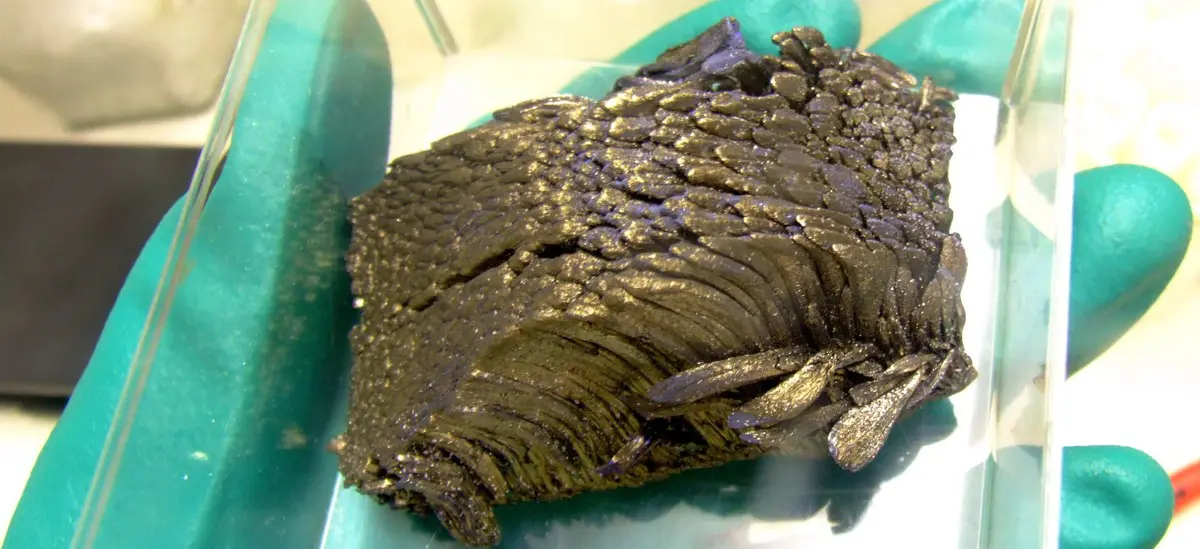
Image credit: Alchemist-hp/ WikiCommons
The security of critical minerals and materials supply has become a significant concern for many governments in light of COVID-19 disruptions to global supply chains. Geopolitical concerns on the security of the supply of critical minerals have increased, given China’s control of many of these supply chains. This is why Canada must establish a comprehensive critical minerals supply chain strategy. Blessed with abundant undeveloped resources of all the critical minerals, Canada lacks the downstream manufacturing capacity to create the internal demand to get started.
Many of these minerals, and the manufacturing capacity, are vital for creating the materials needed for renewable energy and electric vehicles, electronics and aerospace technologies. Important allies such as Japan already have much of the downstream value-added manufacturing capacity and they can inspire Canada to create incentives for more production of these critical minerals. Canada must act now, for the window of opportunity is closing fast due to more rapid advancement in other countries. Similar macroeconomic and political considerations have encouraged allies and competitors to take swift and more decisive action.
Australia, the European Union, the United Kingdom, the United States and even Russia are aggressively moving forward, making significant policy decisions, coupled with strategic investments and incentives to position themselves for success. For Canada, this is a matter of national, economic and technological security, but also an important opportunity because of our natural resource wealth to deepen ties with allies and move more rapidly toward a low-carbon economy. Innovation is key both in creating new technologies and in devising more efficient ways to recover critical minerals and process them in low-energy and environmentally friendly ways.
Canada and Japan, as well as other Asian countries including India, share many common values, such as promoting the rules-based international order, and are committed to deepening bilateral partnerships. In May 2021, the foreign ministers of Canada and Japan agreed on six areas of bilateral co-operation that will advance common interests in the Indo-Pacific region. These six areas are the rule of law; peacekeeping operations, peace building and humanitarian assistance and disaster relief; energy security; health security and responding to COVID-19; free trade promotion and trade agreement implementation; and the environment and climate change.
Both Canada and Japan are members of the G7, G20, Asia-Pacific Economic Cooperation (APEC), Comprehensive and Progressive Agreement for Trans-Pacific Partnership (CPTPP), Asian Development Bank (ADB), International Monetary Fund (IMF), ASEAN Regional Forum (ARF) and the Organization for Economic Co-operation and Development (OECD). Trade and economic relations between Canada and Japan have been steadily expanding, culminating in the 31st meeting of the Canada-Japan Joint Economic Committee (JEC) in December 2021.
The co-chairs recalled their countries’ recent commitments to expand bilateral co-operation in the Indo-Pacific to advance six shared priorities, including economic areas such as energy security, free trade promotion and trade agreement implementation, the environment and climate change. They welcomed the contribution these commitments make to Canada and Japan’s shared vision of a free and open Indo-Pacific, and toward deepening their strategic partnership potential. They recognized the important contribution the Canada-Japan trade and investment relationship makes to both countries’ economies and to their economic security. They acknowledged the significant role of bilateral commercial ties to energy, critical minerals and food security and agreed there is considerable potential to expand trade and investment in these areas.
According to the International Energy Agency (IEA), should the world begin to move with haste toward a more sustainable energy mix, demand for critical materials needed in clean technologies will far outstrip what is readily available today. The IEA estimates that a world on track for net-zero emissions in 2050 will by 2040 need six times as much of these critical materials as it does today. Meanwhile, global demand for the required critical minerals will skyrocket, from around 10 per cent of energy-related trade to roughly 50 per cent by 2050.
Canada and Japan can readily capitalize on this opportunity, advance their domestic visions to stimulate more economic development and help secure their clean energy futures.
Some specific recommendations include:
The clean energy transition and other new technology development require a complete transformation of the global economy and significant additional capital spending over the next three decades. This needs to be inspired by new government policy initiatives that will encourage more investment in innovation in new technologies.
In Canada this also involves updating regulatory policy in the mineral industry that has discouraged innovation in producing non-traditional commodities and denied access to historic mine wastes by entrepreneurs with ideas on extracting valuable rare elements from the wastes while remediating the long-term environmental liability.
This can also create many new economic development opportunities for Indigenous business and more remote First Nations communities that have not yet recognized that participating in critical minerals resource development can create wealth and prosperity for future generations while also preserving the environment.
Collaboration between Canada, Japan, India and other interested Indo-Pacific countries on clean energy economic partnerships can more rapidly foster the needed innovation to accelerate the transition to both the low-carbon economy and the circular economy.
Donald Bubar is a geologist with over 40 years of experience in mineral exploration and development in Canada. He is a graduate of McGill University (BSc. 1977) and Queen’s University (MSc. 1981). From 1984 to 1994, he worked for Aur Resources Inc. as exploration manager and later vice-president, exploration. Donald has been president and CEO of Avalon since 1995.
He served as a director of the Prospectors and Developers Association of Canada (PDAC) for nine years and chair of its Aboriginal Affairs Committee from its creation in December 2004 until retiring from the PDAC board in March 2013. Throughout his career, he has been an advocate for increased Indigenous participation in the mineral industry, first through the PDAC and later through the NWT and Nunavut Chamber of Mines. Donald serves on the advisory board to the Faculty of Science of McGill University and on the board of directors of PDAC’s Mining Matters earth science education program.
Zeeshan Syed is a graduate of the London School of Economics with a Masters degree in Comparative Politics and Economics, and has over fifteen years of multi-sector executive leadership. He has deep expertise as an international business development expert, climate change negotiator, nonprofit founder, and natural resources regulator, providing him a unique perspective of an energy system increasingly marked by change and disruption. Prior to joining Avalon in 2019, Mr. Syed was focused on public-private partnerships and management in public service, the nonprofit sector, and politics. He has served in the Office of the Prime Minister, with the Government of Alberta and with the United Nations Secretariat.
The Canadian Global Affairs Institute focuses on the entire range of Canada’s international relations in all its forms including (in partnership with the University of Calgary’s School of Public Policy), trade investment and international capacity building. Successor to the Canadian Defence and Foreign Affairs Institute (CDFAI, which was established in 2001), the Institute works to inform Canadians about the importance of having a respected and influential voice in those parts of the globe where Canada has significant interests due to trade and investment, origins of Canada’s population, geographic security (and especially security of North America in conjunction with the United States), social development, or the peace and freedom of allied nations. The Institute aims to demonstrate to Canadians the importance of comprehensive foreign, defence and trade policies which both express our values and represent our interests.
The Institute was created to bridge the gap between what Canadians need to know about Canadian international activities and what they do know. Historically Canadians have tended to look abroad out of a search for markets because Canada depends heavily on foreign trade. In the modern post-Cold War world, however, global security and stability have become the bedrocks of global commerce and the free movement of people, goods and ideas across international boundaries. Canada has striven to open the world since the 1930s and was a driving factor behind the adoption of the main structures which underpin globalization such as the International Monetary Fund, the World Bank, the World Trade Organization and emerging free trade networks connecting dozens of international economies. The Canadian Global Affairs Institute recognizes Canada’s contribution to a globalized world and aims to inform Canadians about Canada’s role in that process and the connection between globalization and security.
In all its activities the Institute is a charitable, non-partisan, non-advocacy organization that provides a platform for a variety of viewpoints. It is supported financially by the contributions of individuals, foundations, and corporations. Conclusions or opinions expressed in Institute publications and programs are those of the author(s) and do not necessarily reflect the views of Institute staff, fellows, directors, advisors or any individuals or organizations that provide financial support to, or collaborate with, the Institute.
