Download PDF
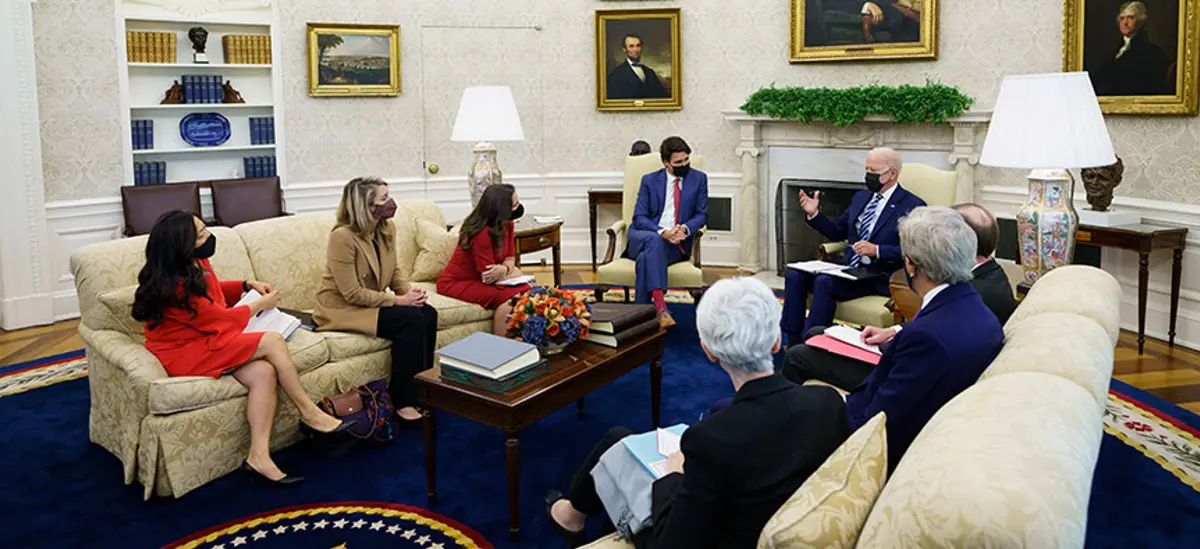
Image credit: Adam Scotti, Prime Minister’s Office
Recently, two respected groups of Canadian experts (many retired from extensive government service) have published reviews of the Canadian national security strategies. They had an unusual warning for Canada. Along with a focus on issues you might expect, such as global warming and competition with Russia, the University of Ottawa review voiced this surprising concern:
The [Canadian trucker] protests [at the U.S.-Canada border] also pointed to a broader and potentially existential question for Canada: the implications of democratic backsliding in the United States. Should scenarios of widespread political violence in our southern neighbour materialize, how should Canada respond? This question would have been fanciful only a few years ago, but it is very real today … An increasingly unpredictable and unilateral United States – especially if Donald Trump, or a like-minded Republican, wins the presidency in 2024 – could raise difficult questions. The United States is and will remain our closest ally, but it could also become a source of threat and instability.
Which raises a fascinating question. There must be a Canadian intelligence threat assessment of the United States, because to fail to have one would be professional malpractice of the highest order and the Canadian intelligence services are too competent to have ignored the question. On the other hand, no Canadian government could publicly acknowledge the existence of such an assessment, because doing so would be intensely politically embarrassing and disclosing the contents of the assessment would, of course, be contrary to Canada’s national interests. So, the assessment must be buried under the highest security classification possible, and we can only imagine its contents.
But we can speculate: What does the Canadian assessment of the United States actually say? Herewith some thoughts about what the executive summary of such a document might contain. We might imagine the director of the Canadian Security Intelligence Service writing as follows:
Of course, all of this is speculation. However, Canadians must be wondering what the future holds, and it is a reasonable bet that their own perspectives on the future bear some moderate resemblance to the foregoing. It is not for nothing that the late comedian Robin Williams’ quip about Canadians feeling like they live above a meth lab enjoys continued popularity as a meme, but there has always been an element of schadenfreude vis a vis our superpower neighbour. And that, in turn, is a depressing thought – for both Canadians and their downstairs neighbours.
Paul Rosenzweig is an accomplished writer and speaker with a national reputation in cyber security and homeland security. He is the founder of Red Branch Consulting PLLC, a homeland security consulting company. He is also a Senior Advisor to The Chertoff Group. Mr. Rosenzweig formerly served as Deputy Assistant Secretary for Policy in the Department of Homeland Security.
He is a Professorial Lecturer in Law at George Washington University, and a Senior Fellow in the Tech, Law & Security Program at the American University, Washington College of Law. He serves as an advisor to and former member of the American Bar Association Standing Committee on Law and National Security, and a Contributing Editor of the Lawfare blog. He is a member of the ABA Cybersecurity Legal Task Force and of the United States Court of Appeals for the District of Columbia Circuit Advisory Committee on Admissions and Grievances. He serves, as well, as a Hearing Committee Member of the District of Columbia Board of Professional Responsibility. In 2011 he was a Carnegie Fellow in National Security Journalism at the Medill School of Journalism, Northwestern University.
Mr. Rosenzweig is a cum laude graduate of the University of Chicago Law School. He has an M.S. in Chemical Oceanography from the Scripps Institution of Oceanography, University of California at San Diego and a B.A from Haverford College. Following graduation from law school he served as a law clerk to the Honorable R. Lanier Anderson, III of the United States Court of Appeals for the Eleventh Circuit.
He is the author of Cyber Warfare: How Conflicts in Cyberspace are Challenging America and Changing the World and of three video lecture series from The Great Courses, Thinking About Cybersecurity: From Cyber Crime to Cyber Warfare; The Surveillance State: Big Data, Freedom, and You; and Investigating American Presidents.
He is the co-author (with James Jay Carafano) of Winning the Long War: Lessons from the Cold War for Defeating Terrorism and Preserving Freedom and co-editor (with Jill D. Rhodes and Robert S. Litt) of the Cybersecurity Handbook (3rd ed.). He is also co-editor (with Timothy McNulty and Ellen Shearer) of two books, Whistleblowers, Leaks and the Media: The First Amendment and National Security, and National Security Law in the News: A Guide for Journalists, Scholars, and Policymakers. Mr. Rosenzweig is a member of the Literary Society of Washington.
The Canadian Global Affairs Institute focuses on the entire range of Canada’s international relations in all its forms including (in partnership with the University of Calgary’s School of Public Policy), trade investment and international capacity building. Successor to the Canadian Defence and Foreign Affairs Institute (CDFAI, which was established in 2001), the Institute works to inform Canadians about the importance of having a respected and influential voice in those parts of the globe where Canada has significant interests due to trade and investment, origins of Canada’s population, geographic security (and especially security of North America in conjunction with the United States), social development, or the peace and freedom of allied nations. The Institute aims to demonstrate to Canadians the importance of comprehensive foreign, defence and trade policies which both express our values and represent our interests.
The Institute was created to bridge the gap between what Canadians need to know about Canadian international activities and what they do know. Historically Canadians have tended to look abroad out of a search for markets because Canada depends heavily on foreign trade. In the modern post-Cold War world, however, global security and stability have become the bedrocks of global commerce and the free movement of people, goods and ideas across international boundaries. Canada has striven to open the world since the 1930s and was a driving factor behind the adoption of the main structures which underpin globalization such as the International Monetary Fund, the World Bank, the World Trade Organization and emerging free trade networks connecting dozens of international economies. The Canadian Global Affairs Institute recognizes Canada’s contribution to a globalized world and aims to inform Canadians about Canada’s role in that process and the connection between globalization and security.
In all its activities the Institute is a charitable, non-partisan, non-advocacy organization that provides a platform for a variety of viewpoints. It is supported financially by the contributions of individuals, foundations, and corporations. Conclusions or opinions expressed in Institute publications and programs are those of the author(s) and do not necessarily reflect the views of Institute staff, fellows, directors, advisors or any individuals or organizations that provide financial support to, or collaborate with, the Institute.
