Download PDF
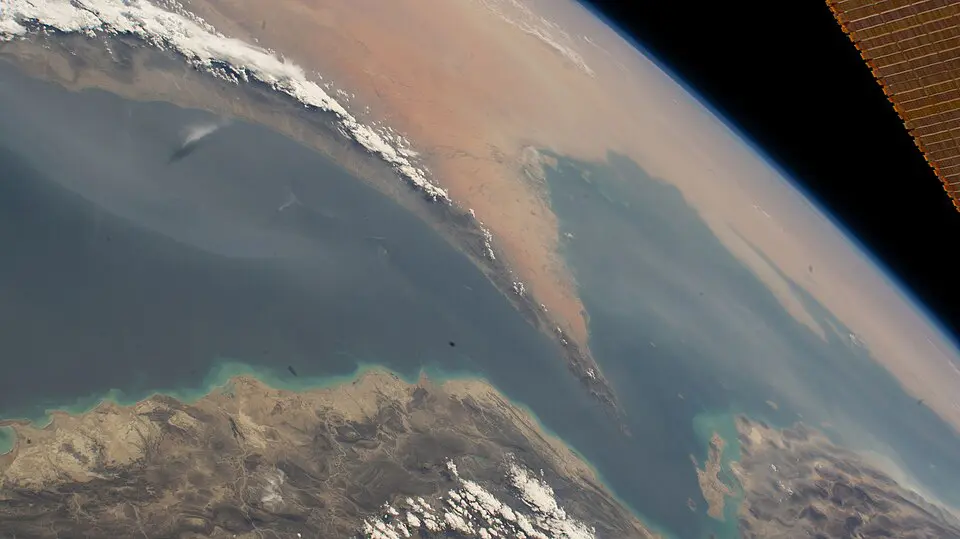
Photo by: NASA
Since early 2026, a US-Israel-Iran war has produced a severe test of chokepoint stability in the Strait of Hormuz
The central question is whether restrictions on maritime chokepoints will become established as a low-cost way for states and non-state actors to pursue asymmetric economic warfare, becoming a permanent feature of global commerce.
Chokepoints can be partially mitigated with alternative infrastructure built by the Persian Gulf countries.
The cost of the current disruption has fallen disproportionately on Asia.
Marine shippers have been forced to change their methods in response to the current crisis
Canada’s Pacific coast energy infrastructure does not rely on any of the world’s currently contested chokepoints, positioning Canada as a comparatively low-geopolitical-risk supplier to Asia-Pacific buyers.
The need to limit global vulnerability to maritime energy chokepoints aligns with Canada’s trade diversification goals, but may be hindered by poor execution.
Joe Calnan is Vice President, Energy and Calgary Operations and a Fellow at the Canadian Global Affairs Institute (CGAI). He is also Co-host of CGAI’s Energy Security Cubed podcast. He a Nonresident Senior Fellow at the Asia Pacific Foundation of Canada, and an Independent Committee Member of the Bilateral Energy Security Initiative (BESI) at the American Chamber of Commerce in Canada. His research focuses on the intersection between energy, economics, policy, and politics in relation to Canada’s role in international energy systems. He frequently appears in major Canadian and international media to provide expertise on energy security and energy trade issues. Joe received a Master’s Degree in Public Policy from the University of Calgary with a focus on Canadian energy and natural resources, and also holds a Bachelor of Arts in Western Society and Culture from Concordia University.
The Canadian Global Affairs Institute focuses on the entire range of Canada’s international relations in all its forms including trade investment and international capacity building. Successor to the Canadian Defence and Foreign Affairs Institute (CDFAI, which was established in 2001), the Institute works to inform Canadians about the importance of having a respected and influential voice in those parts of the globe where Canada has significant interests due to trade and investment, origins of Canada’s population, geographic security (and especially security of North America in conjunction with the United States), social development, or the peace and freedom of allied nations. The Institute aims to demonstrate to Canadians the importance of comprehensive foreign, defence and trade policies which both express our values and represent our interests.
The Institute was created to bridge the gap between what Canadians need to know about Canadian international activities and what they do know. Historically Canadians have tended to look abroad out of a search for markets because Canada depends heavily on foreign trade. In the modern post-Cold War world, however, global security and stability have become the bedrocks of global commerce and the free movement of people, goods and ideas across international boundaries. Canada has striven to open the world since the 1930s and was a driving factor behind the adoption of the main structures which underpin globalization such as the International Monetary Fund, the World Bank, the World Trade Organization and emerging free trade networks connecting dozens of international economies. The Canadian Global Affairs Institute recognizes Canada’s contribution to a globalized world and aims to inform Canadians about Canada’s role in that process and the connection between globalization and security.
In all its activities the Institute is a charitable, non-partisan, non-advocacy organization that provides a platform for a variety of viewpoints. It is supported financially by the contributions of individuals, foundations, and corporations. Conclusions or opinions expressed in Institute publications and programs are those of the author(s) and do not necessarily reflect the views of Institute staff, fellows, directors, advisors or any individuals or organizations that provide financial support to, or collaborate with, the Institute.
